Gene that causes barnacles to avoid ship hulls identified
August 16, 2010
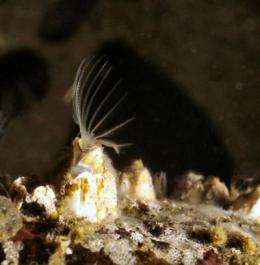
Barnacle. Credit: Dan Isaksson
The substance medetomidine has proved effective in preventing fouling of ship bottoms. Researchers at the University of Gothenburg have now identified the gene that causes the barnacle to react to the substance, opening up the possibility of an antifouling paint that is gentle both on barnacles and on the environment.
Fouling of hulls is a major problem for world shipping, for private leisure craft as well as large cargo ships. The University of Gothenburg has attempted to develop new, environmentally friendly methods that can limit marine fouling in several large research projects.
Veterinary medicine
One of these focuses on the substance medetomidine, a veterinary medicine that has been shown to prevent barnacle larvae from attaching to the hull. Now researchers at the University of Gothenburg are able to explain why.
Reacting gene indentified
In cooperation with colleagues at the universities of Turku and Helsinki, Professor Anders Blomberg at the Department of Cell and Molecular Biology has succeeded in identifying and describing the gene that controls how barnacles sense and react to medetomidine.
Low levels enough
"We have found that medetomidine activates special receptors in barnacle larvae. The receptors emit a signal that causes the larva to swim away from the boat surface, instead of attaching to it. As the receptors are already activated at very low concentrations of the substance, this means that very low levels are also needed to be effective," says Professor Blomberg.
Environmental friendly
The results, which are published in the scientific journal Molecular Pharmacology, explain how it is possible to develop an environmentally friendly and effective antifouling paint which instead of killing barnacles acts as a "deterrent".
"Understanding how the substance works when it binds to the receptor also makes it possible to develop selective agents that only affect barnacles and not other marine organisms," says Professor Blomberg.
-
Potential antifouling substance can cause paler fish
May 10, 2010 |
not rated yet |
0
-
First images of barnacle larva's footprint
Oct 27, 2008 |
not rated yet |
0
-
Barnacles prove hard to please when house-hunting
Nov 12, 2008 |
not rated yet |
0
-
Shark skin saves naval industry money
Jul 15, 2005 |
not rated yet |
0
-
New, bigger barnacle discovered on Florida’s east coast
Oct 25, 2006 |
not rated yet |
0
-
Engineers build first sub-10-nm carbon nanotube transistor
Feb 01, 2012 |
4.9 / 5 (30) |
30
-
Something old, something new: Evolution and the structural divergence of duplicate genes
Jan 31, 2012 |
4.6 / 5 (7) |
1
-
The hidden nanoworld of ice crystals: Revealing the dynamic behavior of quasi-liquid layers
Jan 30, 2012 |
5 / 5 (3) |
1
-
Stock market network reveals investor clustering
Jan 27, 2012 |
3.9 / 5 (23) |
8
-
Of microchemistry and molecules: Electronic microfluidic device synthesizes biocompatible probes
Jan 26, 2012 |
5 / 5 (1) |
0
-
Classical and Quantum Mechanics via Lie algebras
Apr 15, 2011
- More from Physics Forums - Independent Research
More news stories
Antidepressants and pregnancy: Women must consider the impact of drugs on baby, and of depression on baby, themselves
Upon learning they are pregnant, most women dutifully nix the alcohol, sushi and caffeine. But what about antidepressants?
Medicine & Health / Medications
34 minutes ago |
not rated yet |
0
Both maternal and paternal age linked to autism
Older maternal and paternal age are jointly associated with having a child with autism, according to a recently published study led by researchers at The University of Texas Health Science Center at Houston (UTHealth).
Medicine & Health / Psychology & Psychiatry
4 minutes ago |
not rated yet |
0
|
Curry spice component may help slow prostate tumor growth
Curcumin, an active component of the Indian curry spice turmeric, may help slow down tumor growth in castration-resistant prostate cancer patients on androgen deprivation therapy (ADT), a study from researchers ...
1 hour ago |
not rated yet |
0
|
Arthritic knees, but not hips, have robust repair response
Researchers at Duke University Medical Center used new tools they developed to analyze knees and hips and discovered that osteoarthritic knee joints are in a constant state of repair, while hip joints are not.
1 hour ago |
not rated yet |
0
|
Team isolates nerve cells involved in storing long term memory and gene proteins associated with them
(Medical Xpress) -- A research team in Taiwan has succeeded in isolating two nerve cells in fruit fly brains that are believed to be the major players in allowing for the formation of long term memories. Furthermore, ...
Netflix light on flicks as viewers soak up TV shows
Like most fresh faces that arrive in Hollywood, Netflix wanted to be a movie star. But now it's learning what many in Tinseltown have known for decades: Movies are sexy, but the real money is in television.
Zuckerberg's focus drives Facebook's ascent
When Mark Zuckerberg showed up to rent Judy Fusco's Los Altos, Calif., house in the fall of 2004, soon after he'd arrived in Silicon Valley, the landlord was immediately struck by his confidence.
The power of estrogen -- male snakes attract other males
A new study has shown that boosting the estrogen levels of male garter snakes causes them to secrete the same pheromones that females use to attract suitors, and turned the males into just about the sexiest ...
Humans may have helped the decline of African rainforests 3000 years ago
(PhysOrg.com) -- Large areas of rainforests in Central Africa mysteriously disappeared over three thousand years ago, to be replaced by savannas. The prevailing theory has been that the cause was a change ...
Fool's gold may prove an unlikely alternative to overexploited catalytic materials
Catalytic materials, which lower the energy barriers for chemical reactions, are used in everything from the commercial production of chemicals to catalytic converters in car engines. However, with current catalytic materials ...
Experts reveal how plants don't get sunburn
(PhysOrg.com) -- Experts at the University of Glasgow have discovered how plants survive the harmful rays of the sun.