Experiments decipher key piece of the ‘histone code’ in cell division
August 16, 2010
Experiments decipher key piece of the ‘histone code’ in cell division

Enlarge

Credit: Rockefeller University

Reproduce or perish. That’s the bottom line for genes. Because nothing lives forever, reproduction is how life sustains itself, and it happens most fundamentally in the division and replication of the cell, known as mitosis. Now new research at Rockefeller University has detailed a key role in mitosis for a chemical modification to histone proteins that package lengthy strings of DNA into compact chromosomes.

The experiments, published Thursday in Science, add to an increasingly intricate picture of the precisely timed events that separate new copies of to most fundamental processes involved in the reproduction of life.

“We’ve known that histones become decorated during mitosis for more than 30 years, but we haven’t really understood their function,” says Hironori Funabiki, head of the Laboratory of Chromosome and . “Now we’ve finally decoded exactly how one of these marks works.”

Funabiki says the findings provide hard evidence for the “histone code hypothesis,” advanced by Rockefeller’s C. David Allis and colleagues, which suggests that combinations of histone modifications attract or remove specific proteins, controlling the immediate environment of chromosomes in the cell. The orchestration of the exact timing and localization of the vast array of molecules and processes involved in reproducing the chromosomes is one of the basic wonders of biology and is at the core of both healthy living and diseases such as cancer, that arise when the process goes awry.

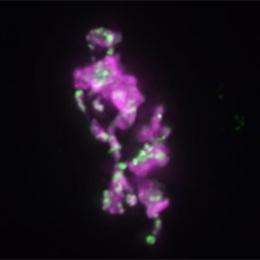
Funabiki, postdoctoral associate Alex Kelly, graduate student Cristina Ghenoiu and their colleagues focused on the addition of a phosphate group to histone H3 at the site theronine 3 (H3T3); it was first identified in 1980, but its function has remained a mystery. The researchers built on their previous work singling out the chromosomal passenger complex, a group of proteins in the cell that includes the enzyme Aurora B. This complex must be brought to chromosomes and activated to facilitate the assembly of cellular scaffolding called spindle microtubules, which are required to separate chromosomes in a dividing cell. In a series of new experiments, they showed that another member of the complex, Survivin (it’s highly similar to a class of proteins known to stem the process of programmed cell death, or apoptosis) recognizes the phosphate group at H3T3 and, in turn, activates Aurora B.

The researchers found that the phosphate group must be removed after the chromosomes are segregated so that the chromosomes can be properly repackaged to repeat the process over again, and they showed that the enzyme Haspin plays a role in adding the phosphate group that Survivin recognizes and is necessary for the chain of events to come off smoothly. Since both Survivin and Aurora B have been implicated in many cancers, molecules that disrupt the interaction between histone H3 and Survivin could allow for a new avenue for targeted therapeutics.

The study also shows that how Survivin recognizes H3T3 phosphorylation is very similar to how “inhibitor of apoptosis” proteins (IAPs) bind to their own ligands, whose mimetics have been investigated as anti-cancer drugs. “It brings a lot of fields together. I think it will be exciting to a lot of people working on epigenetics, apoptosis and the cell cycle,” Kelly says. “We cracked one code,” Funabiki says, “but there are yet many to be decoded to understand how chromosomes orchestrate mitosis.”

Science online: August 12, 2010
Survivin Reads Phosphorylated Histone H3 Threonine 3 to Activate the Mitotic Kinase Aurora B
Alexander E. Kelly, Cristina Ghenoiu, John Z. Xue, Christian Zierhut, Hiroshi Kimura and Hironori Funabiki


More information: DOI: 10.1126/science.1189505

Provided by Rockefeller University (news : web)


Rank 5 /5 (1 vote)
Relevant PhysicsForums posts
  • Pertubance in a model
    created1 hour ago
  • Cancer drugs and Alzheimer's, Oh my!
    created9 hours ago
  • Squishing cells
    created10 hours ago
  • Any books/articles for evolutionary stable strategy models in humans?
    created21 hours ago
  • Science behind the bore feeling?
    createdFeb 09, 2012
  • Homo Sapien vs. Chimpanzee - Divergence Timeline
    createdFeb 09, 2012
  • More from Physics Forums - Biology

More news stories

Miami battling invasion of giant African snails

No one knows how they got there. But an invasion of African giant snails has southern Florida in a panic over potential crop damage, disease and general yuckiness surrounding the slimy gastropods.

Biology / Ecology

created 3 hours ago | popularity not rated yet | comments 1

Cure of ADPKD by selection for spontaneous genetic repair events in Pkd1-mutated iPS cells

A research group including Kyoto University researchers demonstrates that mouse iPS cells, in which genetic correction occurs spontaneously through mitotic recombination, is selectable from the population of genetically mutated ...

Biology / Cell & Microbiology

created 1 hour ago | popularity not rated yet | comments 0

An eye for the tsetse fly

(PhysOrg.com) -- Geoffrey M. Attardo was one of those little boys who made pets of the spiders outside his bedroom window, feeding them and watching as they spun intricate webs. Age has not diminished his ...

Biology / Plants & Animals

created 1 hour ago | popularity not rated yet | comments 0

Protein libraries in a snap

(PhysOrg.com) -- A Rice University undergraduate will depart with not only a degree but also a possible patent for his invention of an efficient way to create protein libraries, an important component of biomolecular ...

Biology / Cell & Microbiology

created 3 hours ago | popularity 5 / 5 (1) | comments 0 | with audio podcast

Fighting crimes against biodiversity: How to catch a killer weed

Invasive species which have the potential to destroy biodiversity and influence global change could be tracked and controlled in the same way as wanted criminals, according to new research from Queen Mary, University of London.

Biology / Ecology

created 4 hours ago | popularity not rated yet | comments 0


Clam fields found at deep, low-temperature Mariana vents

(PhysOrg.com) -- Scientists have marveled at the unusual life forms thriving at high temperature hydrothermal vents of the deep ocean.

Seeing colors in music, tasting flavors in shapes may happen in life's early months

Famed violinist Itzhak Perlman sees a deep forest green whenever he plays a B-flat on his Stradivarius' G string. The A on the E string is red.

Could Venus be shifting gear?

(PhysOrg.com) -- ESA’s Venus Express spacecraft has discovered that our cloud-covered neighbour spins a little slower than previously measured. Peering through the dense atmosphere in the infrared, the ...

Team isolates nerve cells involved in storing long term memory and gene proteins associated with them

(Medical Xpress) -- A research team in Taiwan has succeeded in isolating two nerve cells in fruit fly brains that are believed to be the major players in allowing for the formation of long term memories. Furthermore, ...

Is that sleepiness during pregnancy normal or a sign of sleep apnea?

(Medical Xpress) -- Most pregnant women complain of being tired. Some of them however, could be suffering more than normal fatigue associated with their pregnancy; they may have developed obstructive sleep apnea (OSA), a ...

Engineering images bring life to submerged city

(PhysOrg.com) -- Photo-realistic 3D mapping and digital reconstruction of an ancient underwater city in Greece have earned a team from the University of Sydney's Faculty of Engineering and Information Technologies ...