Human-electric hybrid car expected next year (w/ Video)
August 17, 2010 by Lin Edwards weblog
Human-electric hybrid car expected next year

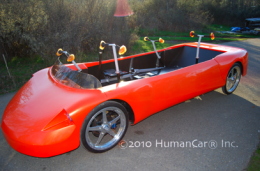
A human-electric hybrid vehicle, the "Imagine PS," capable of 100 kph (60 mph) on the flat and 50 kph uphill, is expected to be commercially available next year.

The hand-cranked low mass vehicle (LMV) was developed by engineer Professor Charles Samuel Greenwood, who has been working on human-powered vehicles for over four decades, and has now developed a street legal sedan version carrying four people. If the four people are all cranking, the vehicle can run solely on human power, but it is also an electric plug-in. The chassis can be adapted to different styles and different types of batteries and future technologies without needing to replace the car.

The Imagine PS (PS standing for power station) is built by HumanCar Inc.. It can be started by a few backwards/forwards hand cranks, but the company says a senior citizen in reasonable shape would be able to manage the cranking easily, and it can be operated in electric power mode only or any combination of human and electric power.

This video is not supported by your browser at this time.

Greenwood said he began working on human powered cars in 1968 as a way to tackle both unhealthy exhaust fumes and the unhealthy and overweight bodies of many of the drivers. Early test devices showed that bicycle style mechanisms would not provide a full-body workout, so the design shifted to rowing-like movements. A range of vehicles has been built and tested since then, culminating in the Imagine PS.

The test vehicle is open, but an all-weather roof will be available for the commercially available cars. Also available will be a touch-screen display with GPS and biometric data logging, and computing/communications and sound systems. Safety is provided by a sophisticated structural system and controlled energy absorption areas.

The Imagine PS is expected to be available next year with a price tag of $15,500, and pre-orders can be made with a $50 100% refundable deposit. Production will begin when the company has received 800 pre-orders, and it already has over 100. Greenwood said the company is independent and "essentially profitable right now," and they have a 200-year business plan that includes taking human-powered cars to the developing world, along with other products such as a two-person mobile power station that folds into a suitcase.

More information: http://humancar.com/

© 2010 PhysOrg.com

4.5 /5 (23 votes)  

Filter


Move the slider to adjust rank threshold, so that you can hide some of the comments.


Display comments: newest first

Doug_Huffman
Aug 17, 2010

Rank: 5 / 5 (2)
I must have missed the part about human powered.
bicycle style mechanisms would not provide a full-body workout
Yes, that is the reason competitive bicyclists use hand cycles too! I rode with a hand-cyclist once, his biceps were as big as my thighs, but I was faster.

See http://www.greenspeed.com.au and their Glyde HPV

I visited HumanCar.com to see their Duet Gen advertised as producing 1 kW with one or two human power. That is unlikely, certainly for more than a moment. A top competitive cyclist might break a kilowatt for a moment.

http://en.wikiped...an_power
Sonhouse
Aug 17, 2010

Rank: 4 / 5 (3)
He could extend that range by paving the skin with PV cells and charging up on a sunny day. Gathering energy while you park.
Doug_Huffman
Aug 17, 2010

Rank: not rated yet
Yep. And little rain drops made the mighty oceans. The Solar Constant is 1350 Watts per square meter outside the atmosphere and 24 hours per day.
Hunnter
Aug 17, 2010

Rank: 4 / 5 (3)
I was wondering why he made it hand-crank rather than pedal style, but he wants a full-body workout.
While the idea is nice, not a lot of people would want to do that every day to work.
Pedal powered would be the only way this would really come to the consumer market, sadly.

Most people would rather just get a bike if they wanted to exercise and get around quick-ish.

Still not entirely sure how direction control works.

SteveL
Aug 17, 2010

Rank: 5 / 5 (1)
Ah, now when they have a car you can feed humans into, as fuel - then we'll have real human-powered car.

Seriously though, do humans produce more useful propulsive energy over a longer period of time via a rowing motion compared to the more traditional bicycle motion?
zevkirsh
Aug 17, 2010

Rank: not rated yet
twike that's the vehicle you should be writing about. not this.
Skeptic_Heretic
Aug 17, 2010

Rank: not rated yet
Ah, now when they have a car you can feed humans into, as fuel - then we'll have real human-powered car.

Seriously though, do humans produce more useful propulsive energy over a longer period of time via a rowing motion compared to the more traditional bicycle motion?

By mechanical advantage, yes. The length of the chain reduces the amount of output power dependant on gearing.

In reality due to the fact that a bicycle wheel is constant motion compared to the stroking of an oar, I'm not sure. I'd think the bicycle motion would win out to be honest.
NickFun
Aug 17, 2010

Rank: not rated yet
It looks nice -- unless it rains -- or unless you need to park it somewhere -- or if you need to take it on the highway. Someone could easily pick it up and throw it in the back of a pickup truck and drive off with it. But I like the idea!
toyo
Aug 17, 2010

Rank: 5 / 5 (1)
Yabba dabba dooo!
fixer
Aug 17, 2010

Rank: not rated yet
Didn't the flintstones invent this?
jselin
Aug 17, 2010

Rank: 4 / 5 (1)
Works best downhill :)
autoquark
Aug 18, 2010

Rank: not rated yet
You'd only be able to stop it with these giant brakes: http://www.autoan...2A1.aspx
Blicker
Aug 18, 2010

Rank: not rated yet
crank
John_Hurd
Aug 18, 2010

Rank: not rated yet
Grey bearded creator Greenwood cranks >800Watts compared to Lance Armstrong pedaling 300 max.
Re:
He could extend that range by paving the skin with PV cells and charging up on a sunny day. Gathering energy while you park.

and
Yep. And little rain drops made the mighty oceans. The Solar Constant is 1350 Watts per square meter outside the atmosphere and 24 hours per day.


Right . And some range increase with no compromise to design is infinitely better than none since 1/0 =infinity.

With >$300k into concept/prototype the rig has brakes that work.
See also:
http://rowingbike...duction/
Shootist
Aug 22, 2010

Rank: not rated yet
He could extend that range by paving the skin with PV cells and charging up on a sunny day. Gathering energy while you park.


yeah, $10000 for 75 watts. right on.
VOR
Sep 06, 2010

Rank: not rated yet
i wonder how much electricity would be made by a busy gym if all the machines were designed to do so,lol..
Rank 4.5 /5 (23 votes)
Related Stories
Relevant PhysicsForums posts
  • Empirical data regarding shower heads and water
    created8 hours ago
  • feed hold button on CNC lathe
    createdFeb 09, 2012
  • RFAC in Fortran
    createdFeb 09, 2012
  • dynamics 2/32
    createdFeb 08, 2012
  • dynamics
    createdFeb 08, 2012
  • Vibration Absorbtion Problem
    createdFeb 08, 2012
  • More from Physics Forums - General Engineering

More news stories

Sony's Hirai refuses to abandon dire TV business

Struggling Japanese entertainment giant Sony will not abandon its cash-bleeding television business, its incoming CEO says, but he acknowledges tough decisions lie ahead including over redundancies.

Technology / Business

created 6 minutes ago | popularity not rated yet | comments 0

New error-correcting codes guarantee the fastest possible rate of data transmission

Error-correcting codes are one of the triumphs of the digital age. They’re a way of encoding information so that it can be transmitted across a communication channel — such as an optical fiber o ...

Technology / Computer Sciences

created 2 hours ago | popularity 5 / 5 (2) | comments 2 | with audio podcast

Small modular reactor design could be a 'SUPERSTAR'

(PhysOrg.com) -- Though most of today's nuclear reactors are cooled by water, we've long known that there are alternatives; in fact, the world's first nuclear-powered electricity in 1951 came from a reactor ...

Technology / Energy & Green Tech

created 2 hours ago | popularity 5 / 5 (4) | comments 7 | with audio podcast

Advanced power-grid model finds low-cost, low-carbon future in West

(PhysOrg.com) -- The least expensive way for the Western U.S. to reduce greenhouse gas emissions enough to help prevent the worst consequences of global warming is to replace coal with renewable and other ...

Technology / Energy & Green Tech

created 2 hours ago | popularity 5 / 5 (1) | comments 3 | with audio podcast

Engineering images bring life to submerged city

(PhysOrg.com) -- Photo-realistic 3D mapping and digital reconstruction of an ancient underwater city in Greece have earned a team from the University of Sydney's Faculty of Engineering and Information Technologies ...

Technology / Engineering

created 1 hour ago | popularity not rated yet | comments 1


The power of estrogen -- male snakes attract other males

A new study has shown that boosting the estrogen levels of male garter snakes causes them to secrete the same pheromones that females use to attract suitors, and turned the males into just about the sexiest ...

Could Venus be shifting gear?

(PhysOrg.com) -- ESA’s Venus Express spacecraft has discovered that our cloud-covered neighbour spins a little slower than previously measured. Peering through the dense atmosphere in the infrared, the ...

Experts reveal how plants don't get sunburn

(PhysOrg.com) -- Experts at the University of Glasgow have discovered how plants survive the harmful rays of the sun.

Team isolates nerve cells involved in storing long term memory and gene proteins associated with them

(Medical Xpress) -- A research team in Taiwan has succeeded in isolating two nerve cells in fruit fly brains that are believed to be the major players in allowing for the formation of long term memories. Furthermore, ...

Fool's gold may prove an unlikely alternative to overexploited catalytic materials

Catalytic materials, which lower the energy barriers for chemical reactions, are used in everything from the commercial production of chemicals to catalytic converters in car engines. However, with current catalytic materials ...

SLAC, Stanford team focuses on high-energy electrons to treat cancer

Accelerator physicists at SLAC and cancer specialists from Stanford are working on a new technology that could dramatically reduce the time needed for cancer radiation treatments. The team ran an initial experiment ...