Tropically Speaking, NASA Investigates Precipitation Shapes, Sizes for Severity
Rain drops are fat and snowflakes are fluffy, but why does it matter in terms of predicting severe storms?
We've all seen fat rain drops, skinny rain drops, round hailstones, fluffy snowflakes and even ice needles. This summer, NASA researchers are going to get a look at just how much these shapes influence severe storm weather. To do it, they'll have to look inside the guts of some of the world's fiercest storms. NASA recently assembled a team of hurricane scientists from across the country to carry out high-altitude-aircraft surveillance to explore in detail how storms form, intensify and dissipate.
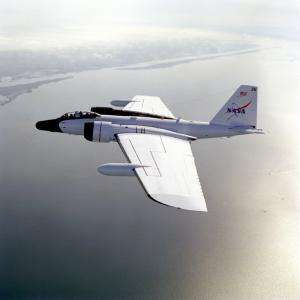
Earth scientists and engineers at NASA's Marshall Space Flight Center in Huntsville, Ala., have redesigned one of their instruments, the Advanced Microwave Precipitation Radiometer, or AMPR, to better observe the different shapes of precipitation. In August and September, AMPR will fly at an altitude of 60,000 feet over the Gulf of Mexico and Atlantic Ocean. It will sit in the bomb bay of a WB-57 airplane, which is based at the NASA Johnson Space Center's Ellington Field in Houston.
During these flights, AMPR researchers will test a new build -- the instrument is an upgraded version of the original AMPR built at NASA Marshall in the early 1990s -- and use it to participate in NASA's upcoming hurricane study, the Genesis and Rapid Intensification Processes field campaign, better known as GRIP. The campaign involves three planes mounted with 14 different instruments, including AMPR. The instruments will all work together to create the most complete view of a hurricane to date.
Researchers hope the hurricane campaign will help them answer some of nature's most perplexing questions. As tropical storms grow, they produce massive amounts of rain -- a key element in the development of full-scale hurricanes. Scientists will use AMPR along with the other instruments, such as data from the Tropical Rainfall Measuring Mission or TRMM satellite, to figure out just how hard it's raining inside these ferocious storms, and how much of that rain is associated with the production of ice during intensification.
"If you don't know how hard it's raining or where the rain is forming in the atmosphere, you don't know hurricanes," said Dr. Walt Petersen, AMPR principle investigator and Marshall Center earth scientist. "AMPR provides us an opportunity to see their precipitation structure by using an instrument like those currently flying on, for example, the TRMM and Aqua satellites in space."
That's because AMPR doesn't just give scientists new information about hurricanes. The instrument also enables them to test equipment currently in space. Every day, numerous weather satellites orbit Earth to measure the rainfall rate of storms across the globe. They work much like AMPR except over much larger scales. Because they're so far above the Earth and moving so fast, they can take only one measurement every few miles along their track. Scientists can correct for such coarse measurements, but to do so they need highly accurate data. AMPR can take several measurements per mile, giving scientists the data they need to verify that weather satellites continue to provide accurate data.
"It's like the pixels in your computer screen," Petersen said. "When satellites take measurements, they have really big pixels, and we might lose some of the finer details of what's happening on the ground. AMPR has much smaller pixels, much higher resolution, and allows us to see a much clearer picture. It's a part of our arsenal to make sure what we're measuring from space makes sense. We'd hate to send something up and not have it accurately measure what's happening on the ground."
That information translates into better predictions of hurricane track and intensity -- how hard it's going to rain in a certain area when a hurricane hits, for example, aiding in early flood warnings.
AMPR doesn't just measure how hard rain falls. Within the last several years, the AMPR team has worked vigorously to upgrade the instrument. These upgrades will enable AMPR to more accurately detect what kind of precipitation is in the storm. By identifying the shape of the precipitation, AMPR may present scientists with recognizable signatures that define different types of precipitation. For example, varying combinations of fat or skinny rain drops, snow, ice or hail distributed throughout the depth of the storm will produce different brightness temperatures when viewed at different angles. A storm may develop and behave differently depending on these variations.
Engineers packed the 380-pound AMPR payload with a delicate set of instruments and computer hardware. AMPR gathers data by measuring the amount of microwave radiation rising from the surface beneath -- often the ocean. Because rain water is a better emitter of microwave radiation than ocean water, the radiation measured from rainfall is actually greater during a big storm. This measurement is converted to a "brightness temperature," which correlates to how much radiation is being generated. The more rain, the higher the brightness temperature.
Alternatively, if a hurricane's clouds are full of ice or hail, as they usually are, much of the microwave radiation is scattered away. The corresponding brightness temperature is much lower than the anticipated surface measurement. Scientists can use those changes to determine how hard it's raining inside a storm or how much ice a given storm might contain.
"Whether rain drops are fat or skinny, and whether ice is round or bumpy, these factors are critical when we're trying to estimate rainfall rates," Petersen explained. "Because of air drag, the rate at which these precipitation particles fall through the air depends on their thickness or shape. A fat rain drop falls more slowly than a hail stone of the same size, for example -- that factor enables you to determine rainfall rate."
After the GRIP experiment ends in September, Petersen and his team will unload the data and begin analyzing it, adding their findings to the increasingly large body of hurricane knowledge.
"The GRIP experiment will give us information about how a hurricane circulates and how it intensifies. Basically we have a bunch of theories about the role of precipitation in hurricanes, and we need to test them. That's where instruments like AMPR come in."
After this summer’s hurricane study, AMPR will continue to fly in storm campaigns. It's already scheduled for a major joint NASA and U.S. Department of Energy study in April 2011 to support the Global Precipitation Measurement
Petersen loves the challenge. Storms have fascinated him ever since his junior year of high school, when lightning struck just inches away from him while he was at a drive-in movie.
"The thing that excites me is looking inside a storm that we can't fly into," he said. "We can't fly inside these big storms because they're just too nasty. The only way to get information about what's going on inside is to do what AMPR does.
"Being able to look at the guts of a storm and figure out what's going on, that's the key thing for me," he added.
With any luck, AMPR's look into hurricanes will put scientists one step closer to predicting some of the world's fiercest storms.
Provided by JPL/NASA


