New Device Will Slash Time for DNA Analysis
(PhysOrg.com) -- The University of Arizona Center for Applied Nanobioscience and Medicine is developing technology to revolutionize procedures in law enforcement and medicine.
For fans of crime television shows such as "CSI" or "Law and Order," DNA samples quickly are identified so perpetrators can be caught and sentenced within the one-hour episode.
In reality, law enforcement officials often need days or weeks to process DNA samples at crime scenes through centralized public laboratories.
However, the Center for Applied Nanobioscience and Medicine at the University of Arizona College of Medicine - Phoenix has been contracted by the Department of Justice, Federal Bureau of Investigation, and more recently by the world leader Forensic Science Service, to develop a rapid integrated tool just like "Grissom" has on "CSI."
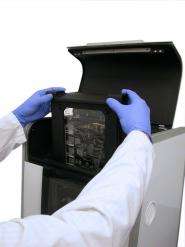
The center, led by internationally noted biochemist and physicist Frederic Zenhausern, director of the Center for Applied Nanobioscience and Medicine, has developed a DNA fingerprinting device that fits on a desk and can process a reference DNA sample from its collection at a police workstation or in a near future at the scene of a crime by matching the DNA profile in a secure national law enforcement database in less than a few hours instead of much longer.
"We are taking what currently is extremely labor intensive and can take weeks to processing it in less than two hours," said Zenhausern. "This could save millions of dollars in costs for fighting crime - a significant part of government budgets - while providing victims with improvement in the quality of their life. The same technology platform has also direct application in point-of-care diagnostics such as diagnosing infectious diseases at the hospitals or assisting clinicians in personalizing therapies."
In the case of law enforcement, cutting processing time also would allow faster investigations, likely resulting in apprehending criminals before they commit additional crimes, Zenhausern noted. The Home Office in the United Kingdom reported in 2004 that if the detection rate of criminal offenders could be improved by only 5 percent, this would prevent about 1,000 assault cases in the same period.
The center also is working with law enforcement in other countries in Europe and in Australia to work out standards and specifications needed for the use of the rapid DNA platform to ensure results can be used in legal systems across the world. For this purpose, the center is one of the six members of a new Security Consortium established through the European Commission Seventh Framework that awarded more than 3 million Euros to the consortium to define requirements and validate the technology developed by the center and its partners.
"Our DNA analysis platform is a fully automated system that doesn't require any human intervention," Zenhausern said. "You load the specimen in a cartridge that can contain all the necessary reagents for processing a sample and place it in the instrument, close the instrument and push a button on the computer, which will control all processing and analysis steps for generating data that can then be loaded in a DNA expert software system for identifying a human profile and matching an offender. That's it."
The center developed the technology for the device and designed it for use by law enforcement. The center is working with the British government-owned Forensic Science Service to introduce the machine to the forensic community, industry partners for commercialization and governmental officials for regulatory compliance and adoption.
Recently, the team presented scientific results at the 2010 Conference of the American Academy of Forensic Science in Seattle, where U.S. corporate leaders expressed commercial interest. The team also submitted several scientific publications to international journals. These publications already generated interest from various scientific communities, first responders and media.
"One of the most exciting outcomes of our efforts is the demonstration of a truly ‘translational' initiative led in Arizona by one of its state academic institutions, but also involving several local suppliers and vendors in Arizona," said Zenhausern. The center is also expecting further development of its commercial enterprise in Arizona and participation of local investors.
The Center for Applied Nanobioscience and Medicine is developing novel molecular-based diagnostic tests that can be used by individuals and public health systems to facilitate personalized medicine, an emerging area that uses genomic and molecular data to better target health care to individuals.
The practice will help determine a person's predisposition to a particular disease or condition and in treatment. The center is also participating in two major contracts of about $40 million each funded by the U.S. Department of Human Health and Services to develop molecular tests against radiation using genetic biomarkers.
"That same DNA system can be used in a number of different areas, because it is genetic-based testing," Zenhausern said. "It could have diagnostic application in oncology, cardiovascular monitoring, full analysis of multiple biofluids and bio-specimens, a number of functions on the medical side that would lend themselves to the technology practice in personalized medicine."
Provided by University of Arizona


