Fossil reveals 48-million-year history of zombie ants
August 18, 2010
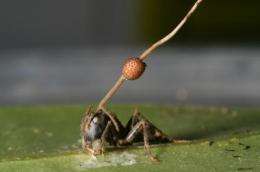
A modern day ant (Camponotus leonardi) from Thailand is killed by the fungus Ophiocordyceps unilateralis. It is biting into the leaf vein and the fungal growth can clearly be seen issuing from its head. Credit: David P. Hughes
A 48-million-year-old fossilised leaf has revealed the oldest known evidence of a macabre part of nature - parasites taking control of their hosts to turn them into zombies.
The discovery has been made by a research team led by Dr David P Hughes, from the University of Exeter, who studies parasites that can take over the minds of their hosts.
All manner of animals are susceptible to the often deadly body invasion, but scientists have been trying to track down when and where such parasites evolved.
Dr Hughes, from the University's School of Biosciences, said: "There are various techniques, called a molecular clock approach, which we can use to estimate where and when they developed and fossils are an important source of information to calibrate such clocks.
"This leaf shows clear signs of one well documented form of zombie-parasite, a fungus which infects ants and then manipulates their behaviour."
The fungus, called Ophiocordyceps unilateralis, causes ants to leave their colonies and head for a leaf which provides the ideal conditions for the host to reproduce.
When it gets there the ant goes into a 'death grip'- biting down very hard on the major vein of a leaf. This means that when the ant dies, its body stays put so the fungus has time to grow and release its spores to infect other ants.
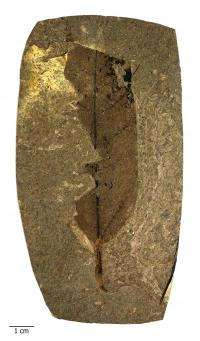
This is the 48-million-year-old fossil leaf from Messel which bears the tell-tale death grip scars. Credit: Torsten Wappler
The death grip bite leaves a very distinct scar on the leaves. This prompted Dr Hughes, together with research partners Conrad Labandeira from the Smithsonian Institution in the USA and Torsten Wappler, from the Steinmann Institute in Germany, to search for potential evidence of the fungus at work by studying the fossilised remains of leaves.After studying leaf fossils from the Messel Pit, a site on the eastern side of the Rhine Rift Valley in Hesse, Germany, they found clear evidence of the death grip bite in a 48-million-year-old leaf specimen.
Dr Hughes said: "The evidence we found mirrors very closely the type of leaf scars that we find today, showing that the parasite has been working in the same way for a very long time.
"This is, as far as we know, the oldest evidence of parasites manipulating the behaviour of their hosts and it shows this parasitic association with ants is relatively ancient and not a recent development.
"Hopefully we can now find more fossilised evidence of parasitic manipulation. This will help us shed further light on the origins of this association so we can get a better idea of how it has evolved and spread."
More information: The paper, title Ancient death-grip leaf scars reveal ant-fungal parasitism, is published in the latest edition of Royal Society journal Biology Letters.
-
Parasite causes zombie ants to die in an ideal spot
Aug 11, 2009 |
not rated yet |
0
-
Food security for leaf-cutting ants: Workers and their fungus garden reject endophyte invaders (w/Video)
Apr 02, 2009 |
not rated yet |
0
-
Farming and chemical warfare: A day in the life of an ant?
Nov 17, 2008 |
not rated yet |
0
-
Study reveals classic symbiotic relationship between ants, bacteria
Jan 05, 2006 |
not rated yet |
0
-
Ants die alone, protecting their nest mates from infection
Feb 16, 2010 |
not rated yet |
0
-
Engineers build first sub-10-nm carbon nanotube transistor
Feb 01, 2012 |
4.9 / 5 (31) |
30
-
Something old, something new: Evolution and the structural divergence of duplicate genes
Jan 31, 2012 |
4.6 / 5 (7) |
1
-
The hidden nanoworld of ice crystals: Revealing the dynamic behavior of quasi-liquid layers
Jan 30, 2012 |
5 / 5 (3) |
1
-
Stock market network reveals investor clustering
Jan 27, 2012 |
3.9 / 5 (23) |
8
-
Of microchemistry and molecules: Electronic microfluidic device synthesizes biocompatible probes
Jan 26, 2012 |
5 / 5 (1) |
0
-
Protease cleavage
3 hours ago
-
Pertubance in a model
9 hours ago
-
Cancer drugs and Alzheimer's, Oh my!
17 hours ago
-
Squishing cells
18 hours ago
-
Any books/articles for evolutionary stable strategy models in humans?
Feb 09, 2012
-
Science behind the bore feeling?
Feb 09, 2012
- More from Physics Forums - Biology
More news stories
The power of estrogen -- male snakes attract other males
A new study has shown that boosting the estrogen levels of male garter snakes causes them to secrete the same pheromones that females use to attract suitors, and turned the males into just about the sexiest ...
7 hours ago |
5 / 5 (3) |
0
|
Experts reveal how plants don't get sunburn
(PhysOrg.com) -- Experts at the University of Glasgow have discovered how plants survive the harmful rays of the sun.
7 hours ago |
5 / 5 (2) |
0
|
Protein libraries in a snap
(PhysOrg.com) -- A Rice University undergraduate will depart with not only a degree but also a possible patent for his invention of an efficient way to create protein libraries, an important component of biomolecular ...
11 hours ago |
5 / 5 (2) |
0
|
Grass to gas: Researchers' genome map speeds biofuel development
Researchers at the University of Georgia have taken a major step in the ongoing effort to find sources of cleaner, renewable energy by mapping the genomes of two originator cells of Miscanthus x giganteus, a large perenn ...
4 hours ago |
3.7 / 5 (3) |
0
|
Miami battling invasion of giant African snails
No one knows how they got there. But an invasion of African giant snails has southern Florida in a panic over potential crop damage, disease and general yuckiness surrounding the slimy gastropods.
11 hours ago |
not rated yet |
2
NASA sees wide-eyed cyclone Jasmine
Cyclone Jasmine's eye has opened wider on NASA satellite imagery, as it moves through the Southern Pacific Ocean.
NASA sees Giovanna reach cyclone strength, threaten Madagascar
Tropical Storm 12S built up steam and became a cyclone on February 10, 2012 as NASA's Terra satellite passed overhead. Residents of east-central Madagascar should prepare for this cyclone to make landfall ...
CIA website offline, Anonymous takes credit
The website of the Central Intelligence Agency was unresponsive on Friday after the hacker group Anonymous claimed to have knocked it offline.
Complex wiring of the nervous system may rely on a just a handful of genes and proteins
Researchers at the Salk Institute have discovered a startling feature of early brain development that helps to explain how complex neuron wiring patterns are programmed using just a handful of critical genes. ...
New error-correcting codes guarantee the fastest possible rate of data transmission
Error-correcting codes are one of the triumphs of the digital age. Theyre a way of encoding information so that it can be transmitted across a communication channel such as an optical fiber o ...
Humans may have helped the decline of African rainforests 3000 years ago
(PhysOrg.com) -- Large areas of rainforests in Central Africa mysteriously disappeared over three thousand years ago, to be replaced by savannas. The prevailing theory has been that the cause was a change ...

Aug 18, 2010
Rank: 5 / 5 (2)
Aug 18, 2010
Rank: not rated yet