Roller coaster superconductivity discovered
August 18, 2010
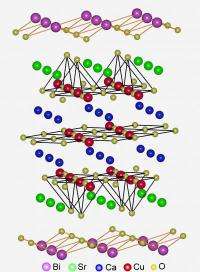
This graphic shows the crystal structure of three-layered bismuth oxide. Credit: Xiao-Jia Chen
Superconductors are more than 150 times more efficient at carrying electricity than copper wires. However, to attain the superconducting state, these materials have to be cooled below an extremely low, so-called transition temperature, at which point normal electrical resistance disappears. Developing superconductors with higher transition temperatures is one of physics' greatest quests.
Until now, copper-laden materials called cuprates have been the only superconductors whose transition temperatures are higher than the liquid nitrogen boiling point at -321F (77 K). Whether researchers can make transition temperatures higher in such materials remains a challenge.
Now, researchers at the Carnegie Institution's Geophysical Laboratory, with colleagues, have unexpectedly found that the transition temperature can be induced under two different intense pressures in a three-layered bismuth oxide crystal referred to as "Bi2223." The higher pressure produces the higher transition temperature. They believe this unusual two-step phenomena comes from competition of electronic behavior in different kinds of copper-oxygen layers in the crystal. The work is published in the August 19, 2010, issue of Nature.
"Bi2223 is like a layered cake," explained lead author Xiao-Jia Chen at Carnegie. "On the top and bottom there are insulating bismuth-oxide layers. On the inside of those, come layers of strontium oxide. Next, are layers of copper oxide, then calcium, and finally the middle is another copper-oxide layer. Interestingly, the outermost and inner layers of copper oxide have different physical properties resulting in an imbalance of electric charge between the layers."
One way scientists have found to increase the transition temperature of superconducting materials is to "dope" them by adding charged particles.
Under normal pressure, the optimally doped Bi2223's transition temperature is -265F (108K). The scientists subjected doped crystals of the material to a range of pressures up to 359,000 times the atmospheric pressure at sea level (36.4 Giga Pascal), the highest pressure yet for magnetic measurements in cuprate superconductors. The first higher transition temperature happened at 100,666 atmospheres (10.2 GPa).
"After that, increasing pressures ended up with lower transition temperatures," remarked Chen. "Then to our complete surprise at about 237,000 atmospheres (24 GPa) the superconducting state reappeared. Under even more pressure, 359,000 atmospheres, the transition temperature rose to -215F (136K). That was the highest pressure our measuring system could detect."
Other research has shown that some multilayered superconducting materials like this one exhibit different electronic and vibrational behaviors in different layers. The researchers think that 237,000 atmospheres might be a critical point where pressure suppresses one behavior and enhances superconductivity.
"The finding gives new perspectives on making higher transition temperature in multilayer cuprate superconductors. The research may offer a promising way of designing and engineering superconductors with much higher transition temperatures at ambient conditions," concluded coauthor Viktor Struzhkin also of Carnegie.
Provided by Carnegie Institution
-
New insights, and a new angle, on high-temperature superconductivity
Jun 29, 2009 |
not rated yet |
0
-
Superconducting hydrogen?
Jan 25, 2010 |
not rated yet |
0
-
Secrets behind high temperature superconductors revealed
Feb 22, 2009 |
not rated yet |
0
-
Pinning Down Superconductivity to a Single Layer
Oct 29, 2009 |
not rated yet |
0
-
Scientists Detect 'Fingerprint' of High-Temp Superconductivity Above Transition Temperature
Aug 27, 2009 |
not rated yet |
0
-
Engineers build first sub-10-nm carbon nanotube transistor
Feb 01, 2012 |
4.9 / 5 (31) |
30
-
Something old, something new: Evolution and the structural divergence of duplicate genes
Jan 31, 2012 |
4.6 / 5 (7) |
1
-
The hidden nanoworld of ice crystals: Revealing the dynamic behavior of quasi-liquid layers
Jan 30, 2012 |
5 / 5 (3) |
1
-
Stock market network reveals investor clustering
Jan 27, 2012 |
3.9 / 5 (23) |
8
-
Of microchemistry and molecules: Electronic microfluidic device synthesizes biocompatible probes
Jan 26, 2012 |
5 / 5 (1) |
0
-
How to calculate theoretical initial velocity?
1 hour ago
-
Question about Gravity?
2 hours ago
-
Wearing black in a desert
3 hours ago
-
Did space exist before mass?
3 hours ago
-
How can E&M Waves be polarized?
3 hours ago
-
Does light travel for ever?
4 hours ago
- More from Physics Forums - General Physics
More news stories
Putting the squeeze on planets outside our solar system
(PhysOrg.com) -- Using high-powered lasers, scientists at Lawrence Livermore National Laboratory and collaborators discovered that molten magnesium silicate undergoes a phase change in the liquid state, abruptly ...
10 hours ago |
4.3 / 5 (7) |
0
|
Hovering not hard if you're top-heavy, researchers find
Top-heavy structures are more likely to maintain their balance while hovering in the air than are those that bear a lower center of gravity, researchers at New York University's Courant Institute of Mathematical Sciences ...
11 hours ago |
5 / 5 (1) |
1
|
SLAC, Stanford team focuses on high-energy electrons to treat cancer
Accelerator physicists at SLAC and cancer specialists from Stanford are working on a new technology that could dramatically reduce the time needed for cancer radiation treatments. The team ran an initial experiment ...
14 hours ago |
5 / 5 (2) |
0
Measurements from high-energy collisions lead to better understanding of why meson particles disappear
For several years, physicists at the Relativistic Heavy Ion Collider (RHIC) at Brookhaven National Laboratory (BNL), USA, have studied an unusual state of matter called the quarkgluon plasma, which they ...
15 hours ago |
4.5 / 5 (4) |
0
Explained: Sigma
It's a question that arises with virtually every major new finding in science or medicine: What makes a result reliable enough to be taken seriously? The answer has to do with statistical significance -- but ...
Feb 09, 2012 |
5 / 5 (16) |
53
Google users warned of threat to smartphone wallets
Users of Google smartphone wallets were being warned on Friday that there is a way to crack pass codes intended to thwart thieves from going on illicit shopping sprees.
Anonymous knocks CIA website offline (Update)
The website of the Central Intelligence Agency was inaccessible on Friday after the hacker group Anonymous claimed to have knocked it offline.
New error-correcting codes guarantee the fastest possible rate of data transmission
Error-correcting codes are one of the triumphs of the digital age. Theyre a way of encoding information so that it can be transmitted across a communication channel such as an optical fiber o ...
Humans may have helped the decline of African rainforests 3000 years ago
(PhysOrg.com) -- Large areas of rainforests in Central Africa mysteriously disappeared over three thousand years ago, to be replaced by savannas. The prevailing theory has been that the cause was a change ...
Complex wiring of the nervous system may rely on a just a handful of genes and proteins
Researchers at the Salk Institute have discovered a startling feature of early brain development that helps to explain how complex neuron wiring patterns are programmed using just a handful of critical genes. ...
New power source discovered
(PhysOrg.com) -- Researchers at the Massachusetts Institute of Technology (MIT) and RMIT University have made a breakthrough in energy storage and power generation.
Aug 18, 2010
Rank: 1 / 5 (3)
Aug 19, 2010
Rank: 1 / 5 (3)
Aug 19, 2010
Rank: 1 / 5 (1)
Pressure increases the proximity of atoms and particles and thus increases their tendency to synchronize via Winfree's law of coupled oscillators (which he applied to biology, not physics). However, pressure also restrains the movements of the oscillating components, which may in turn cross a limit and prevent the oscillators from synchronizing. In that case, higher temperatures might overcome that constraint. The increased temperature (energy) may increase the force of the oscillations enough to permit sufficient interaction among the oscillators so they synchronize in time and space. The spacial separation in tetragonal and orthorhombic superconductors, and some freedom of movement therein, is the image to keep in mind as you ponder my analysis. Superconductivity is Winfree synchrony.
Aug 21, 2010
Rank: 1.8 / 5 (5)
But what will happen, if you compress electrons inside of pipe very much? Every electron will be surrounded with many others and their repulsive forces will overlap and compensate mutually from all directions at the same moment. The portion of electrons would move freely inside of such superfluid.
BTW On the similar principle the bazooka weapon is based. High pressure wave liquefies the metal, so that the portion of explosive target can propagate through it at large distance.
Aug 21, 2010
Rank: 1.8 / 5 (5)
Aug 21, 2010
Rank: 1.8 / 5 (5)
For example, pressure sterilization is based on the liquefaction of membranes of microorganisms, which destroys complex tertiary structure of proteins.
http://www.food-f...rlin.pdf
Aug 22, 2010
Rank: 3 / 5 (4)
Aug 22, 2010
Rank: 1.8 / 5 (5)
http://en.wikiped...smolysis
You're half educated senile troll, who is confusing and mixing various concepts together - which is apparent, whenever you open your mouth.
Aug 22, 2010
Rank: 3 / 5 (2)
You may want to take it easy with the baseless insults when you have little to no understanding of the person you're speaking to.
Aug 22, 2010
Rank: 1.7 / 5 (6)
http://aem.asm.or...6/9/3966
You actually never heard of high pressure sterilization, am I right? The senility is a medical term - I'm just describing the real state of your mind in objective way.
Do you know, what is real problem with you? You're too lazy to search and provide links, supporting your stance. You're just believing, you're smart enough to replace the missing information at run time. If you would use a Google before starting your negativism, you could never get into such situations repeatedly, because you would have a relevant link prepared already. You're too arrogant and lazy at the same moment - and this is a deadly combination at internet discussions
Aug 22, 2010
Rank: 2.3 / 5 (3)
Aug 22, 2010
Rank: 3.4 / 5 (7)
Aug 22, 2010
Rank: 1.7 / 5 (6)
High pressure sterilization doesn't makes cell inflate or implode. After all, if it would, it couldn't be used as one of the most careful treatment of sensitive food. After all, I'm not here for explanation the difference between pressure sterilization and osmosis or whatever else concept, randomly picked by senile troll from the net.
You got the link, educate yourself. If you're incapable of it - you know already, where to go...
Aug 22, 2010
Rank: 1.8 / 5 (5)
http://en.wikiped...r_effect
Aug 22, 2010
Rank: 1 / 5 (2)
Aug 22, 2010
Rank: 1 / 5 (2)
1. Cooper pairs: orbit oscillations and spin oscillations both coupled, exactly antisynchronously. S wave symmetry (simple form). Lowest temp.
2. Pnictides. The Riken research (2010) shows that waves (aka oscillations) intersect perfectly if the angle is set just right. S wave symmetry (extended version). Somewhat higher temp.
3. Cuprates: D wave symmetry. And at the transition point, the four way clusters organize themselves at precise distances with respect to all the other clusters. Four way symmetry, internally and externally. Higher temp. Symmetry and fractal extensions thereof.
Why do these transitions happen? Think German history, for example. Hundreds of princes held power in the Middle Ages. Travel difficult, trade minor. Then trade increases, railways emerge and interconnect, common currency emerges. In short, interconnections expand dramatically. Bismarck mediates these changes into a nation. Or think warlords in China, then Sun Yat Sen, on to Mao.
Aug 22, 2010
Rank: 1 / 5 (2)
Temperature and pressure govern most phase transitions. Temperature = frequency of oscillation. Pressure = proximity of oscillators. If there is no latent heat, the oscillation in question is typically spin.
Now for some speculation. Higher temp superconductors, above the cuprates, will involve complex 8-way pairing.
Aug 22, 2010
Rank: 1 / 5 (2)
Scientists at Argonne National have discovered a superinsulator state in a material that is a superconductor at other temperatures. See Nature, 2008, and PRL 2010. The theories on offer for superconductivity do not suggest anything like this. Yet this result fits perfectly within the Winfree law of coupled oscillators. Winfree proves that some systems of oscillators, such as a two oscillator system, will couple either synchronously or exactly antisynchronously. That is the Argonne result.
6. Fractional Quantum Hall Effect.
Same analysis: the fractions for fqHe are all implicit in the patterns described by Winfree as the allowable coupling patterns within systems of oscillators (configured in the manner that produces fqHe). Moreover, the exactness of the fqHe phenomenon, which understandably stuns Robert Laughlin and other experts, must be a case of perfect synchrony, where every oscillation in the system is synchronized with the others. No strays.
Aug 23, 2010
Rank: 4 / 5 (3)
Aug 23, 2010
Rank: 1.8 / 5 (5)
http://carma.newc...apers/By Others/strogatz.pdf
Aug 23, 2010
Rank: 1 / 5 (1)
True, Art Winfree applied his theory to bio only...not physics. But Mother Nature does not distinguish between the two disciplines. And I spoke to Art several times in the last two or three years before he died, asking whether his idea could be extended to physics. He said he believed so.
As applied by Winfree to bio, the idea is that oscillators synchronize in time, in certain exact patterns. Again, see page 72 for some patterns. In physics, synchrony is in organization of particles, atoms.
Aug 23, 2010
Rank: 1 / 5 (1)
There are more than 110,000 papers on Arxiv about superconductivity, with no theory yet. Physicists may have exhausted their tool kit. In that light, the fact that physicists are largely unaware of Winfree's work is a reason to consider that work, not reject it. Winfree's theory knocks on our door: It is well grounded in math; identifies a new approach to organization of many bodies; applies throughout the natural (bio) world; and it shows how organization emerges from and is driven by oscillations. Condensed matter physics is rich with oscillations of all types.
Aug 23, 2010
Rank: 1 / 5 (1)
Unfortunately this doesn't help me to understand what "Winfree's theory of coupled oscillators" is about. I'm suspecting it's a misnomer, as the phenomenon of coupled oscillators is well known in physics since more than three centuries.
Aug 23, 2010
Rank: 1 / 5 (1)
Not sure why there was a problem. I pulled it up minutes before making my post to be sure it still worked.
Regarding your three centuries comment, yes, the original idea can be traced to Christian Huygens and his two pendulum clocks. The pendula synced, to his amazement, in 1657, if memory serves. But Winfree contributed important new ideas in the 1960s, subsequently extended by Kuramoto in the 1980s, I believe.
I have made one adjustment. Winfree said, in effect, that oscillators (humans, horses, fireflies) adjust their oscillations. I reverse that, and say that in physics the oscillations organize their oscillators (which, when organized, are what we call phases of matter).
Another example is the relatively new "bosenova" phenomenon. The application of a specific external control (magnetism--spin) shrinks the rubidium cloud instantly; but when the oscillators are so shrunk, in close proximity, they cannot live together. Two Winfree patterns at work.
Aug 23, 2010
Rank: 1 / 5 (4)
http://tam.cornel...sync.pdf
I don't see any usage of it at the case of high Tc superconductivity. It's completely ad-hoced in this context.
Aug 23, 2010
Rank: not rated yet
Thanks for the link you provided in the preceding post. That's the right one.
Sincerely,
Macksb
Aug 23, 2010
Rank: not rated yet
Thanks also for you "ad hoc" challenge. Let's take BCS theory. Cooper pairs clearly involve synchronized oscillations--spin. The two half spins, organized antisynchronously, act as a boson. And what mechanism organizes those oscillations? More oscillations, in the form of phonons. BCS by its own terms is all about oscillations.
Recast in this light, BCS theory becomes much broader, and looks like Winfree's theory. It becomes logical to ask if the same oscillations, or other oscillations, might form pairs or synchronies in other patterns--perhaps more complex patterns. The evidence so far in pnictides and cuprates suggests yes--there are patterns and symmetries. These symmetries might be produced by synchronized oscillations, and the data suggest as much. The patterns seem to be somewhat more complex, and extended, than the simple Cooper pair model.
Two fermions will behave like a boson if their spin oscillations are coupled. One half and one half make one.
Aug 23, 2010
Rank: 1 / 5 (4)
It brings me this famous joke on the mind:
http://i38.tinypi...i2og.png
Aug 23, 2010
Rank: 1 / 5 (1)
Fun joke. As Brer Rabbit said, "Please don't throw me in that briar patch."
Macksb
Aug 26, 2010
Rank: not rated yet