Titanium coating with protein 'flower bouquet' nanoclusters strengthens implant attachment
Researchers have developed an improved coating technique that could strengthen the connection between titanium joint-replacement implants and a patients' own bone. The stronger connection -- created by manipulating signals the body's own cells use to encourage growth -- could allow the implants to last longer.
Implants coated with "flower bouquet" clusters of an engineered protein that mimics the body's own cell-adhesion material fibronectin made 50 percent more contact with the surrounding bone than implants coated with protein pairs or individual strands. The cluster-coated implants were fixed in place more than twice as securely as plugs made from bare titanium -- which is how joints are currently attached.
Researchers believe the biologically-inspired material improves bone growth around the implant and strengthens the attachment and integration of the implant to the bone. This work also shows for the first time that biomaterials presenting biological sequences clustered together at the nanoscale enhance cell adhesion signals. These enhanced signals result in higher levels of bone cell differentiation in human stem cells and promote better integration of biomaterial implants into bone.
"By clustering the engineered fibronectin pieces together, we were able to create an amplified signal for attracting integrins, receptors that attached to the fibronectin and directed and enhanced bone formation around the implant," said Andrés García, professor in Georgia Tech's Woodruff School of Mechanical Engineering and the Petit Institute for Bioengineering and Bioscience.
Details of the new coating were reported in the August 18 issue of the journal Science Translational Medicine. The research was supported by the National Institutes of Health, the Arthritis Foundation, and the Atlanta Clinical and Translational Science Institute through the Georgia Tech/Emory Center for the Engineering of Living Tissues.
Total knee and hip replacements typically last about 15 years until the components wear down or loosen. For many younger patients, this means a second surgery to replace the first artificial joint. With approximately 40 percent of the 712,000 total hip and knee replacements in the United States in 2004 performed on younger patients 45-64 years old, improving the lifetime of the titanium joints and creating a better connection with the bone becomes extremely important.
In this study, Georgia Tech School of Chemistry and Biochemistry professor David Collard and his students coated clinical-grade titanium with a high density of polymer strands -- akin to the bristles on a toothbrush. Then, García and Tim Petrie -- formerly a graduate student at Georgia Tech and currently a postdoctoral fellow at the University of Washington -- modified the polymer to create three or five self-assembled tethered clusters of the engineered fibronectin, which contained the arginine-glycine-aspartic acid (RGD) sequence to which integrins binds.
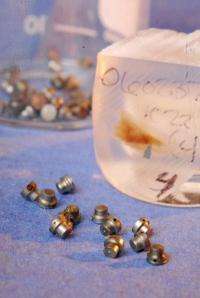
To evaluate the in vivo performance of the coated titanium in bone healing, the researchers drilled two-millimeter circular holes into a rat's tibia bone and pressed tiny clinical-grade titanium cylinders into the holes. The research team tested coatings that included individual strands, pairs, three-strand clusters and five-strand clusters of the engineered fibronectin protein.
"To investigate the function of these surfaces in promoting bone growth, we quantified osseointegration, or the growth of bone around the implant and strength of the attachment of the implant to the bone," explained García, who is also a Woodruff Faculty Fellow at Georgia Tech.
Analysis of the bone-implant interface four weeks later revealed a 50 percent enhancement in the amount of contact between the bone and implants coated with three- or five-strand tethered clusters compared to implants coated with single strands. The experiments also revealed a 75 percent increase in the contact of the three- and five-strand clusters compared to the current clinical standard for replacement-joint implants, which is uncoated titanium.
The researchers also tested the fixation of the implants by measuring the amount of force required to pull the implants out of the bone. Implants coated with three- and five-strand tethered clusters of the engineered fibronectin fragment displayed 250 percent higher mechanical fixation over the individual strand and pairs coatings and a 400 percent improvement compared to the unmodified polymer coating. The three- and five-cluster coatings also exhibited a twofold enhancement in pullout strength compared to uncoated titanium.


