Incredible shrinking moon is revealed by the Lunar Reconnaissance Orbiter
August 19, 2010
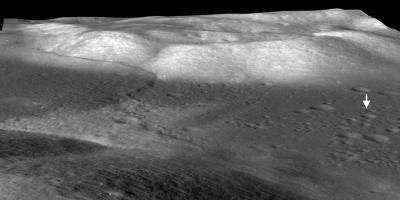
The mare basalts that fill the Taurus-Littrow valley were thrust up by contractional forces to form the Lee-Lincoln fault scarp, just west of the Apollo 17 landing site (arrow). It is the only extraterrestrial fault scarp to be explored by humans (astronauts Eugene Cernan and Harrison Schmitt). The digital terrain model derived from Lunar Reconnaissance Orbiter Camera (LROC) stereo images shows the fault extending upslope into North Massif were highlands material are also thrust up. The fault cuts upslope and abruptly changes orientation and cuts along slope, forming a narrow bench. LROC images show boulders shed from North Massif that have rolled downhill and collected on the bench. Credit: NASA/GSFC/Arizona State University
The Lunar Reconnaissance Orbiter is revealing previously undetected landforms that indicate the moon is shrinking. The findings are reported in a paper, "Evidence of Recent Thrust Faulting on the Moon Revealed by the Lunar Reconnaissance Orbiter Camera" scheduled for publication in the Aug. 20 issue of the journal Science.
Newly discovered cliffs in the lunar crust indicate the moon shrank globally in the geologically recent past and might still be shrinking today, according to a team analyzing new images from NASA's Lunar Reconnaissance Orbiter (LRO) spacecraft. The results provide important clues to the moon's recent geologic and tectonic evolution.
The moon formed in a chaotic environment of intense bombardment by asteroids and meteors. These collisions, along with the decay of radioactive elements, made the moon hot. The moon cooled off as it aged, and scientists have long thought the moon shrank over time as it cooled, especially in its early history. The new research reveals relatively recent tectonic activity connected to the long-lived cooling and associated contraction of the lunar interior.
"We estimate these cliffs, called lobate scarps, formed less than a billion years ago, and they could be as young as a hundred million years," said Dr. Thomas Watters of the Center for Earth and Planetary Studies at the Smithsonian's National Air and Space Museum, Washington. While ancient in human terms, it is less than 25 percent of the moon's current age of more than four billion years. "Based on the size of the scarps, we estimate the distance between the moon's center and its surface shrank by about 300 feet," said Watters, lead author of a paper on this research appearing in Science August 20.
"These exciting results highlight the importance of global observations for understanding global processes," said Dr. John Keller, Deputy Project Scientist for LRO at NASA's Goddard Space Flight Center, Greenbelt, Md. "As the LRO mission continues in to a new phase, with emphasis on science measurements, our ability to create inventories of lunar geologic features will be a powerful tool for understanding the history of the moon and the solar system."
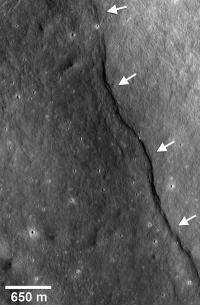
Over recent geologic time, as the lunar interior cooled and contracted the entire Moon shrank by about 100 m. As a result its brittle crust ruptured and thrust faults (compression) formed distinctive landforms known as lobate scarps. In a particularly dramatic example, a thrust fault pushed crustal materials (arrows) up the side of the farside impact crater named Gregory (2.1°N, 128.1°E). By mapping the distribution and determining the size of all lobate scarps, the tectonic and thermal history of the Moon can be reconstructed over the past billion years. Credit: NASA/GSFC/Arizona State University/Smithsonian
The scarps are relatively small; the largest is about 300 feet high and extends for several miles or so, but typical lengths are shorter and heights are more in the tens of yards (meters) range. The team believes they are among the freshest features on the moon, in part because they cut across small craters. Since the moon is constantly bombarded by meteors, features like small craters (those less than about 1,200 feet across) are likely to be young because they are quickly destroyed by other impacts and don't last long. So, if a small crater has been disrupted by a scarp, the scarp formed after the crater and is even younger. Even more compelling evidence is that large craters, which are likely to be old, don't appear on top any of the scarps, and the scarps look crisp and relatively undegraded.
Lobate scarps on the moon were discovered during the Apollo missions with analysis of pictures from the high-resolution Panoramic Camera installed on Apollo 15, 16, and 17. However, these missions orbited over regions near the lunar equator, and were only able to photograph some 20 percent of the lunar surface, so researchers couldn't be sure the scarps were not just the result of local activity around the equator. The team found 14 previously undetected scarps in the LRO images, seven of which are at high latitudes (more than 60 degrees). This confirms that the scarps are a global phenomenon, making a shrinking moon the most likely explanation for their wide distribution, according to the team.
As the moon contracted, the mantle and surface crust were forced to respond, forming thrust faults where a section of the crust cracks and juts out over another. Many of the resulting cliffs, or scarps, have a semi-circular or lobe-shaped appearance, giving rise to the term "lobate scarps". Scientists aren't sure why they look this way; perhaps it's the way the lunar soil (regolith) expresses thrust faults, according to Watters.
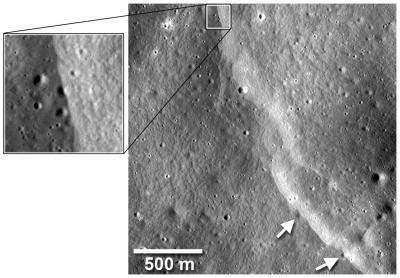
Another fault cut across and deformed several small diameter (~40-m diameter) impact craters (arrows) on the flanks of Mandel’shtam crater (6.5°N, 161°E). The fault carried near-surface crustal materials up and over the craters, burying parts of their floors and rims. About half of the rim and floor of a 20 m-in-diameter crater shown in the box has been lost. Since small craters only have a limited lifetime before they are destroyed by newer impacts, their deformation by the fault shows the fault to be relatively young. Credit: NASA/GSFC/Arizona State University/Smithsonian
Lobate scarps are found on other worlds in our solar system, including Mercury, where they are much larger. "Lobate scarps on Mercury can be over a mile high and run for hundreds of miles," said Watters. Massive scarps like these lead scientists to believe that Mercury was completely molten as it formed. If so, Mercury would be expected to shrink more as it cooled, and thus form larger scarps, than a world that may have been only partially molten with a relatively small core. Our moon has more than a third of the volume of Mercury, but since the moon's scarps are typically much smaller, the team believes the moon shrank less.Because the scarps are so young, the moon could have been cooling and shrinking very recently, according to the team. Seismometers emplaced by the Apollo missions have recorded moonquakes. While most can be attributed to things like meteorite strikes, the Earth's gravitational tides, and day/night temperature changes, it's remotely possible that some moonquakes might be associated with ongoing scarp formation, according to Watters. The team plans to compare photographs of scarps by the Apollo Panoramic Cameras to new images from LRO to see if any have changed over the decades, possibly indicating recent activity.
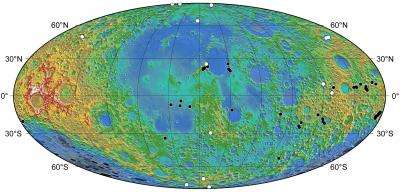
This map illustrates the distribution of lobate scarp features located thus far. Black dots indicate previously known scarps while white dots depict newly detected scarps found in images from the Lunar Reconnaissance Orbiter Camera. Credit: NASA/Arizona State University/Smithsonian
While Earth's tides are most likely not strong enough to create the scarps, they could contribute to their appearance, perhaps influencing their orientation, according to Watters. During the next few years, the team hopes to use LRO's high-resolution Narrow Angle Cameras (NACs) to build up a global, highly detailed map of the moon. This could identify additional scarps and allow the team to see if some have a preferred orientation or other features that might be associated with Earth's gravitational pull."The ultrahigh resolution images from the NACs are changing our view of the moon," said Dr. Mark Robinson of the School of Earth and Space Exploration at Arizona State University, Tempe, Ariz., a coauthor and Principal Investigator of the Lunar Reconnaissance Orbiter Camera. "We've not only detected many previously unknown lunar scarps; we're also seeing much greater detail on the scarps identified in the Apollo photographs."
-
Mercury's shifting, rolling past
Mar 17, 2008 |
not rated yet |
0
-
Mercury's shifting, rolling past
Mar 27, 2008 |
not rated yet |
0
-
Send Your Name to the Moon Aboard LRO
May 01, 2008 |
not rated yet |
0
-
Scientist to Work With NASA's Lunar Orbiter
Jan 25, 2005 |
not rated yet |
0
-
NASA tests moon orbiter components
Jan 12, 2008 |
not rated yet |
0
-
Engineers build first sub-10-nm carbon nanotube transistor
Feb 01, 2012 |
4.9 / 5 (31) |
30
-
Something old, something new: Evolution and the structural divergence of duplicate genes
Jan 31, 2012 |
4.6 / 5 (7) |
1
-
The hidden nanoworld of ice crystals: Revealing the dynamic behavior of quasi-liquid layers
Jan 30, 2012 |
5 / 5 (3) |
1
-
Stock market network reveals investor clustering
Jan 27, 2012 |
3.9 / 5 (23) |
8
-
Of microchemistry and molecules: Electronic microfluidic device synthesizes biocompatible probes
Jan 26, 2012 |
5 / 5 (1) |
0
-
Scale of the Universe
13 hours ago
-
Titan's lack of impact craters
Feb 09, 2012
-
Real pictures of black hole eating a star?
Feb 08, 2012
-
Hypothetical way to travel faster than light, but not technically exceed lightspeed
Feb 06, 2012
-
How do scientists monitor the Sun's activity?
Feb 05, 2012
-
Search patterns in observational studies
Feb 05, 2012
- More from Physics Forums - General Astronomy
More news stories
Could Venus be shifting gear?
(PhysOrg.com) -- ESAs Venus Express spacecraft has discovered that our cloud-covered neighbour spins a little slower than previously measured. Peering through the dense atmosphere in the infrared, the ...
Space & Earth / Space Exploration
21 hours ago |
5 / 5 (7) |
8
|
Mars Science Laboratory computer issue resolved
(PhysOrg.com) -- Engineers have found the root cause of a computer reset that occurred two months ago on NASA's Mars Science Laboratory and have determined how to correct it.
Space & Earth / Space Exploration
22 hours ago |
4.7 / 5 (6) |
4
|
Two new moons for Jupiter
Advances in technology have lead to the discovery of new planets outside of our Solar System, and now even new moons in our own backyard.
Space & Earth / Space Exploration
21 hours ago |
4 / 5 (1) |
7
NASA sees wide-eyed cyclone Jasmine
Cyclone Jasmine's eye has opened wider on NASA satellite imagery, as it moves through the Southern Pacific Ocean.
Space & Earth / Earth Sciences
13 hours ago |
3.5 / 5 (2) |
2
Clam fields found at deep, low-temperature Mariana vents
(PhysOrg.com) -- Scientists have marveled at the unusual life forms thriving at high temperature hydrothermal vents of the deep ocean.
Space & Earth / Earth Sciences
21 hours ago |
4.3 / 5 (3) |
0
|
Anonymous knocks CIA website offline (Update)
The website of the Central Intelligence Agency was inaccessible on Friday after the hacker group Anonymous claimed to have knocked it offline.
New error-correcting codes guarantee the fastest possible rate of data transmission
Error-correcting codes are one of the triumphs of the digital age. Theyre a way of encoding information so that it can be transmitted across a communication channel such as an optical fiber o ...
Small modular reactor design could be a 'SUPERSTAR'
(PhysOrg.com) -- Though most of today's nuclear reactors are cooled by water, we've long known that there are alternatives; in fact, the world's first nuclear-powered electricity in 1951 came from a reactor ...
New power source discovered
(PhysOrg.com) -- Researchers at the Massachusetts Institute of Technology (MIT) and RMIT University have made a breakthrough in energy storage and power generation.
The power of estrogen -- male snakes attract other males
A new study has shown that boosting the estrogen levels of male garter snakes causes them to secrete the same pheromones that females use to attract suitors, and turned the males into just about the sexiest ...
Advanced power-grid model finds low-cost, low-carbon future in West
(PhysOrg.com) -- The least expensive way for the Western U.S. to reduce greenhouse gas emissions enough to help prevent the worst consequences of global warming is to replace coal with renewable and other ...


Aug 19, 2010
Rank: 5 / 5 (2)
Aug 19, 2010
Rank: 3 / 5 (2)
1. Obama will have to fix
2. Al Gore will promote
3. Congress will have to have another bailout for ...
Sep 02, 2010
Rank: 1 / 5 (4)
1. If the moon is supposed to be shrinking, how long has the shrinking been going on for? 100 million years? Not likely. It should now be dead and quiet.
2. If those scarps are 100million years old why are there no crater indents OVER them? Is there any evidence that the scarps have been hit by asteroids/meteorites in the supposed 100Ma? If not, then one has to come to the conclusion that either there were no hits in 100Ma - which would be preposterous or else those scarps are a lot younger than thought and hence the moon is still much more active than it should be according to current evolutionary theory.
In fact one could point out that such theory is seriously at fault and needs to be revised: the moon is showing signs of life - after 4.5Ga - which is extremely unlikely.
Couple this with the isolated reports of volcanic and seismic activity and things really get hot for the molten rock theory.
Sep 02, 2010
Rank: 3.7 / 5 (3)