Researchers find empirical link between multisensory integration and autism
A new study by researchers at Albert Einstein College of Medicine of Yeshiva University has provided concrete evidence that children with autism spectrum disorders (ASD) process sensory information such as sound, touch and vision differently than typically developing children.
The study, which appears in the August 17 online issue of Autism Research, supports decades of clinical and anecdotal observations that individuals with ASD have difficulty coping with multiple sources of sensory information. The Einstein finding offers new insights into autism and could lead to objective measures for evaluating the effectiveness of autism therapies.
"One of the classic presentations of autism is the child in the corner with his hands over his ears rocking back and forth trying to block out the environment," said senior author Sophie Molholm, Ph.D., associate professor in the Dominick P. Purpura Department of Neuroscience and of pediatrics. "People have long theorized that these children might not be integrating information across the senses very well. If you have all these sights and sounds coming at you but you can't put them together in a meaningful way, the world can be an overwhelming place."
The theory that autistic kids have trouble processing multisensory information has not been reliably supported by behavioral studies, and has rarely, if at all, been tested using measures of brain activity. Over the last few years, Dr. Molholm and her colleagues have been refining methods for measuring multisensory integration (MSI) using brainwave electroencephalogram (EEG) recordings.
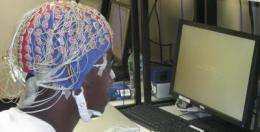
In the current study, MSI was measured in 17 ASD children, ages 6 to 16, and 17 typically developing children matched for age and non-verbal IQ. The children watched a silent video of their choice while they were presented with unrelated sounds and vibrations. The auditory and vibrational stimuli were presented separately (creating so-called unisensory conditions) and then together (multisensory condition), which acted as the researchers' index of MSI. The children's EEG responses to the unisensory conditions were summed and compared to their EEG responses to multisensory conditions.
The responses of the typically developing children to the multisensory stimuli exceeded the sum of their responses to the unisensory stimuli―an indication of healthy MSI, according to the researchers. In the ASD children, by contrast, the differences between the sum of children's unisensory responses and their MSI responses were not nearly as pronounced, indicating that these kids were not integrating multisensory information as effectively.
"Our data makes a compelling case, at least for these conditions, that there are differences in multisensory integration between the two groups," said Dr. Molholm.
After our nerves are stimulated, "sensory information arrives in the brain's cortex within 20 milliseconds (ms), or 20/1000ths of a second," said co-author John Foxe, Ph.D., professor in the Dominick P. Purpura Department of Neuroscience and of pediatrics and director of research of the Children's Evaluation and Rehabilitation Center at Einstein. "Then it takes an additional 100 to 200 ms for the brain to integrate information arriving from different senses, since many brain regions are involved in analyzing it."
In this study, the differences between the typically developing and ASD children were most striking for that time interval in which multisensory stimuli is normally processed. "We saw robust MSI in the typically developing kids from 100 and 200 ms after sensory stimulation reached the brain's cortex," said Dr. Foxe. "But in the ASD kids, MSI occurred significantly later—at about 310 ms—and at a much lower level."
"This doesn't mean that the children with ASD didn't integrate the information at all," he added. "It does mean that they didn't integrate it as effectively as they should have, given their age and maturity. They may go on to integrate well later in life. We don't know. This is a single slice of the developmental trajectory."
"This was a much-needed study of multisensory integration in autism," said Barry E. Stein, Ph.D., professor and chair of neurobiology & anatomy at Wake Forest University School of Medicine, who was not involved in the Einstein study. "Using simple logic and standard techniques for electrically mapping the brain, the authors have identified defects in the way ASD individuals synthesize cues from different senses. In doing so, they have not only helped confirm the insights of parents and clinicians, but they've improved our understanding of how the behavioral differences in children with ASD may result from sensory anomalies."
"Today, there's a cottage industry -- actually more like a military-industrial complex -- for multisensory integration therapies for children with autism," said Dr. Foxe. "A lot of parents' hard-earned cash goes into these interventions, all in the absence of actual empirical evidence that there is anything wrong with MSI in these children or that these therapies do any good."
The researchers are currently evaluating MSI in children from 6 years of age through early adulthood to better understand the developmental trajectory of multisensory integration. They also plan to study MSI in lower-functioning ASD children. "This experimental paradigm is especially good for that, because it makes so little demand on the kids," said Dr. Foxe. "As you can imagine, asking them to do tasks doesn't work very well."


