Computer chip that computes probabilities and not logic
August 19, 2010 by John Messina weblog
Computer Chip That Computes Probabilities and Not Logic

Enlarge

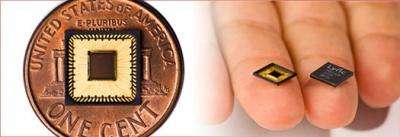
Lyric's Error Correction Chip for Flash Memory. Credit: Lyric Semiconductor

(PhysOrg.com) -- Lyric Semiconductor has unveiled a new type of chip that uses probability inputs and outputs instead of the conventional 1's and 0's used in logic chips today. Crunching probabilities is much more applicable to many computing task performed today rather than binary logic.

Ben Vigoda, CEO and founder of Lyric Semiconductor, has been aggressively working on this technology since 2006 and is partly being funded by the U.S. Defense Advanced Research Projects Agency (DARPA). DARPA is interested in using this technology in defense applications that involves information that is not clear cut and can use probability calculations to come to a conclusion.

Because probability calculations are used in so many products, there are many potential applications. Ben Vigoda stated: "To take one example, Amazon's recommendations to you are based on probability. Any time you buy from them, the fraud check on your credit card is also probability based, and when they e-mail your confirmation, it passes through a spam filter that also uses probability."

Conventional chips have transistors arranged in digital NAND gates which are used to implement digital functions using 1's and 0's. In a probability processor transistors are used to build Bayesian NAND gates. Bayesian probability is a field of mathematics named after the eighteenth century English statistician Thomas Bayes.

Lyric Semiconductor plans to have prototypes of their all-purpose probability chips operational within three years. Currently a smaller flash memory error-correcting , based on the technology, is available for license this week. The company plans on having flash memory chips in portable devices like tablets and smartphones within two years.

More information: Lyric Semiconductor
Via: Technology Review

© 2010 PhysOrg.com

4.2 /5 (27 votes)  

Filter


Move the slider to adjust rank threshold, so that you can hide some of the comments.


Display comments: newest first

ClickHere
Aug 19, 2010

Rank: 5 / 5 (4)
So, looks like the Infinite Improbability Drive will reach market before warp technology.
balde
Aug 19, 2010

Rank: 5 / 5 (2)
As one nerd to another I say, well played sir!
gunslingor1
Aug 19, 2010

Rank: 5 / 5 (1)
Lol... see you at DragonCon in two weeks!
d44x
Aug 19, 2010

Rank: 5 / 5 (1)
Agggggghhhhhhhhhhhh

wrong, wrong, wrong, wrong, wrong

It's a different type of processor architecture that's all. It'll still use 0s and 1s. However it may lead to new types of CPU architecture which incorporate a PPU (probability processor unit), however this would assume the design could be optimised so that the inevitable slow down which would occur with the extra gates needed to incorporate such a processor, wouldn't out way the positive effects of having a very minimised design. - Most often in CPU design, less is more - just look at the RISC vs CISC for example.

Also not all (in fact most minimised chips aren't) made up of NAND gates - they are made up of whatever types of gate the engineer thought best to make them up out of!
DamienS
Aug 19, 2010

Rank: 5 / 5 (1)
This sounds interesting in principle, in that it may find use in hardware based neural AI situations (as opposed to software based simulations), but I don't know how useful it will be in general computing (such as the Amazon example cited), as conventional chips are perfectly well capable of doing probabilistic/Bayesian computations.
plasticpower
Aug 20, 2010

Rank: 5 / 5 (1)
It could very well be a fuzzy logic circuit of some sort. It doesn't need to do boolean algebra, therefore doesn't need conventional transistors arranged in gates.

I think the idea is to make them really fast. Your brain predicts objects before fully recognizing them. It will either confirm the prediction, or correct itself, but a significant amount of time is passed between when your brain predicts an object to be something and when it confirms that prediction. Ever stare at something for a long time thinking it's one thing or the other but not completely sure until it clicks? Computers would hang and freeze or give up presented such a task. With this chip it can be done much faster. The military needs it to automate UAVs and all kinds of equipment.
dangiankit
Aug 20, 2010

Rank: 5 / 5 (1)
The application example of Amazon doesn't relate well. I am curious to understand the advantages of such a chip. Any one?
marcin_szczurowski
Aug 20, 2010

Rank: not rated yet
It's all mystification. Inside there's token or RNG ;]
CSharpner
Aug 21, 2010

Rank: not rated yet
Sounds like an analog computer. I haven't heard any chatter about those in a while.
TabulaMentis
Aug 22, 2010

Rank: not rated yet
D44X:

The article says the probability chips will not use conventional 1's and 0's.

C Sharperner is right when they say it sounds like an analog computer.

Anyone know what the human brain use besides logic and probablities even if it is a really far out theory?
GrayMatter
Aug 22, 2010

Rank: not rated yet
A chip based on probability tech? Maybe we can use it to predict future lottery results. :)
tpq
Aug 23, 2010

Rank: not rated yet
So where are the comparisons to quantum computing..? To me this sounds immitation of quantum computers but still done with 0's and 1's (thus slow) or am I totally wrong?

Granted, we might need a while for quantum computing to really appear
Skeptic_Heretic
Aug 23, 2010

Rank: not rated yet
Looks like we're simply moving towards a chip design that allows for qualitative processing in addition to quantitative.

Very interesting.
TabulaMentis
Aug 23, 2010

Rank: not rated yet
So where are the comparisons to quantum computing..? To me this sounds immitation of quantum computers but still done with 0's and 1's (thus slow) or am I totally wrong?
Granted, we might need a while for quantum computing to really appear

A quantum computer uses 0's and 1's, and values in between, or something like that. Eventually, quantum computers will use 0's, 1's and 2's.
Javinator
Aug 23, 2010

Rank: not rated yet
A chip based on probability tech? Maybe we can use it to predict future lottery results. :)


Unfortunately all lottery picks are equally probable (or improbable depending on how you look at it)
Skeptic_Heretic
Aug 24, 2010

Rank: not rated yet
A quantum computer uses 0's and 1's, and values in between, or something like that. Eventually, quantum computers will use 0's, 1's and 2's.

Not really. A quantum computer would use superpositions. So a bit would be either 0, 1, or a superposition of both 0 and 1.
TabulaMentis
Aug 24, 2010

Rank: not rated yet
A quantum computer uses 0's and 1's, and values in between, or something like that. Eventually, quantum computers will use 0's, 1's and 2's.

Not really. A quantum computer would use superpositions. So a bit would be either 0, 1, or a superposition of both 0 and 1.

Yes, but we are both right.
Maybe I should have said a quantum computer uses 0's and 1's and superpositions in between, but I have heard it said other ways.
Skeptic_Heretic
Aug 24, 2010

Rank: not rated yet
Yes, but we are both right.
Maybe I should have said a quantum computer uses 0's and 1's and superpositions in between, but I have heard it said other ways.
Superpositions are not "in between" they are both at once. It's a little different, but different enough to make a semantics argument out of it. For example a superposition isn't 0.25 or 0.5 it is both 1 AND 0. If you could liken it to a light switch you'd have off, on, and this weird position where the light was both off and on at the same time.
TabulaMentis
Aug 24, 2010

Rank: not rated yet
You are correct. I do not memorize/retain all of that stuff. I was trying to answer TPQ's question/statement above.
I am glad you straigthened that one out.
Thanks.
Rank 4.2 /5 (27 votes)
Related Stories
Relevant PhysicsForums posts

More news stories

Soraa LED light may dim 50-watt halogen rivals

(PhysOrg.com) -- Soraa, a Fremont, California company founded in 2008, this week launched its first product, a light that uses LEDS (light emitting diodes). The "Soraa LED MR16 lamp" is the "perfect" replacement ...

Technology / Semiconductors

created 18 hours ago | popularity 4.3 / 5 (17) | comments 15 | with audio podcast report

First Google hire leaving for online academy

The first person hired by Google's founders is leaving the Internet giant to devote himself to an innovative online education website called Khan Academy.

Technology / Internet

created 6 hours ago | popularity 5 / 5 (1) | comments 0

FBI file: Steve Jobs was considered for govt post

(AP) -- FBI background interviews of some people who knew Apple co-founder Steve Jobs reveal a man driven by power and alienating some of the people who worked with him.

Technology / Business

created 6 hours ago | popularity 3.4 / 5 (5) | comments 0

New integrated building model may improve fish farming operations

Today's "locavore" movement with its emphasis on eating more locally-produced food is a natural fit for fruits and vegetables in nearly every region, but few entrepreneurs have dared to apply the concept to ...

Technology / Engineering

created 7 hours ago | popularity not rated yet | comments 0

NY attorney general ends lawsuit against Intel

(AP) -- Intel Corp. is paying $6.5 million as part of a deal to terminate an antitrust lawsuit filed against the chip maker by the New York attorney general's office.

Technology / Business

created 6 hours ago | popularity not rated yet | comments 0


'Dark plasmons' transmit energy

Microscopic channels of gold nanoparticles have the ability to transmit electromagnetic energy that starts as light and propagates via "dark plasmons," according to researchers at Rice University.

FDA-approved drug rapidly clears amyloid from the brain, reverses Alzheimer's symptoms in mice

Neuroscientists at Case Western Reserve University School of Medicine have made a dramatic breakthrough in their efforts to find a cure for Alzheimer's disease. The researchers' findings, published in the journal Science, show t ...

Hydrogen from acidic water: Researchers develop potential low cost alternative to platinum for splitting water

A technique for creating a new molecule that structurally and chemically replicates the active part of the widely used industrial catalyst molybdenite has been developed by researchers with the Lawrence Berkeley ...

Ultraviolet protection molecule in plants yields its secrets

Lying around in the sun all day is hazardous not just for humans but also for plants, which have no means of escape. Ultraviolet (UV) radiation from the sun can damage proteins and DNA inside cells, leading ...

Anyone can learn to be more inventive, cognitive researcher says

There will always be a wild and unpredictable quality to creativity and invention, says Anthony McCaffrey, a cognitive psychology researcher at the University of Massachusetts Amherst, because an "Aha moment" is rare and ...

New method makes culture of complex tissue possible in any lab

Scientists at the University of California, San Diego have developed a new method for making scaffolds for culturing tissue in three-dimensional arrangements that mimic those in the body. This advance, published online in ...