Mud Volcanoes on Mars
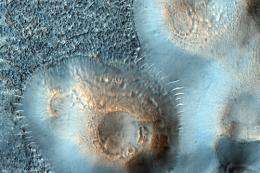
Spewing out material from deep underground, geological structures on Mars thought to be mud volcanoes could give scientists the clues they need to determine if life exists, or ever existed, on the Red Planet.
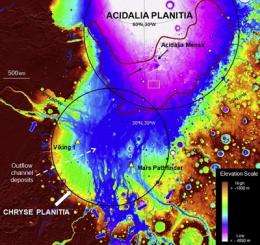
If life does - or did - exist on Mars, signs of such life might well be found in a region in the northern plains called Acidalia Planitia, according to a new study.
The region appears to be dotted with what scientists believe are geological structures known as mud volcanoes, spewing out muddy sediments from underground. These sediments might contain organic materials that could be biosignatures of possible past and present life.
“If there was life on Mars, it probably developed in a fluid-rich environment,” said lead author Dorothy Oehler, a research scientist at the Astromaterials Research and Exploration Science Directorate at NASA’s Johnson Space Center. “Mud volcanoes themselves are an indicator of a fluid-rich subsurface, and they bring up material from relatively deep parts of the subsurface that we might not have a chance to see otherwise.”
In a study published in the August issue of Icarus, Oehler and her co-author Carlton Allen mapped, for the first time, more than 18,000 of these circular mounds. Their estimate is that more than 40,000 mud volcanoes could be found in that region if the mapping continued.
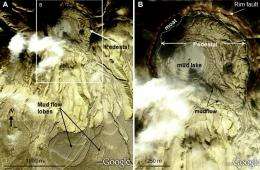
“The Oehler paper adds to [previous studies] by documenting in much greater detail [the] number and distribution [of the mud volcanoes] and analyzes more deeply their origin and possible implications as paleo-habitats,” said Kenneth Tanaka, a scientist at the Astrogeology Science Center of the U.S. Geological Survey.
Oehler and Allen analyzed images obtained from the Mars Reconnaissance Orbiter (MRO), which allowed them to take a closer look at the structure of some of the mounds and their flow-like features. More data from the imaging spectrometer known as CRISM provided new information on the mineralogy of the mud volcano-like mounds.
Through these assessments, the two scientists were able to rule out the possibility that the mounds were caused by other processes. The paper provides a detailed explanation of why the mounds cannot be impact structures, ice-cored mounds, evaporation deposits or structures caused by lava flow.
Scientists first observed the mounds in Acidalia using imagery obtained from the Viking mission in the late 1970s. However, it was more recently that these mounds were thought to represent mud volcanoes. Tanaka was one of the first to make that suggestion.
“I also thought that these features, which also occur elsewhere in the northern plains of Mars, were good places to search for signs of life,” Tanaka said.
Mud volcanoes are geological structures in which a mixture of gas, liquid and fine-grained rock (or mud) is forced to the surface from several meters or kilometers underground. On Earth, mud volcanoes have specific significance to the oil industry. Those found on land have been found to play a significant role in predicting petroleum reservoirs. Offshore, they can also be a “huge drilling hazard,” according to Oehler, because the earth around a mud volcano is unstable and the activity inside is somewhat unpredictable. It is difficult to predetermine how much mud will surface and whether the process will be a quiet one or an explosive one.
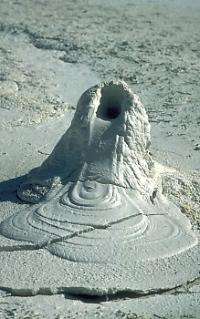
The size of mud volcanoes can range up to about ten of kilometers in diameter and several hundred meters in height. The mud flows in an upward direction because the muddy mixture is more buoyant than the surrounding rocks.
One of the major goals of the Mars exploration program is to try to understand if life ever evolved on the planet. In that hunt, astrobiologists are searching for biosignatures that would indicate the presence of extraterrestrial life. While the surface of Mars is thought to be inhospitable to life, microbial life possibly could exist underground. Mud volcanoes bring materials from great depths to the surface, providing samples from deep inside the planetary body that, on a place like Mars, would otherwise be completely inaccessible to scientists.
“If life were present in the subsurface, the water and slurries involved in forming the mud volcanoes would have brought it to the surface,” Tanaka explained. “While life may not have survived at the surface, it at least could have been brought there by this process.”
Studies such as this could help identify regions on the Red Planet that may have been the most suitable places for life to take hold. Missions could use this information to target sites that would be the most likely to have organic biosignatures.
“None of the previous landers or rovers on Mars has tested any structure interpreted as a possible mud volcano,” Oehler said. “So the mounds in Acidalia represent an entirely new, and untested, class of exploration target for Mars.”
However, Tanaka said the age of the mud volcanoes, which could be two to three billion years old, might make them less suitable locations for finding signs of life.
“There has been a great amount of time [for UV radiation and other surface processes] to destroy possible microfossils in surface rocks and soils,” Tanaka said. “For this reason, it is unclear if these features are the best places to search for preserved life. Better places might include recent crater impacts and deposits from younger flood discharges.”
Tanaka points to a Martian valley called Athabasca Valles as a good alternative location for astrobiologists to search for biosignatures. Scientists estimate its age to be in the range of two to 30 million years, making it the youngest channel on the planet. The younger the geological structure, the greater likelihood of finding better-preserved biosignatures.
Meanwhile, Oehler and her colleagues are hoping to continue analyzing the MRO imagery to provide further evidence that the circular structures in Acidalia are in fact mud volcanoes. They plan on analyzing their distribution on the surface, and how the shapes of the different structures vary. This analysis could provide more information about the subsurface conditions in the Acidalia region.
“We do believe that Acidalia is a place where life could have been abundant because of long-lived water sources,” Oehler said. “It is one of the better places to look for evidence of life - if life ever developed on Mars.”
Source: Astrobio.net, by Anuradha K. Herath


