Geologists revisit the Great Oxygenation Event
In "The Sign of the Four" Sherlock Holmes tells Watson he has written a monograph on 140 forms of cigar-, cigarette-, and pipe-tobacco, "with colored plates illustrating the difference in the ash." He finds the ash invaluable for the identification of miscreants who happen to smoke during the commission of a crime.
But Sherlock Holmes and his cigarette ash and pipe dottle don't have a patch on geologists and the "redox proxies" from which they deduce chemical conditions early in Earth's history.
Redox proxies, such as the ratio of chromium isotopes in banded iron formations or the ratio of isotopes in sulfide particles trapped in diamonds, tell geologists indirectly whether the Earth' s atmosphere and oceans were reducing (inclined to give away electrons to other atoms) or oxidizing (inclined to glom onto them).
It makes all the difference: the bacterium that causes botulism, and the methanogens that make swamp gas are anaerobes, and thrive in reducing conditions. Badgers and butterflies, on the other hand, are aerobes, and require oxygen to keep going.
In the July issue of Nature Geoscience Washington University in St. Louis geochemist David Fike gives an unusually candid account of the difficulties his community faces in correctly interpreting redox proxies, issuing a call for denser sampling and more judicious reading of rock samples.
The world ocean
Fike, assistant professor of earth and planetary sciences in Arts & Sciences, focuses on the dramatic change from anoxic to oxygenated conditions in the world's oceans that preceded the Ediacaran period (from 635 to 542 million years ago) when the first multicellular animals appeared.
If you look in a textbook, you'll find a story that goes something like this: Four billion years ago the earth's atmosphere was a deadly mixture of gases spewed forth by volcanoes, such as nitrogen and its oxides, carbon dioxide, methane, ammonia, sulfur dioxide and hydrogen sulfide.
The oceans that formed from condensing water vapor (or incoming comets) were reservoirs of dissolved iron, pumped through hydrothermal vents on the ocean floor.
Then about 2.7 billion years ago, cyanobacteria, which have been called the most self-sufficient organisms on the planet because they can both photosynthesize and fix nitrogen, began bubbling oxygen into the atmosphere and shallow waters.
At first oxygen built up gradually in the atmosphere, but about 2.5 billion years ago there was a sudden spike upward, traditionally called the Great Oxygenation Event.
The oxygen killed off anerobes that didn't find refuge in sediments, the deep ocean and other airless environments and led to the evolution of aerobes that could use oxygen to spark their metabolism.
At roughly the same time iron began to precipitate out of the oceans, forming rocks peculiar to this period called banded iron formations that consist of alternating layers of gray and red rock.
Banded iron formations were created episodically from about 3 billion years ago until 1.8 billion years ago and almost never again.
The usual story is that iron was being swept from the oceans by increasing levels of dissolved oxygen.
And then, another two billion years after the Great Oxygenation Event, multicellular lifeforms finally put in an appearance. The first metazoans, as they are called, were the bizarre Edicaran fauna, sometimes unflatteringly compared to sacks of mud and quilted mattresses.
The assumption was oxygen levels were now high enough to support something more than a single cell in lonely solitude.
Of course, this story has holes you could drive a truck through.
Why did oxygen levels spike 2.5 billion years ago, and how much oxygen was there in the atmosphere really? Why are banded iron formations made of layers only a few centimeters thick, and why did they stop forming so abruptly? If the oceans were oxygenated 2.5 billion years ago, why did multicellular life delay its appearance for another 2 billion years? And did all these changes really take place at pretty much the same time everywhere on Earth?
The problems arise, says Fike, because scientists don't have dense enough data to recognize spatial variations in Earth's geochemical past and because the geochemical proxies are so devilishly hard to interpret.
The world beach
The story started to fall apart in 1998, says Fike, when Don Canfield of Odense University in Denmark suggested that sulfur compounds had also played a role in the transformation of Earth's chemistry.
Canfield argued that that the Great Oxygenation Event actually took place in two steps and that it was sulfides rather than oxygen that removed the iron from deep ocean water.
The first rise in oxygen caused oxidative weathering of rocks on land that delivered sulfates to the ocean through rivers and streams. In the ocean, sulfate-reducing bacteria converted the sulfates to sulfide to gain the energy they needed for daily housekeeping. The dissolved iron combined with the sulfides to form iron sulfide minerals such as pyrite that dropped out of solution.
During the second, much later stage, enough oxygen was generated to sweep the deep ocean of the toxic sulfides, ushering in the era of biological innovation, a.k.a. the mud sacks and quilted mattresses.
These transitions were still discussed as changes in bulk ocean chemistry — just from one anoxic chemistry to another anoxic chemistry.
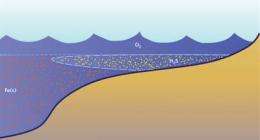
However, in the July issue of Nature Geoscience, Simon Poulton of the University of Newcastle in England showed that sulfidic water protruded into the ocean only in a narrow wedge along the shorelines of ancient continents. This meant that the water column, instead of being homogeneous, was stratified, with different chemistries in different layers.
So much for the world ocean.
It's Complicated
"Recent geochemical evidence indicates that, at least locally, ferruginous (iron rich) or even sulphidic (sulfur rich) conditions persisted through the Ediacaran period, long after the Great Oxygenation Event," Fike says.
"Things are much more complicated than we had supposed."
"As a community, we don't have a good sense of the spatial variation of these zones within different bodies of water, " says Fike.
"What's more, different assessments can arise from the interpretation of different geochemical proxies, from physical separation between different ocean basins, or from the reworking of sediments after deposition," he continues.
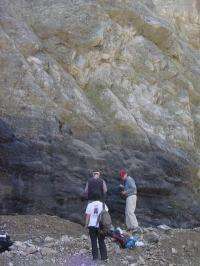
The underlying problem is a low sampling rate. "As we try to unravel these changes in Earth's history, " Fike says, "we often don't have 100 different places where we can measure rocks of the same age. We're stuck with a few samples, and the natural tendency is to take your rocks and extrapolate."
The only way "to wring order from the chaos," Fike says, is to develop a full three-dimensional model of the Earth that has enough spatial resolution to wash out bad data.
Mystery of the vanishing acritarchs
"If you map out redox proxies in enough spatial detail, you can tell a beautiful, consistent story that relates environmental change to the paleontological record," Fike says.
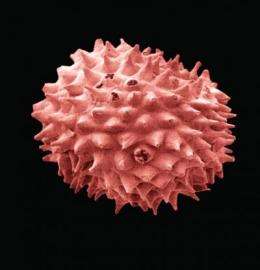
To illustrate, he tells the story of a group of spiny acritarchs, microfossils found in the one of the oldest fossil beds on Earth, the Doushantuo formation in south China.
Nobody was really sure what the acritarchs were. Some people thought they were green algae. Others thought they might be dinoflagellates that had evolved spines to avoid predation by animals.
"Scientists looking at the Doushantuo thought they understood what they were seeing," Fike says. "Oxygen is appearing, the acritarchs are evolving, and this is the start of the big rise in evolution associated with the final oxygen event."
"But then they noticed that after the big rise in spiny cysts and just when we see evidence for oxygen in the rock record, the acritarchs disappear. And that really doesn't make sense if you're evolving new groups because of the increase in oxygen."
"In 2009 a group of scientists led by Phoebe Cohen of Harvard University inspected acritarchs with transmission electron microscopes and concluded that they are not algae but rather animals, encased in protective cysts that animals form when conditions are not favorable to life," says Fike.
At the same time a group of scientists (including Fike) led by Chao Li of the University of California Riverside measured redox proxies in several different sections through the formation.
These measurements showed that the Nanhua Basin had had a layered chemical structure with deep iron-rich waters, near-shore wedges of sulfur-rich water and an oxygenated surface.
Both the sulfur- and the iron-rich waters would have been lethal to oxygen-loving species.
A Cautionary Tale
At the same time Fike acknowledges that spatial variability in redox proxies may make many geologists feel ill at ease because it might instead reflect an unusual depositional context or the reworking of the proxy after deposition instead of a signficant change in geochemistry.
By way of illustration, he describes a study of Amazonian mud belts, published this year by Robert Aller of Stony Brook University and colleagues in Geochimica et Cosmochimica Acta.
"The Amazon dumps mud rich in organic material into the Atlantic," Fike says. "The mud is deposited and the oxygen in it is consumed by biological activity, but then a storm churns it up, it gets reoxygenated, and redeposited. And this process happens over and over again."
By the time the muds become sediments, their chemistry is very different from what it was when they were first deposited.
"The redox indicators for the Amazonian sediments suggest that they were deposited under anoxic, sulfate-poor conditions, but we know they were deposited in well-oxygenated, sulfate-rich marine waters," Fike writes.
It is as if the murderer had deliberately removed cigar ash and substituted cigarette ash at the scene of the crime.
"Much work remains ahead of us before we can have a true sense of the three-dimensional redox structure of the oceans and how it varied through time," Fike concludes.
Provided by Washington University in St. Louis


