German researchers take a look inside molecules
August 20, 2010
Juelich researchers take a look inside molecules

Enlarge

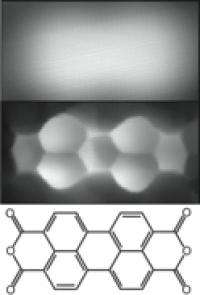
The Juelich method makes it possible to resolve molecule structure where only a blurred cloud was visible before. Credit: Forschungszentrum Jülich

Looking at individual molecules through a microscope is part of nanotechnologists' everyday lives. However, it has so far been difficult to observe atomic structures inside organic molecules. In the renowned scientific journal Physical Review Letters, Juelich researchers explain their novel method, which enables them to take an "x-ray view" inside molecules. The method may facilitate the analysis of organic semiconductors and proteins.

For their look into the nanoworld, the Juelich researchers used a scanning tunneling . Its thin metal tip scans the specimen surface like the needle of a record player and registers the atomic irregularies and differences of approximately one nanometre (a billionth of a millimetre) with minuscule electric currents. However, even though the tip of the microscope only has the width of an atom, it has not been able so far to take a look inside molecules.

"In order to increase the sensitivity for , we put a sensor and signal transducer on the tip," says Dr. Ruslan Temirov. Both functions are fulfilled by a small molecule made up of two deuterium atoms, also called heavy hydrogen. Since it hangs from the tip and can be moved, it follow the contours of the molecule and influences the current flowing from the tip of the microscope. One of the first molecules studied by Temirov and co-workers was the perylene tetracarboxylic dianhydride compound. It consists of 26 , eight and six oxygen atoms forming seven interconnected rings. Earlier images only showed a spot with a diameter of approximately one nanometre and without any contours. Much like an X-ray image, the Juelich shows the molecule's honeycombed inner structure, which is formed by the rings.

"It's the remarkable simplicity of the method that makes it so valuable for future research," says Prof. Stefan Tautz, Director at the Institute of Bio- and Nanosystems at Forschungszentrum Juelich. The Juelich method has been filed as a patent and can easily be used with commercial scanning tunnelling microscopes. "The spatial dimensions inside molecules can now be determined within a few minutes, and the preparation of the specimen is based predominantly on standard techniques," says Tautz. In the next step, the Jülich scientists are planning to calibrate the measured current intensity as well. If they are successful, the measured current intensities may allow the type of atoms to be directly determined.

After publishing initial images produced with the new method in 2008, the research group of Tautz and Temirov has now been able to explain the quantum mechanical principle of operation of the deuterium at the tip of the microscope. Their results were supported by computer-assisted calculations by the working group of Prof. Michael Rohlfing at the University of Osnabruck. The so-called short-range Pauli repulsion is a quantum-physical force between the deuterium and the molecule which modulates the conductivity and allows us to measure the fine structures very sensitively.

The Juelich method can be used to measure the structure and charge distribution of flat molecules which can be used as organic semiconductors or as part of fast and efficient future electronic devices. Large three-dimensional biomolecules such as proteins can be examined as soon as the techniques have been refined.

More information: The publication at Physical Review Letters: Weiss et al., Imaging Pauli repulsion in scanning tunneling microscopy, 10.1103/PhysRevLett.105.086103 (2010)

Provided by Helmholtz Association of German Research Centres (news : web)


Rank 5 /5 (24 votes)
Related Stories
Relevant PhysicsForums posts
  • Books To Inspire a Beginnig Physics Student
    created2 hours ago
  • Pith balls problem
    created3 hours ago
  • Electrostatics
    created3 hours ago
  • what is phase constant
    created3 hours ago
  • Basics In electromagnetic wave
    created3 hours ago
  • How to calculate theoretical initial velocity?
    created4 hours ago
  • More from Physics Forums - General Physics

More news stories

What lies beneath: Mapping hidden nanostructures

The ability to diagnose and predict the properties of materials is vital, particularly in the expanding field of nanotechnology. Electron and atom-probe microscopy can categorize atoms in thin sheets of material, ...

Nanotechnology / Nanophysics

created 17 hours ago | popularity 5 / 5 (3) | comments 1

New kind of solar cell could capture significantly more energy than current cells

New solar cells could increase the maximum efficiency of solar panels by over 25%, according to scientists from the University of Cambridge.

Nanotechnology / Nanophysics

created Feb 08, 2012 | popularity 4.5 / 5 (12) | comments 14 | with audio podcast

Nanoshell whispering galleries improve thin solar panels

Visitors to Statuary Hall in the U.S. Capitol Building may have experienced a curious acoustic feature that allows a person to whisper softly at one side of the cavernous, half-domed room and for another on ...

Nanotechnology / Nanomaterials

created Feb 07, 2012 | popularity 4.3 / 5 (6) | comments 6 | with audio podcast

'Dark plasmons' transmit energy

Microscopic channels of gold nanoparticles have the ability to transmit electromagnetic energy that starts as light and propagates via "dark plasmons," according to researchers at Rice University.

Nanotechnology / Nanophysics

created Feb 09, 2012 | popularity 4.8 / 5 (8) | comments 1 | with audio podcast

Revealing how a battery material works

Since its discovery 15 years ago, lithium iron phosphate (LiFePO4) has become one of the most promising materials for rechargeable batteries because of its stability, durability, safety and ability to deliver ...

Nanotechnology / Nanomaterials

created Feb 08, 2012 | popularity 5 / 5 (5) | comments 0 | with audio podcast


Anonymous knocks CIA website offline (Update)

The website of the Central Intelligence Agency was inaccessible on Friday after the hacker group Anonymous claimed to have knocked it offline.

New error-correcting codes guarantee the fastest possible rate of data transmission

Error-correcting codes are one of the triumphs of the digital age. They’re a way of encoding information so that it can be transmitted across a communication channel — such as an optical fiber o ...

Google users warned of threat to smartphone wallets

Users of Google smartphone wallets were being warned on Friday that there is a way to crack pass codes intended to thwart thieves from going on illicit shopping sprees.

Humans may have helped the decline of African rainforests 3000 years ago

(PhysOrg.com) -- Large areas of rainforests in Central Africa mysteriously disappeared over three thousand years ago, to be replaced by savannas. The prevailing theory has been that the cause was a change ...

New power source discovered

(PhysOrg.com) -- Researchers at the Massachusetts Institute of Technology (MIT) and RMIT University have made a breakthrough in energy storage and power generation.

The power of estrogen -- male snakes attract other males

A new study has shown that boosting the estrogen levels of male garter snakes causes them to secrete the same pheromones that females use to attract suitors, and turned the males into just about the sexiest ...