DNA puts Stanford chemists on scent of better artificial nose
A new approach to building an "artificial nose" -- using fluorescent compounds and DNA -- could accelerate the use of sniffing sensors into the realm of mass production and widespread use, say Stanford chemists. If their method lives up to its promise, it could one day detect everything from incipiently souring milk to high explosives.
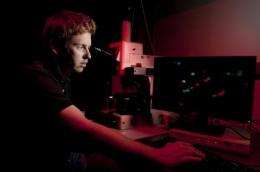
By sticking fluorescent compounds onto short strands of the molecules that form the backbone of DNA, the researchers have produced tiny sensor molecules that change color when they detect certain substances. The sensors were made using existing technology for synthesizing DNA, and are viewed with a fluorescence microscope.
The color changes enable the new sensors to convey far more information than most other existing optical sensors, which typically just detect one specific molecule, said Eric Kool, professor of chemistry and senior author of a paper published online this week in the German journal Angewandte Chemie.
"We were blown away by how strong the color changes were," Kool said. "One of the surprising findings was that we could tell the difference between four different organic vapors with just one sensor, because it would turn different colors with different vapors."
The key to Kool's versatile sensor molecules lies in the structure of DNA, the famous double helix that encodes the genetic blueprint for life, often described as looking like a twisted ladder. Two long parallel chains of sugar and phosphate molecules constitute the rails of the ladder, with the rungs made of pairs of molecules called bases. The arrangement of the bases, of which there are only four types, encodes the genetic data.
Kool's team of researchers developed a new set of fluorescent replacements for the DNA bases - seven different ones they could choose from - to attach to the DNA backbone of the new sensor in place of the usual four. They used only a single helix, so the bases project out from a single twisted pole, ready to detect organic vapors.
Florent Samain, a postdoctoral researcher in chemistry and lead author on the Angewandte Chemie paper, used DNA synthesis techniques to generate a library of all 2,401 possible ways that the seven substitute molecules could be combined in a string of four units.
The team then screened all the possible combinations for sensitivity to four different test substances - as vapors - that differed significantly in their structural and electronic properties.
One substance was commonly used as an aquatic herbicide, another as a solvent in research and industrial applications, another as an inhibitor of mold and bacteria in food and the fourth as an ingredient in products ranging from shoe polish to pesticides, as well as in the preparation of explosives.
The researchers found multiple sensors that showed marked fluorescent responses when exposed to the four test substances. "This is our first try with vapors and it ended up working really well," Kool said.
"What makes these sensors work exceptionally well is that the bases in DNA are stacked on one another, physically touching each other," he said. "DNA bases talk to one another, electronically."
That close physical contact also allows the compounds that Kool's group attaches to the DNA backbone to communicate with each other, which is crucial to their functionality.
What is also crucial, the researchers found out, is the order of the compounds along the DNA backbone. Like the sequence of natural DNA, which varies among different animals, the different sequences of the artificial DNA sensors gave different color changes.
"We saw a couple of examples where we had the same components, but in a different order and got a different response," Kool said. "So clearly they are talking to one another and whoever is next to someone else, it makes a difference."
"One of our long-term goals is to now build up a set of sensors for a much more complex range of possible substances for analysis," Kool said. "Because we get such a diversity of responses - even one molecule can tell the difference among four different things - we could have a set of 10 or 20, or 100 sensors, which would give a vast array of responses to many different kinds of molecules."
Having a large number of sensors available in a single device could broaden the application of the sensors from pure organic molecules such as the ones used in the tests to the many mixtures of molecules often encountered outside the laboratory.
Outside the lab is where the researchers see the DNA sensors being used most effectively. They hope to eventually pair their sensors with some type of portable device that would contain an inexpensive fluorescence microscope, which Kool says a number of other laboratories are already working on. One example - called the "CellScope" - was recently developed at the University of California-Berkeley.
The researchers still need to determine how small a quantity of any given substance the DNA sensors can detect.
"Another of our long-term goals is to print these sensors on plastic, and if the spots were big enough to see, you could see the color changes," Kool said. "You could hold a black light over the sensor and read the response. Then you could match up the color of the sensor with a key of some sort and say, 'Ah, this sensor best compares with this color on the key - this milk is about to go sour.'"
Kool said it might even be possible, with more research, to use the DNA sensors in liquids.
"To me, the most intriguing possibility is smelling differences that are biologically important," Kool said. "It could be smelling differences in cells that are related to disease or sensing toxins in the environment. Those are probably the most likely applications in the near future.
"We want to sense everything," Kool said. "That is our ultimate goal."
Provided by Stanford University


