Is the ice in the Arctic Ocean getting thinner and thinner?
August 20, 2010
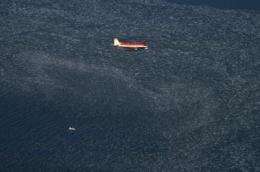
Polar 5 tows a probe for sea ice thickness measurements -- the so called EM-Bird -- on a test flight. Credit: Christian Haas, University of Alberta / Alfred Wegener Institute
The extent of the sea ice in the Arctic will reach its annual minimum in September. Forecasts indicate that it will not be as low as in 2007, the year of the smallest area covered by sea ice since satellites started recording such data. Nevertheless, sea ice physicists at the Alfred Wegener Institute are concerned about the long-term equilibrium in the Arctic Ocean.
They have indications that the mass of sea ice is dwindling because its thickness is declining. To substantiate this, they are currently measuring the ice thickness north and east of Greenland using the research aircraft Polar 5. The objective of the roughly one-week campaign is to determine the export of sea ice from the Arctic. Around a third to half of the freshwater export from the Arctic Ocean takes place in this way - a major drive factor in the global ocean current system.
The question of when the Arctic will be ice-free in the summer has been preoccupying the sea ice researchers headed by Prof. Dr. Rüdiger Gerdes from the Alfred Wegener Institute for Polar and Marine Research in the Helmholtz Association for a long time now. Satellites have been recording the extent of the Arctic ice for more than 30 years. In addition to the area covered, the thickness of the ice is a decisive factor in assessing how much sea ice there is.
However, the thickness can only be determined locally, for example by means of the so-called EM-Bird, an electromagnetic measuring device which helicopters or planes tow over the ice. For Gerdes this is a very special job because he usually models his forecasts on his home computer. The campaign with the research aircraft Polar 5 of the Alfred Wegener Institute now takes him on an expedition in the Arctic for the first time. "I'm very keen on seeing the results of the sea ice thickness measurements," says Gerdes. "Only when we know the distribution of ice of varying thickness, can we calculate how much freshwater is carried out of the Arctic Ocean via ice."
About 3000 cubic kilometres of ice drift out of the Arctic Ocean every year, corresponding to around 2700 billion tons. The ice exports freshwater that reaches the Arctic Ocean via rivers and precipitation. This maintains its salt concentration, which has been constant over the long term. The temperature rise observed worldwide is especially pronounced in the Arctic latitudes. Researchers have been observing that the ice is getting thinner and thinner for several years now.
As a result, it stores and exports less freshwater and the salt concentration (also referred to as salinity) of the Arctic Ocean declines. On the one hand, this influences all living things that have adapted to the local conditions. On the other hand, changes in salinity also have an impact on current patterns of global ocean circulation and thus on meridional heat transport. In the TIFAX (Thick Ice Feeding Arctic Export) measurement campaign the researchers are primarily interested in ice that is several years old, several metres thick and occurs predominantly on the northern coast of Greenland.
"Taking off on the measurement flights from Station Nord here is a special adventure," reports Gerdes from one of the northernmost measuring stations in the world. "Flying through virtually unsettled regions of the Arctic in the high-tech research aircraft is a stark contrast to my modelling work on the computer."
Provided by Helmholtz Association of German Research Centres (news : web)
-
How will the Arctic sea ice cover develop this summer?
Jul 09, 2008 |
not rated yet |
0
-
Arctic sea ice may be at 'tipping point'
Sep 16, 2005 |
not rated yet |
0
-
Higher Water Temperatures and Reduced Ice Cover In the Arctic Ocean
Aug 27, 2004 |
not rated yet |
0
-
By airship to the North Pole
Apr 12, 2007 |
not rated yet |
0
-
New method to estimate sea ice thickness
Mar 05, 2008 |
not rated yet |
0
-
Engineers build first sub-10-nm carbon nanotube transistor
Feb 01, 2012 |
4.9 / 5 (31) |
30
-
Something old, something new: Evolution and the structural divergence of duplicate genes
Jan 31, 2012 |
4.6 / 5 (7) |
1
-
The hidden nanoworld of ice crystals: Revealing the dynamic behavior of quasi-liquid layers
Jan 30, 2012 |
5 / 5 (3) |
1
-
Stock market network reveals investor clustering
Jan 27, 2012 |
3.9 / 5 (23) |
8
-
Of microchemistry and molecules: Electronic microfluidic device synthesizes biocompatible probes
Jan 26, 2012 |
5 / 5 (1) |
0
-
Discrepancy between oxygen and carbon-dioxide levels
Feb 09, 2012
-
where gems are found in the world
Feb 09, 2012
-
Wind Waves in Reservoir ~ Wind run-up and Wind set-up
Feb 08, 2012
-
Balance of oxygen in the atmosphere
Feb 01, 2012
-
The case for a methanol-based economy
Jan 30, 2012
-
Weather in a rotating cylinder
Jan 25, 2012
- More from Physics Forums - Earth
More news stories
Could Venus be shifting gear?
(PhysOrg.com) -- ESAs Venus Express spacecraft has discovered that our cloud-covered neighbour spins a little slower than previously measured. Peering through the dense atmosphere in the infrared, the ...
Space & Earth / Space Exploration
21 hours ago |
5 / 5 (7) |
8
|
Mars Science Laboratory computer issue resolved
(PhysOrg.com) -- Engineers have found the root cause of a computer reset that occurred two months ago on NASA's Mars Science Laboratory and have determined how to correct it.
Space & Earth / Space Exploration
22 hours ago |
4.7 / 5 (6) |
4
|
Two new moons for Jupiter
Advances in technology have lead to the discovery of new planets outside of our Solar System, and now even new moons in our own backyard.
Space & Earth / Space Exploration
21 hours ago |
4 / 5 (1) |
7
NASA sees wide-eyed cyclone Jasmine
Cyclone Jasmine's eye has opened wider on NASA satellite imagery, as it moves through the Southern Pacific Ocean.
Space & Earth / Earth Sciences
13 hours ago |
3.5 / 5 (2) |
2
Clam fields found at deep, low-temperature Mariana vents
(PhysOrg.com) -- Scientists have marveled at the unusual life forms thriving at high temperature hydrothermal vents of the deep ocean.
Space & Earth / Earth Sciences
21 hours ago |
4.3 / 5 (3) |
0
|
Anonymous knocks CIA website offline (Update)
The website of the Central Intelligence Agency was inaccessible on Friday after the hacker group Anonymous claimed to have knocked it offline.
New error-correcting codes guarantee the fastest possible rate of data transmission
Error-correcting codes are one of the triumphs of the digital age. Theyre a way of encoding information so that it can be transmitted across a communication channel such as an optical fiber o ...
Small modular reactor design could be a 'SUPERSTAR'
(PhysOrg.com) -- Though most of today's nuclear reactors are cooled by water, we've long known that there are alternatives; in fact, the world's first nuclear-powered electricity in 1951 came from a reactor ...
New power source discovered
(PhysOrg.com) -- Researchers at the Massachusetts Institute of Technology (MIT) and RMIT University have made a breakthrough in energy storage and power generation.
The power of estrogen -- male snakes attract other males
A new study has shown that boosting the estrogen levels of male garter snakes causes them to secrete the same pheromones that females use to attract suitors, and turned the males into just about the sexiest ...
Advanced power-grid model finds low-cost, low-carbon future in West
(PhysOrg.com) -- The least expensive way for the Western U.S. to reduce greenhouse gas emissions enough to help prevent the worst consequences of global warming is to replace coal with renewable and other ...
Aug 20, 2010
Rank: 2.1 / 5 (7)
Have the dairy farms in Greenland come out from under the glaciers yet? Are their vineyards in Scotland or Nova Scotia and Newfoundland?
Aug 21, 2010
Rank: 5 / 5 (3)
Dairy farms, but no bread or beer.
It must have been a hard life.
http://www.collec...2551.pdf
Aug 24, 2010
Rank: not rated yet
No. Whats your point.?
Because these things haven't happened, it doesn't mean they won't.
The earth is changing, we have to deal with it.
Sticking to some tired notion that you got from FOX News doesn't work in the real world.