Researchers develop a better way to grow stem cells
August 22, 2010
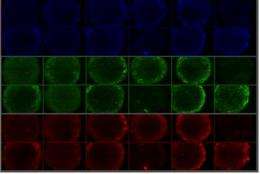
This image shows human embryonic stem cells grown on a synthetic surface developed by MIT researchers. The cells at top (blue) are stained to reveal their nuclei, while the cells in the middle and bottom are stained for proteins that are known to be present when cells are pluripotent. Green cells are stained for Oct4 (using green fluorescent protein) and red cells are stained for SSEA-4. Credit: Ying Mei, Krishanu Saha, Robert Langer, Rudolf Jaenisch, and Daniel G. Anderson
Human pluripotent stem cells, which can become any other kind of body cell, hold great potential to treat a wide range of ailments, including Parkinson's disease, multiple sclerosis and spinal cord injuries. However, scientists who work with such cells have had trouble growing large enough quantities to perform experiments -- in particular, to be used in human studies. Furthermore, most materials now used to grow human stem cells include cells or proteins that come from mice embryos, which help stimulate stem-cell growth but would likely cause an immune reaction if injected into a human patient.
To overcome those issues, MIT chemical engineers, materials scientists and biologists have devised a synthetic surface that includes no foreign animal material and allows stem cells to stay alive and continue reproducing themselves for at least three months. It's also the first synthetic material that allows single cells to form colonies of identical cells, which is necessary to identify cells with desired traits and has been difficult to achieve with existing materials.
The research team, led by Professors Robert Langer, Rudolf Jaenisch and Daniel G. Anderson, describes the new material in the Aug. 22 issue of Nature Materials. First authors of the paper are postdoctoral associates Ying Mei and Krishanu Saha.
Human stem cells can come from two sources — embryonic cells or body cells that have been reprogrammed to an immature state. That state, known as pluripotency, allows the cells to develop into any kind of specialized body cells.
It also allows the possibility of treating nearly any kind of disease that involves injuries to cells. Scientists could grow new neurons for patients with spinal cord injuries, for example, or new insulin-producing cells for people with type 1 diabetes.
To engineer such treatments, scientists would need to be able to grow stem cells in the lab for an extended period of time, manipulate their genes, and grow colonies of identical cells after they have been genetically modified. Current growth surfaces, consisting of a plastic dish coated with a layer of gelatin and then a layer of mouse cells or proteins, are notoriously inefficient, says Saha, who works in Jaenisch's lab at the Whitehead Institute for Biomedical Research.
"For therapeutics, you need millions and millions of cells," says Saha. "If we can make it easier for the cells to divide and grow, that will really help to get the number of cells you need to do all of the disease studies that people are excited about."
Previous studies had suggested that several chemical and physical properties of surfaces — including roughness, stiffness and affinity for water — might play a role in stem-cell growth. The researchers created about 500 polymers (long chains of repeating molecules) that varied in those traits, grew stem cells on them and analyzed each polymer's performance. After correlating surface characteristics with performance, they found that there was an optimal range of surface hydrophobicity (water-repelling behavior), but varying roughness and stiffness did not have much effect on cell growth.
They also adjusted the composition of the materials, including proteins embedded in the polymer. They found that the best polymers contained a high percentage of acrylates, a common ingredient in plastics, and were coated with a protein called vitronectin, which encourages cells to attach to surfaces.
Using their best-performing material, the researchers got stem cells (both embryonic and induced pluripotent) to continue growing and dividing for up to three months. They were also able to generate large quantities of cells — in the millions.
The MIT researchers hope to refine their knowledge to help them build materials suited to other types of cells, says Anderson, from the MIT Department of Chemical Engineering, the Harvard-MIT Division of Health Sciences and Technology, and the David H. Koch Institute for Integrative Cancer Research. "We want to better understand the interactions between the cell, the surface and the proteins, and define more clearly what it takes to get the cells to grow," he says.
More information: "Combinatorial development of biomaterials for clonal growth of human pluripotent stem cells" by Ying Mei, Krishanu Saha, Said R. Bogatyrev, Jing Yang, Andrew L. Hook, Z. Ilke Kalcioglu, Seung-Woo Cho, Maisam Mitalipova, Neena Pyzocha, Fredrick Rojas, Krystyn J. Van Vliet, Martyn C. Davies, Morgan R. Alexander, Robert Langer, Rudolf Jaenisch and Daniel G. Anderson. Nature Materials, 22 August, 2010.
Provided by Massachusetts Institute of Technology (news : web)
-
Embryonic stem cells can kill cancer cells
Oct 11, 2005 |
not rated yet |
0
-
Mature B cells reprogrammed to stem-cell-like state
Apr 17, 2008 |
not rated yet |
0
-
Sweet success for new stem cell ID trick
Nov 20, 2008 |
not rated yet |
0
-
Study: Skin cells turned into stem cells
Aug 22, 2005 |
not rated yet |
0
-
Researchers Grow Neural, Blood Vessel Cells from Adult Stem Cells
Sep 18, 2006 |
not rated yet |
0
-
Engineers build first sub-10-nm carbon nanotube transistor
Feb 01, 2012 |
4.9 / 5 (31) |
30
-
Something old, something new: Evolution and the structural divergence of duplicate genes
Jan 31, 2012 |
4.6 / 5 (7) |
1
-
The hidden nanoworld of ice crystals: Revealing the dynamic behavior of quasi-liquid layers
Jan 30, 2012 |
5 / 5 (3) |
1
-
Stock market network reveals investor clustering
Jan 27, 2012 |
3.9 / 5 (23) |
8
-
Of microchemistry and molecules: Electronic microfluidic device synthesizes biocompatible probes
Jan 26, 2012 |
5 / 5 (1) |
0
-
Stoichiometry
Feb 10, 2012
-
Boiling and melting point of impure substances
Feb 10, 2012
-
Safe nitrogen compound to decompose a 500 deg C in a furnace?
Feb 09, 2012
-
[ask]electron inside drinking water
Feb 08, 2012
-
How to avoid formation of Lithium Chromate ???
Feb 08, 2012
-
how to choose a reduced or oxidated form in a redox
Feb 08, 2012
- More from Physics Forums - Chemistry
More news stories
Fool's gold may prove an unlikely alternative to overexploited catalytic materials
Catalytic materials, which lower the energy barriers for chemical reactions, are used in everything from the commercial production of chemicals to catalytic converters in car engines. However, with current catalytic materials ...
18 hours ago |
4.4 / 5 (8) |
6
|
Unpicking HIV’s invisibility cloak
Drug researchers hunting for alternative ways to treat human immunodeficiency virus (HIV) infections may soon have a novel targetits camouflage coat. HIV hides inside a cloak unusually rich in a sugar ...
18 hours ago |
5 / 5 (5) |
0
Hydrogen from acidic water: Researchers develop potential low cost alternative to platinum for splitting water
A technique for creating a new molecule that structurally and chemically replicates the active part of the widely used industrial catalyst molybdenite has been developed by researchers with the Lawrence Berkeley ...
Feb 09, 2012 |
4.8 / 5 (14) |
15
|
No entry without protein recycling: Researchers discover new coherence in enzyme transport
The group of Prof. Dr. Ralf Erdmann at the Ruhr-Universität Bochum, Germany, discovered a connection of peroxisomal protein import and receptor export. In the Journal of Biological Chemistry, they disclo ...
18 hours ago |
not rated yet |
0
Under the microscope #7
In this video Dr Ingrid Graz shows us a thin layer of gold on top of rubber. Cracks in the gold allow it to stretch and we can use this for stretchable electronics.
20 hours ago |
not rated yet |
0
Anonymous knocks CIA website offline (Update)
The website of the Central Intelligence Agency was inaccessible on Friday after the hacker group Anonymous claimed to have knocked it offline.
New error-correcting codes guarantee the fastest possible rate of data transmission
Error-correcting codes are one of the triumphs of the digital age. Theyre a way of encoding information so that it can be transmitted across a communication channel such as an optical fiber o ...
Humans may have helped the decline of African rainforests 3000 years ago
(PhysOrg.com) -- Large areas of rainforests in Central Africa mysteriously disappeared over three thousand years ago, to be replaced by savannas. The prevailing theory has been that the cause was a change ...
New power source discovered
(PhysOrg.com) -- Researchers at the Massachusetts Institute of Technology (MIT) and RMIT University have made a breakthrough in energy storage and power generation.
Small modular reactor design could be a 'SUPERSTAR'
(PhysOrg.com) -- Though most of today's nuclear reactors are cooled by water, we've long known that there are alternatives; in fact, the world's first nuclear-powered electricity in 1951 came from a reactor ...
Google users warned of threat to smartphone wallets
Users of Google smartphone wallets were being warned on Friday that there is a way to crack pass codes intended to thwart thieves from going on illicit shopping sprees.