Solar System older than thought
August 22, 2010
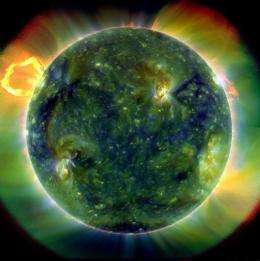
A full-disk multiwavelength extreme ultraviolet image of the sun taken by the Solar Dynamics Observatory (SDO) on March 30, 2010 and released by NASA on April 21, 2010. The Solar System could be nearly two million years older than thought, according to a study published on Sunday by the journal Nature Geoscience.
The Solar System could be nearly two million years older than thought, according to a study published on Sunday by the journal Nature Geoscience.
The evidence comes from a 1.49-kilo (3.2-pound) meteorite, found in the Moroccan desert in 2004, that contains a "relict" mineral, which is one of the oldest solid materials formed after the birth of the Sun.
Analysis of lead isotopes suggest the mineral was formed 4.45682 billion years ago, making the meteorite the oldest object ever found.
As a result, the Solar System is likely to be between 300,000 and 1.9 million years older than previous estimates, says the paper, authored by Audrey Bouvier and Meenakshi Wadhwa of Arizona State University's the Center for Meteorite Studies.
More information: Bouvier, A. & Wadhwa, M. Nature Geosci. advance online publication doi:10.1038/NGEO941 (2010).
(c) 2010 AFP
-
One-of-a-kind meteorite unveiled
Apr 22, 2006 |
not rated yet |
0
-
Chemical snapshot: Murchison meteorite reveals diversity of early Solar System
Feb 17, 2010 |
not rated yet |
0
-
Meteorite grains divulge Earth's cosmic roots
Jun 15, 2009 |
not rated yet |
0
-
Unusual meteorite found by time-lapse camera observatory
Nov 05, 2009 |
not rated yet |
0
-
In Brief: Second meteorite in a month hits Norway
Jul 11, 2006 |
not rated yet |
0
-
Engineers build first sub-10-nm carbon nanotube transistor
Feb 01, 2012 |
4.9 / 5 (31) |
30
-
Something old, something new: Evolution and the structural divergence of duplicate genes
Jan 31, 2012 |
4.6 / 5 (7) |
1
-
The hidden nanoworld of ice crystals: Revealing the dynamic behavior of quasi-liquid layers
Jan 30, 2012 |
5 / 5 (3) |
1
-
Stock market network reveals investor clustering
Jan 27, 2012 |
3.9 / 5 (23) |
8
-
Of microchemistry and molecules: Electronic microfluidic device synthesizes biocompatible probes
Jan 26, 2012 |
5 / 5 (1) |
0
-
Titan's lack of impact craters
Feb 09, 2012
-
Real pictures of black hole eating a star?
Feb 08, 2012
-
Hypothetical way to travel faster than light, but not technically exceed lightspeed
Feb 06, 2012
-
How do scientists monitor the Sun's activity?
Feb 05, 2012
-
Search patterns in observational studies
Feb 05, 2012
-
Derivation of Pogson's law
Feb 03, 2012
- More from Physics Forums - General Astronomy
More news stories
Could Venus be shifting gear?
(PhysOrg.com) -- ESAs Venus Express spacecraft has discovered that our cloud-covered neighbour spins a little slower than previously measured. Peering through the dense atmosphere in the infrared, the ...
Space & Earth / Space Exploration
5 hours ago |
5 / 5 (5) |
7
|
Humans may have helped the decline of African rainforests 3000 years ago
(PhysOrg.com) -- Large areas of rainforests in Central Africa mysteriously disappeared over three thousand years ago, to be replaced by savannas. The prevailing theory has been that the cause was a change ...
Mars Science Laboratory computer issue resolved
(PhysOrg.com) -- Engineers have found the root cause of a computer reset that occurred two months ago on NASA's Mars Science Laboratory and have determined how to correct it.
Space & Earth / Space Exploration
6 hours ago |
5 / 5 (5) |
3
|
Clam fields found at deep, low-temperature Mariana vents
(PhysOrg.com) -- Scientists have marveled at the unusual life forms thriving at high temperature hydrothermal vents of the deep ocean.
Space & Earth / Earth Sciences
5 hours ago |
not rated yet |
0
|
Two new moons for Jupiter
Advances in technology have lead to the discovery of new planets outside of our Solar System, and now even new moons in our own backyard.
Space & Earth / Space Exploration
5 hours ago |
not rated yet |
2
Putting the squeeze on planets outside our solar system
(PhysOrg.com) -- Using high-powered lasers, scientists at Lawrence Livermore National Laboratory and collaborators discovered that molten magnesium silicate undergoes a phase change in the liquid state, abruptly ...
Employers feel no love for unscrupulous practice of 'service sweethearting'
A new study led by two Florida State University marketing professors finds that some frontline service employees who are rewarded for hikes in customer loyalty and satisfaction also may engage in "service ...
US issues guidelines to avoid heparin contamination
Four years after US drug-maker Baxter International's blood thinner heparin was contaminated in China, causing dozens of deaths, US regulators on Friday issued draft guidelines for safe production.
Expat French get Internet vote for first time
French citizens will for the first time this year be able to vote in a parliamentary election over the Internet, an experiment that could be extended to other elections if successful.
"Twisted Metal" gamers get shot at real gunplay
Fans of "Twisted Metal" will get to welcome a long-awaited sequel of the car-battle videogame with a real-world bang by blasting an ice cream truck to bits with a machine gun.
The power of estrogen -- male snakes attract other males
A new study has shown that boosting the estrogen levels of male garter snakes causes them to secrete the same pheromones that females use to attract suitors, and turned the males into just about the sexiest ...
Aug 22, 2010
Rank: 1 / 5 (1)
Aug 22, 2010
Rank: 4.4 / 5 (7)
Aug 22, 2010
Rank: 1 / 5 (5)
Aug 22, 2010
Rank: 5 / 5 (4)
...from a dim fuzzy shapeless mass a gas...how one can say that mass has separated from the original (the Sun is a second generation star-it has "metals"-, or third, of fourth?) mother cloud and then start the clock!
Aug 22, 2010
Rank: 2.1 / 5 (8)
In truth, one can never be sure of anything where eye witness account is not part of the data proof. Nevertheless, consider this, ANYTHING within our solar system from another solar system BEFORE the sun exploded, would have had to have travelled truly astronomical distances to arrive here. Without FTL-Speeds, 300,000 to 1.9 Million years is not enough time to get here-back then...it would be getting here in our future..dig?
First the birth of the Sun and all our planets witnesses extraordinary energy release that hurled more stuff 'out' than it could ever possibly have 'taken in.'
Radiation: subatomic energetics would have WHITEWASHED so-to-speak many small macrobodies essentially 'resetting' their birthdates -follow me here?
nuff' said.
Aug 22, 2010
Rank: 3 / 5 (4)
EXCELLENT question, and the answer is IN the question :-)
The dust that made our sun and the planets was the material hurled from the star(s) that died before it and the ejecta from Black Holes- metals are produced as a star ages. Our earth has metals, some of the other planets in our system do NOT, ergo Jupiter for example is an unburnt star, waiting to show humanity just what kind of gases were present when it/we were made! As the fusion engine of our sun burns , we can calculate the RATE at which Hydrogen is being consumed,and due to the laws of physics and chemistry, we can deduce very accurate rates and changes in fusion levels and 'poison' by products.
Aug 22, 2010
Rank: 5 / 5 (2)
Aug 22, 2010
Rank: 1.7 / 5 (3)
That is because star systems are very isolated from each other in terms of distance. Also big amounts of dense matter(such as meteorites) are formed in stars only. So there is an astonishingly low chance for alien meteorites to come to Earth.
Aug 22, 2010
Rank: 2.5 / 5 (4)
It may be not THAT important, but the whole science is a sum of such discoveries. What is really important is the trend, there may be larger corrections in the future.
Aug 22, 2010
Rank: 1.8 / 5 (5)
Aug 22, 2010
Rank: 1 / 5 (5)
There is no doubt that the question is important. The composition of the sample may suggest its origin.
Aug 22, 2010
Rank: 5 / 5 (5)
Aug 23, 2010
Rank: 5 / 5 (3)
I for one was pretty sure the margin of error in any estimates was a lot greater than 2 million years.
And since all the material in the solar system had to come from some other star or stars the consensus is that all this material arrived here as individual molecules.
This may not be the case for every single molecule though. Surely some parts of the solar system would have coalesced before the rest. Surely there would have been some planetoids or comet sized bits before the formation of the sun. Estimating the age of solar system then has to take into account some arbitrary agreed start time.
Aug 23, 2010
Rank: not rated yet
Well, I don't see any trend here but another measurement confirming the previously published data.
Aug 23, 2010
Rank: not rated yet
I suspect the solar system will be older and older in scientists' view. That's what i kept in mind.
Aug 23, 2010
Rank: 1 / 5 (2)
Things really get very strange indeed once you start asking questions about this.
Where did that star/stars come from? How did they first appear on the scene? Remember that the big bang dictates an inflationary period in which all matter was smoothed out so how did the first clumps form from a extremely high velocity [greater than the speed of light?] outward radial movement?
Since stars only produce Iron before going into decline, where did the lead come from? So if that meteorite is as old as the solar system itself, it wouldn't have been able to have formed inside the solar system itself.
Correct me if I'm wrong, here.
Aug 23, 2010
Rank: 5 / 5 (3)
And we KNOW that the solar system is 4,456,820,000 years old.
Aug 29, 2010
Rank: not rated yet
Aug 29, 2010
Rank: not rated yet
Aug 29, 2010
Rank: 1.7 / 5 (6)
Once we thought the earth was flat and that we were at the center of it it all as it revolved around us.
Seems rather strange we are still clinging to the notion that the Sun is just a ball of Hydrogen considering it is because of observations made in the time of Galileo.
Our tools have gotten a bit better since then but it takes a great deal of evidence to overturn dogma it seems.
Aug 29, 2010
Rank: 4 / 5 (4)
Aug 30, 2010
Rank: 5 / 5 (1)
It alters nothing of consequence.
Aug 30, 2010
Rank: 1 / 5 (3)
http://www.thesur...sun.com/
Aug 30, 2010
Rank: 5 / 5 (3)
Aug 30, 2010
Rank: 5 / 5 (4)