Antibiotic may reduce stroke risk and injury in diabetics
August 23, 2010
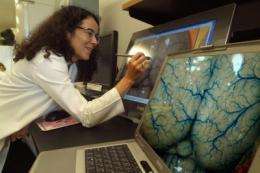
Dr. Adviye Ergul, physiologist at the Medical College of Georgia, is finding a daily dose of an old antibiotic can help diabetics avoid a stroke or at least minimize its damage. Credit: Phil Jones, Campus Photographer
A daily dose of an old antibiotic may help diabetics avoid a stroke or at least minimize its damage, Medical College of Georgia researchers report.
Minocycline, a drug already under study at MCG for stroke treatment, may help diabetics reduce remodeling of blood vessels in the brain that increases their stroke risk and help stop bleeding that often follows a stroke, said Dr. Adviye Ergul, physiologist in the MCG Schools of Medicine and Graduate Studies.
"We know that diabetes is bad and that diabetics have more strokes and that when they have a stroke they do more poorly," said Ergul, corresponding author on the study published in the Journal of Cerebral Blood Flow and Metabolism. Nearly 70 percent of the estimated 24 million Americans with diabetes list a major vascular event such as a stroke or heart attack as a cause of death, according to the American Diabetes Association.
To figure out why, the researchers focused on the blood vessels of diabetic rats, finding that even moderately elevated blood glucose levels can result in thicker, twisted blood vessels that tend to leak, resulting in the bleeding that can follow a stroke. Clot-based strokes are the most common type while hemorrhagic strokes tend to be most lethal. But diabetics are at risk for a sort of combination in which a clot causes the stroke and leaking from the blood vessels follows - called hemorrhagic transformation - a scenario that can dramatically worsen the stroke's effect, Ergul said.
Much of the bad vascular remodeling that occurs in diabetes results from elevated glucose activating matrix metalloproteinases or MMPs. "They break down things and allow for cells to move so blood vessels change shape," Ergul said. They also destroy the basement membrane of blood vessels, allowing the destructive bleeding that often follows a diabetic stroke. On the good side, MMPs help clean up damage to enable repair and recovery.
One way minocycline works is by blocking MMPs. Less directly, diabetes drugs like metformin, used to lower blood sugar, also reduce MMP levels.
Another MCG research team, led by Dr. David Hess, stroke specialist and chairman of the Department of Neurology, is showing that minocycline given alone or with tPA, the clot dissolver that is the only FDA-approved stroke treatment, can also work after a stroke to help minimize damage. One great synergy about the pair is that tPA increases bleeding risk and minocycline decreases it.
That could particularly benefit diabetics who already are at increased risk for bleeding, particularly when oxygen is restored to that area of the brain. This damage - called a reperfusion injury - is a primary reason that a diabetic stroke may look small on a magnetic resonance image but can have a devastating, effect, Ergul also has found.
Some of her next studies will include giving both tPA and minocycline to diabetic rats to study bleeding and the impact of the two drugs on blood vessels, particularly the tiny ones that are tightly connected to brain cells.
Provided by Medical College of Georgia
-
Old antibiotic may find new life as a stroke treatment
May 19, 2008 |
not rated yet |
0
-
Leukemia drug could save lives of stroke patients
Jun 22, 2008 |
not rated yet |
0
-
High blood pressure after stroke should not necessarily rule out use of clot-busting treatment
Sep 08, 2008 |
not rated yet |
0
-
Smoking and high blood pressure: a double blow for bleeding stroke risk
Mar 06, 2008 |
not rated yet |
0
-
Gastrointestinal bleeding after stroke may increase risk of death
Aug 06, 2008 |
not rated yet |
0
-
Engineers build first sub-10-nm carbon nanotube transistor
Feb 01, 2012 |
4.9 / 5 (31) |
30
-
Something old, something new: Evolution and the structural divergence of duplicate genes
Jan 31, 2012 |
4.6 / 5 (7) |
1
-
The hidden nanoworld of ice crystals: Revealing the dynamic behavior of quasi-liquid layers
Jan 30, 2012 |
5 / 5 (3) |
1
-
Stock market network reveals investor clustering
Jan 27, 2012 |
3.9 / 5 (23) |
8
-
Of microchemistry and molecules: Electronic microfluidic device synthesizes biocompatible probes
Jan 26, 2012 |
5 / 5 (1) |
0
-
Is Everyday Technology Killing Us?
Feb 08, 2012
-
Exercise and weight loss
Feb 08, 2012
-
Why do we have head aches? Our brains can't feel anything.
Feb 07, 2012
-
"The end of diseases" by David Agus, interview from Daily Show with Jon Stewart
Feb 04, 2012
-
Oncolytic adenovirus
Feb 04, 2012
-
Nutrition label stuffs and diets
Feb 02, 2012
- More from Physics Forums - Medical Sciences
More news stories
Complex wiring of the nervous system may rely on a just a handful of genes and proteins
Researchers at the Salk Institute have discovered a startling feature of early brain development that helps to explain how complex neuron wiring patterns are programmed using just a handful of critical genes. ...
11 hours ago |
4.9 / 5 (9) |
1
|
Team isolates nerve cells involved in storing long term memory and gene proteins associated with them
(Medical Xpress) -- A research team in Taiwan has succeeded in isolating two nerve cells in fruit fly brains that are believed to be the major players in allowing for the formation of long term memories. Furthermore, ...
Seeing colors in music, tasting flavors in shapes may happen in life's early months
Famed violinist Itzhak Perlman sees a deep forest green whenever he plays a B-flat on his Stradivarius' G string. The A on the E string is red.
Medicine & Health / Psychology & Psychiatry
18 hours ago |
4.5 / 5 (2) |
2
|
Both maternal and paternal age linked to autism
Older maternal and paternal age are jointly associated with having a child with autism, according to a recently published study led by researchers at The University of Texas Health Science Center at Houston (UTHealth).
Medicine & Health / Psychology & Psychiatry
15 hours ago |
4.3 / 5 (3) |
0
|
New understanding of DNA repair could eventually lead to cancer therapy
A research group in the Faculty of Medicine & Dentistry at the University of Alberta is hoping its latest discovery could one day be used to develop new therapies that target certain types of cancers.
15 hours ago |
4.8 / 5 (6) |
0
|
Anonymous knocks CIA website offline (Update)
The website of the Central Intelligence Agency was inaccessible on Friday after the hacker group Anonymous claimed to have knocked it offline.
New error-correcting codes guarantee the fastest possible rate of data transmission
Error-correcting codes are one of the triumphs of the digital age. Theyre a way of encoding information so that it can be transmitted across a communication channel such as an optical fiber o ...
Humans may have helped the decline of African rainforests 3000 years ago
(PhysOrg.com) -- Large areas of rainforests in Central Africa mysteriously disappeared over three thousand years ago, to be replaced by savannas. The prevailing theory has been that the cause was a change ...
Google users warned of threat to smartphone wallets
Users of Google smartphone wallets were being warned on Friday that there is a way to crack pass codes intended to thwart thieves from going on illicit shopping sprees.
New power source discovered
(PhysOrg.com) -- Researchers at the Massachusetts Institute of Technology (MIT) and RMIT University have made a breakthrough in energy storage and power generation.
The power of estrogen -- male snakes attract other males
A new study has shown that boosting the estrogen levels of male garter snakes causes them to secrete the same pheromones that females use to attract suitors, and turned the males into just about the sexiest ...
Aug 23, 2010
Rank: 1 / 5 (1)
Both metformin and minocycline affect iron.
"Three tetracyclines (tetracycline, doxycycline, and minocycline) were found to possess iron-chelating activity in a colorimetric siderophore assay"
"Does metformin improve polycystic ovary syndrome symptoms through reduction in body iron stores?"