Math from the heart: Simulating stent design and coating
August 23, 2010
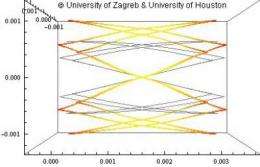
This simpler computer model simulates stents just as accurately as the more complex 3-D models. Credit: S. Canic, M. Kosor and J. Tambaca, University of Houston and University of Zagreb
Suncica "Sunny" Canic was good at math in school, so that's what she pursued as a career. But she always liked medicine, too. When she moved to Houston, Texas, and met some cardiologists at a party, she started talking with them about what they do -- and knew she could help them.
"I realized we could provide them with a fluid dynamics and mechanics point of view to help them make decisions about, for example, which stent grafts they use in their procedures," she says.
Stents are tiny mesh tubes made from metal alloys that hold blood vessels open after they've been clogged with disease-causing plaque. Even though stents are designed to be compatible with the human body, they sometimes cause unwanted reactions, such as blood clots and scar tissue formation. So scientists have tried to coat stents with cells that make the tiny tubes even more compatible.
But these, too, aren't yet perfect, says Canic. Blood flowing over a coated stent can still clot or tear cells away. This is, as Canic puts it, "not good."
This video is not supported by your browser at this time.
University of Houston mathematician "Sunny" Canic builds computer models to study stents -- tiny mesh tubes used to hold blood vessels open. Her simulations could improve patients' health by helping manufacturers optimize stent design and helping doctors choose the best stent for a specific procedure. Credit: Produced by Stephanie Dutchen/ National Institute of General Medical Sciences, National Institutes of Health
A professor of mathematics at the University of Houston, Canic makes computer models to guide the search for a better stent coating. She also uses computer models to study the strengths and weaknesses of different stent structures. Supported by a joint grant from the National Institute of General Medical Sciences, part of the National Institutes of Health, and the National Science Foundation, her work could help manufacturers optimize stent design and help doctors choose the right stents for their patients, ultimately improving patient outcomes.Computer scientists usually model stents in three dimensions. Keeping track of about 200,000 points, or nodes, along the stent mesh, the models are massive. Together with a collaborator at the University of Zagreb in Croatia, Canic wrote a much simpler program that approximates stents as meshes of one-dimensional rods. It let them achieve the same result using just 400 nodes.
Using their simplified model, Canic and her collaborator have examined the designs of several stents on the market to see which structures seem to be best for specific blood vessels or procedures. For instance, they found that stents with an "open design"—where every other horizontal rod is taken out—bend easily, which makes them good to put in curvy coronary arteries.
Canic has also used the model to design a stent with mechanical properties specifically tailored to an experimental heart valve replacement procedure. She found that this specialized stent works best for the procedure when it's stiff in the middle and less stiff at the ends.
And she has found that combining bendiness with radial stiffness—where you can bend the stent into a U shape, but you can't squeeze the tube shut—produces a stent with less chance of buckling than those that are currently in use.
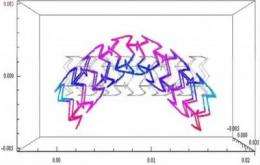
Computer models show the varying flexibility of different stent designs. Credit: S. Canic, M. Kosor and J. Tambaca, University of Houston and University of Zagreb
The most rewarding part of her work, says Canic, is that "we can use mathematics for something useful, connected to real-world problems." She reports that her collaborators are already putting the results of her simulations into practice.Her greatest challenge, meanwhile, is serving as an ambassador of mathematics to the medical and bioengineering communities.
In the beginning, she says, it was difficult to collaborate with people from different disciplines who speak different scientific languages. "But once they saw that there is a lot of information there that could be helpful, it has been much easier," she says. "Now people want to talk to us from the medical center. They come to us and ask questions, and that's good."
Today, Canic is helping a team at the Texas Heart Institute study an unusual source for stent coating: ear cartilage. The team believes this easy-to-harvest tissue will make stents more biocompatible, though they don't yet know how ear cartilage cells grow or behave in environments like human blood vessels.
So Canic is using her computer programs to simulate how blood interacts with the stent-coating cartilage cells and how the cells stick (or don't) to the stent surface. She plugs in different fluid thicknesses and shear forces of blood flowing over the stent to see what might encourage the cartilage on freshly coated stents to stabilize quickly. The models have helped her collaborators home in on the best conditions to test in follow-up experiments as they search for ways to pre-treat stents before doctors implant them.
Canic wants to keep collaborating with the medical community as she moves forward with her research. She plans to look at biodegradable stents, as well as simulate the fluid dynamics of regurgitating mitral valves (where some blood flows backwards in the pumping heart) to help doctors more accurately diagnose the condition using ultrasound.
"Certainly I am going to continue working in this area," she says. "It is very rewarding."
Provided by National Institutes of Health
-
Boston Scientific admits stent risks
Sep 07, 2006 |
not rated yet |
0
-
Drug-coated stents less risky for heart bypass patients
Jan 22, 2009 |
not rated yet |
0
-
Model predicts how to build a better stent
Jan 06, 2009 |
not rated yet |
0
-
New computer model could lead to safer stents
Dec 02, 2009 |
not rated yet |
0
-
New computer model could lead to safer stents
Dec 07, 2009 |
not rated yet |
0
-
Engineers build first sub-10-nm carbon nanotube transistor
Feb 01, 2012 |
4.9 / 5 (30) |
30
-
Something old, something new: Evolution and the structural divergence of duplicate genes
Jan 31, 2012 |
4.6 / 5 (7) |
1
-
The hidden nanoworld of ice crystals: Revealing the dynamic behavior of quasi-liquid layers
Jan 30, 2012 |
5 / 5 (3) |
1
-
Stock market network reveals investor clustering
Jan 27, 2012 |
3.9 / 5 (23) |
8
-
Of microchemistry and molecules: Electronic microfluidic device synthesizes biocompatible probes
Jan 26, 2012 |
5 / 5 (1) |
0
-
A discrete logarithm Question
10 hours ago
-
What does it mean to solve a problem 'analytically'?
11 hours ago
-
Heisenberg Nilpotent Lie Group
12 hours ago
-
Operator precedence for: 1/-2/3
16 hours ago
-
simple question about nth-roots of negative numbers
17 hours ago
-
Is the square of a function always positive
17 hours ago
- More from Physics Forums - General Math
More news stories
Chilean miners' rescue capsule on show in London
The capsule used to rescue Chilean miners trapped underground for two months goes on display Saturday at the Science Museum in London -- the first time it has been seen in Europe.
17 minutes ago |
not rated yet |
0
A frank discussion of the power law and linking correlation to causation
(PhysOrg.com) -- Michael Stumpf a mathematics professor at Imperial College in London, and Mason Porter a lecturer at Oxford have teamed together to write and publish a perspective piece in Science regarding the in ...
The question of life in the ancient world
Theres a general feeling that we dont get the Greeks ancient or modern. Many, including heads of state like Angela Merkel, visibly shake their head in exasperation, rightly or wrongly, at ...
Other Sciences / Archaeology & Fossils
1 hour ago |
not rated yet |
2
Soccer -- the link between managers and captains
Soccer managers regard their captains as an extension of themselves, according to new research from Northumbria University, which could explain why Fabio Capello quit as England manager following the FA row ...
1 hour ago |
not rated yet |
0
US workers are 'giving away the store,' costing firms billions
Nearly 70 percent of the nation's service employees give away free goods and services from hamburgers to cable TV costing companies billions of dollars a year, according to a groundbreaking study.
Other Sciences / Economics & Business
19 hours ago |
4.5 / 5 (2) |
8
The power of estrogen -- male snakes attract other males
A new study has shown that boosting the estrogen levels of male garter snakes causes them to secrete the same pheromones that females use to attract suitors, and turned the males into just about the sexiest ...
Clam fields found at deep, low-temperature Mariana vents
(PhysOrg.com) -- Scientists have marveled at the unusual life forms thriving at high temperature hydrothermal vents of the deep ocean.
Seeing colors in music, tasting flavors in shapes may happen in life's early months
Famed violinist Itzhak Perlman sees a deep forest green whenever he plays a B-flat on his Stradivarius' G string. The A on the E string is red.
Could Venus be shifting gear?
(PhysOrg.com) -- ESAs Venus Express spacecraft has discovered that our cloud-covered neighbour spins a little slower than previously measured. Peering through the dense atmosphere in the infrared, the ...
Team isolates nerve cells involved in storing long term memory and gene proteins associated with them
(Medical Xpress) -- A research team in Taiwan has succeeded in isolating two nerve cells in fruit fly brains that are believed to be the major players in allowing for the formation of long term memories. Furthermore, ...
Is that sleepiness during pregnancy normal or a sign of sleep apnea?
(Medical Xpress) -- Most pregnant women complain of being tired. Some of them however, could be suffering more than normal fatigue associated with their pregnancy; they may have developed obstructive sleep apnea (OSA), a ...
