German researchers demonstrate rocking movement in the anti-stress protein Hsp90
August 23, 2010
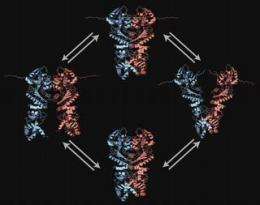
The protein Hsp90 plays a significant role in the survival of cells that are exposed to stress. Researchers at the Technische Universitaet Muenchen (TUM) uncovered this protein's mode of operation some time ago - but now Hsp90 has surprised even the experts with an unexpected pattern of motion. The results are published in the current online issue of the renowned science journal PNAS and may help researchers discover specific cancer medication.
This video is not supported by your browser at this time.
This is a schematic animation of the dynamics of Hsp90 about 5 times speed up. The first part is without nucleotide, then with ATP bound, and finally in the ADP bound state. Movie by W. Schürmann, Medienlabor, TUM
Proteins are the motors of the cell: They transport, among other things, nutrients, move our muscles, convert substances chemically or fold other proteins. The so-called heat shock protein Hsp90 is eminently important for our cells since it plays a decisive role in many basic processes - in humans as well as in bacteria or yeasts. For example, it is decisive in folding polypeptide chains into functioning proteins with very precisely defined spatial structures. Especially when cells are exposed to stress through heat or poisonous substances, Hsp90 production increases to keep the damage in check.The anti-stress protein is a dimer (which consists of two identical proteins) and can be roughly divided into three segments: the N terminal domain at the top, the middle domain and the C terminal at the bottom. Hsp90 taps the energy it requires for its work from the slow splitting of ATP, the fuel of every cell. In this process, the two strands move in opposing directions, albeit only a few nanometers. The TUM groups of Prof. Thorsten Hugel from the Department of Physics and Prof. Johannes Buchner from the Department of Chemistry are quite familiar with the movement of Hsp90: They were the first to observe the scissor-like movement in real-time. Yet even they were caught off guard: Instead of the familiar one-ended scissor movement at the N terminal domains they were now observing the rocking movement at both ends of the protein.
Hsp90 opens and closes in a scissors-like manner at the C terminal as well - something hitherto unknown in dimers. The researchers relied on the so-called FRET technology (FRET = Förster Resonance Energy Transfer) in their new study. They attached two fluorescent molecules at precisely defined positions in the Hsp90 and used these as a molecular ruler: When one pigment is illuminated, the other glows with increasing intensity the closer the two pigments get to each other. Using this effect, they were able to observe the nanometer-scale, double-ended scissor movement in individual Hsp90 dimers using a specially constructed microscope which allowed to study single molecules.
Particularly interesting is that the double scissor movements at the N and C terminals are closely coupled: The Hsp90 dimer obviously opens and closes in alternation at each end, like a rocker. "That explains the great stability of the dimer - otherwise Hsp90 would fall apart much faster," explains Thorsten Hugel. His team was also very surprised by the mechanism regulating the speed of the rocking motion: it is the ATP bound at the N terminal domains that regulates the motion at the C terminal end. The researchers showed this by switching off the dimer's ATP energy supply. The team concluded that Hsp90 communicates internally across an unusually long distance of almost ten nanometers.
The observed movement and communication patterns are interesting not only for basic research, but also for medical research since Hsp90 is a new drug target in cancer therapy. The most promising drug candidates to date block the binding of ATP at the N terminal domains of the anti-stress protein. However, these compounds may have undesirable side effects. Thanks to their new insights, the TUM researchers can now concentrate on the C terminal dimerisation of Hsp90: "There we have unique docking points for anti-cancer drugs that should function without side effects," says Hugel.
More information: C. Ratzke, M. Mickler, B. Hellenkamp, J. Buchner and T. Hugel: „Dynamics of heat shock protein 90 C-terminal dimerization is an important part of its conformational cycle". PNAS, Online Early Edition in the week of August 23, 2010.
Provided by Technische Universitaet Muenchen
-
Targeting helpers of heat shock proteins could help treat cancer, cardiovascular disease
Jun 22, 2009 |
not rated yet |
0
-
Sidestepping cancer's chaperone
Oct 18, 2007 |
not rated yet |
0
-
First high-res 3D structures of mammalian HSP90 protein solved
Oct 13, 2007 |
not rated yet |
0
-
HSP90: New point of view on melanoma of the eye
Feb 19, 2008 |
not rated yet |
0
-
New cancer therapy may fight cardiovascular disease
Mar 30, 2010 |
not rated yet |
0
-
Engineers build first sub-10-nm carbon nanotube transistor
Feb 01, 2012 |
4.9 / 5 (31) |
30
-
Something old, something new: Evolution and the structural divergence of duplicate genes
Jan 31, 2012 |
4.6 / 5 (7) |
1
-
The hidden nanoworld of ice crystals: Revealing the dynamic behavior of quasi-liquid layers
Jan 30, 2012 |
5 / 5 (3) |
1
-
Stock market network reveals investor clustering
Jan 27, 2012 |
3.9 / 5 (23) |
8
-
Of microchemistry and molecules: Electronic microfluidic device synthesizes biocompatible probes
Jan 26, 2012 |
5 / 5 (1) |
0
-
Protease cleavage
4 hours ago
-
Pertubance in a model
11 hours ago
-
Cancer drugs and Alzheimer's, Oh my!
19 hours ago
-
Squishing cells
20 hours ago
-
Any books/articles for evolutionary stable strategy models in humans?
Feb 09, 2012
-
Science behind the bore feeling?
Feb 09, 2012
- More from Physics Forums - Biology
More news stories
The power of estrogen -- male snakes attract other males
A new study has shown that boosting the estrogen levels of male garter snakes causes them to secrete the same pheromones that females use to attract suitors, and turned the males into just about the sexiest ...
9 hours ago |
5 / 5 (3) |
0
|
Grass to gas: Researchers' genome map speeds biofuel development
Researchers at the University of Georgia have taken a major step in the ongoing effort to find sources of cleaner, renewable energy by mapping the genomes of two originator cells of Miscanthus x giganteus, a large perenn ...
6 hours ago |
3.7 / 5 (3) |
0
|
Experts reveal how plants don't get sunburn
(PhysOrg.com) -- Experts at the University of Glasgow have discovered how plants survive the harmful rays of the sun.
9 hours ago |
5 / 5 (2) |
0
|
Protein libraries in a snap
(PhysOrg.com) -- A Rice University undergraduate will depart with not only a degree but also a possible patent for his invention of an efficient way to create protein libraries, an important component of biomolecular ...
12 hours ago |
5 / 5 (2) |
0
|
Miami battling invasion of giant African snails
No one knows how they got there. But an invasion of African giant snails has southern Florida in a panic over potential crop damage, disease and general yuckiness surrounding the slimy gastropods.
13 hours ago |
4 / 5 (1) |
4
Google users warned of threat to smartphone wallets
Users of Google smartphone wallets were being warned on Friday that there is a way to crack pass codes intended to thwart thieves from going on illicit shopping sprees.
Anonymous knocks CIA website offline (Update)
The website of the Central Intelligence Agency was inaccessible on Friday after the hacker group Anonymous claimed to have knocked it offline.
Complex wiring of the nervous system may rely on a just a handful of genes and proteins
Researchers at the Salk Institute have discovered a startling feature of early brain development that helps to explain how complex neuron wiring patterns are programmed using just a handful of critical genes. ...
NASA sees wide-eyed cyclone Jasmine
Cyclone Jasmine's eye has opened wider on NASA satellite imagery, as it moves through the Southern Pacific Ocean.
NASA sees Giovanna reach cyclone strength, threaten Madagascar
Tropical Storm 12S built up steam and became a cyclone on February 10, 2012 as NASA's Terra satellite passed overhead. Residents of east-central Madagascar should prepare for this cyclone to make landfall ...
Putting the squeeze on planets outside our solar system
(PhysOrg.com) -- Using high-powered lasers, scientists at Lawrence Livermore National Laboratory and collaborators discovered that molten magnesium silicate undergoes a phase change in the liquid state, abruptly ...