Richest planetary system discovered (w/ Video)
August 24, 2010
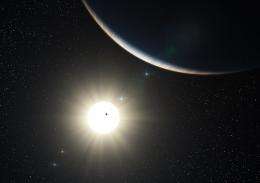
This artist's impression shows the remarkable planetary system around the Sun-like star HD 10180. Credit: ESO
(PhysOrg.com) -- Astronomers using ESO's world-leading HARPS instrument have discovered a planetary system containing at least five planets, orbiting the Sun-like star HD 10180. The researchers also have tantalising evidence that two other planets may be present, one of which would have the lowest mass ever found. This would make the system similar to our Solar System in terms of the number of planets (seven as compared to the Solar System's eight planets). Furthermore, the team also found evidence that the distances of the planets from their star follow a regular pattern, as also seen in our Solar System.
“We have found what is most likely the system with the most planets yet discovered,” says Christophe Lovis, lead author of the paper reporting the result. “This remarkable discovery also highlights the fact that we are now entering a new era in exoplanet research: the study of complex planetary systems and not just of individual planets. Studies of planetary motions in the new system reveal complex gravitational interactions between the planets and give us insights into the long-term evolution of the system.”
The team of astronomers used the HARPS spectrograph, attached to ESO’s 3.6-metre telescope at La Silla, Chile, for a six-year-long study of the Sun-like star HD 10180, located 127 light-years away in the southern constellation of Hydrus (the Male Water Snake). HARPS is an instrument with unrivalled measurement stability and great precision and is the world’s most successful exoplanet hunter.
Thanks to the 190 individual HARPS measurements, the astronomers detected the tiny back and forth motions of the star caused by the complex gravitational attractions from five or more planets. The five strongest signals correspond to planets with Neptune-like masses — between 13 and 25 Earth masses -- which orbit the star with periods ranging from about 6 to 600 days. These planets are located between 0.06 and 1.4 times the Earth-Sun distance from their central star.
This video is not supported by your browser at this time.
This animation shows an artist’s impression of the remarkable planetary system around the Sun-like star HD 10180. Credit: ESO
“We also have good reasons to believe that two other planets are present,” says Lovis. One would be a Saturn-like planet (with a minimum mass of 65 Earth masses) orbiting in 2200 days. The other would be the least massive exoplanet ever discovered, with a mass of about 1.4 times that of the Earth. It is very close to its host star, at just 2 percent of the Earth-Sun distance. One “year” on this planet would last only 1.18 Earth-days.“This object causes a wobble of its star of only about 3 km/hour— slower than walking speed — and this motion is very hard to measure,” says team member Damien Ségransan. If confirmed, this object would be another example of a hot rocky planet, similar to Corot-7b.
The newly discovered system of planets around HD 10180 is unique in several respects. First of all, with at least five Neptune-like planets lying within a distance equivalent to the orbit of Mars, this system is more populated than our Solar System in its inner region, and has many more massive planets there. Furthermore, the system probably has no Jupiter-like gas giant. In addition, all the planets seem to have almost circular orbits. On average the planets in the inner region of the HD 10180 system have 20 times the mass of the Earth, whereas the inner planets in our own Solar System (Mercury, Venus, Earth and Mars) have an average mass of half that of the Earth.
So far, astronomers know of fifteen systems with at least three planets. The last record-holder was 55 Cancri, which contains five planets, two of them being giant planets. “Systems of low-mass planets like the one around HD 10180 appear to be quite common, but their formation history remains a puzzle,” says Lovis.
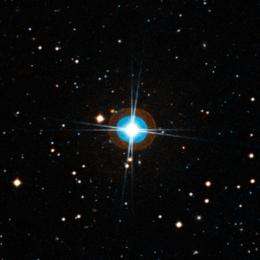
This image shows a close-up of the sky around the star HD 10180. The picture was created from photographs taken through red and blue filters and forming part of the Digitized Sky Survey 2. The field of view is approximately eleven arcminutes across. The blue and orange halos around the star, and the eight spikes of light, are artifacts of the imaging process and are not real. The remarkable planetary system around this star is far too faint and close in to be visible in this image. Credit: ESO and Digitized Sky Survey 2. Acknowledgment: Davide De Martin
Using the new discovery as well as data for other planetary systems, the astronomers found an equivalent of the Titius-Bode law that exists in our Solar System: the distances of the planets from their star seem to follow a regular pattern. “This could be a signature of the formation process of these planetary systems,” says team member Michel Mayor.The Titius-Bode law states that the distances of the planets from the Sun follow a simple pattern. For the outer planets, each planet is predicted to be roughly twice as far away from the Sun as the previous object. The hypothesis correctly predicted the orbits of Ceres and Uranus, but failed as a predictor of Neptune's orbit.
Another important result found by the astronomers while studying these systems is that there is a relationship between the mass of a planetary system and the mass and chemical content of its host star. All very massive planetary systems are found around massive and metal-rich stars, while the four lowest-mass systems are found around lower-mass and metal-poor stars. Such properties confirm current theoretical models. According to the definition used in astronomy, “metals” are all the elements other than hydrogen and helium. Such metals, except for a very few minor light chemical elements, have all been created by the various generations of stars. Rocky planets are made of "metals".
This video is not supported by your browser at this time.
This animation shows how astronomers use very precise spectrographs such as the HARPS instrument on the 3.6-metre telescope at La Silla, Chile to find exoplanets. As the planet orbits its gravitational pull causes the parent star to move back and forth. This tiny radial motion shifts the observed spectrum of the star by a correspondingly small amount because of the Doppler shift. With super-sensitive spectrographs such as HARPS the shifts can be measured and used to infer details of a planet’s mass and orbit. Credit: ESO
The discovery is announced today at the international colloquium “Detection and dynamics of transiting exoplanets”, at the Observatoire de Haute-Provence, France.-
Trio of Neptunes and their belt
May 17, 2006 |
not rated yet |
0
-
Fourteen Times the Earth - Smallest Ever Extra-Solar Planet Discovered
Aug 26, 2004 |
not rated yet |
0
-
Scientists discover a nearly Earth-sized planet (Update)
Apr 21, 2009 |
not rated yet |
0
-
32 New Exoplanets Found (w/ Video)
Oct 19, 2009 |
not rated yet |
0
-
Astronomers discover 'tilted planets'
Dec 22, 2009 |
not rated yet |
0
-
Engineers build first sub-10-nm carbon nanotube transistor
Feb 01, 2012 |
4.9 / 5 (31) |
30
-
Something old, something new: Evolution and the structural divergence of duplicate genes
Jan 31, 2012 |
4.6 / 5 (7) |
1
-
The hidden nanoworld of ice crystals: Revealing the dynamic behavior of quasi-liquid layers
Jan 30, 2012 |
5 / 5 (3) |
1
-
Stock market network reveals investor clustering
Jan 27, 2012 |
3.9 / 5 (23) |
8
-
Of microchemistry and molecules: Electronic microfluidic device synthesizes biocompatible probes
Jan 26, 2012 |
5 / 5 (1) |
0
-
Scale of the Universe
1 hour ago
-
Titan's lack of impact craters
Feb 09, 2012
-
Real pictures of black hole eating a star?
Feb 08, 2012
-
Hypothetical way to travel faster than light, but not technically exceed lightspeed
Feb 06, 2012
-
How do scientists monitor the Sun's activity?
Feb 05, 2012
-
Search patterns in observational studies
Feb 05, 2012
- More from Physics Forums - General Astronomy
More news stories
NASA sees wide-eyed cyclone Jasmine
Cyclone Jasmine's eye has opened wider on NASA satellite imagery, as it moves through the Southern Pacific Ocean.
Space & Earth / Earth Sciences
50 minutes ago |
not rated yet |
0
NASA sees Giovanna reach cyclone strength, threaten Madagascar
Tropical Storm 12S built up steam and became a cyclone on February 10, 2012 as NASA's Terra satellite passed overhead. Residents of east-central Madagascar should prepare for this cyclone to make landfall ...
Space & Earth / Earth Sciences
49 minutes ago |
not rated yet |
0
Humans may have helped the decline of African rainforests 3000 years ago
(PhysOrg.com) -- Large areas of rainforests in Central Africa mysteriously disappeared over three thousand years ago, to be replaced by savannas. The prevailing theory has been that the cause was a change ...
Could Venus be shifting gear?
(PhysOrg.com) -- ESAs Venus Express spacecraft has discovered that our cloud-covered neighbour spins a little slower than previously measured. Peering through the dense atmosphere in the infrared, the ...
Space & Earth / Space Exploration
8 hours ago |
5 / 5 (7) |
7
|
Clam fields found at deep, low-temperature Mariana vents
(PhysOrg.com) -- Scientists have marveled at the unusual life forms thriving at high temperature hydrothermal vents of the deep ocean.
Space & Earth / Earth Sciences
9 hours ago |
not rated yet |
0
|
Google users warned of threat to smartphone wallets
Users of Google smartphone wallets were being warned on Friday that there is a way to crack pass codes intended to thwart thieves from going on illicit shopping sprees.
CIA website offline, Anonymous takes credit
The website of the Central Intelligence Agency was unresponsive on Friday after the hacker group Anonymous claimed to have knocked it offline.
Complex wiring of the nervous system may rely on a just a handful of genes and proteins
Researchers at the Salk Institute have discovered a startling feature of early brain development that helps to explain how complex neuron wiring patterns are programmed using just a handful of critical genes. ...
Putting the squeeze on planets outside our solar system
(PhysOrg.com) -- Using high-powered lasers, scientists at Lawrence Livermore National Laboratory and collaborators discovered that molten magnesium silicate undergoes a phase change in the liquid state, abruptly ...
The power of estrogen -- male snakes attract other males
A new study has shown that boosting the estrogen levels of male garter snakes causes them to secrete the same pheromones that females use to attract suitors, and turned the males into just about the sexiest ...
New error-correcting codes guarantee the fastest possible rate of data transmission
Error-correcting codes are one of the triumphs of the digital age. Theyre a way of encoding information so that it can be transmitted across a communication channel such as an optical fiber o ...

Aug 24, 2010
Rank: 5 / 5 (2)
Aug 24, 2010
Rank: not rated yet
So wouldn't that mean that a few of the planets may be in the Habitable Zone? I love how they don't give any details about that or even mention it at all. Even finding that one of the planets has the same temperature ranges as Earth would be a huge find, let alone the same planet size and with liquid on it.
Aug 24, 2010
Rank: 5 / 5 (1)
Really though, this whole wobble indicating planets thing needs to be verified by observation.
Aug 24, 2010
Rank: not rated yet
Aug 24, 2010
Rank: 5 / 5 (2)
"There is no solid theoretical explanation of the Titius–Bode law, but if there is one it is possibly a combination of orbital resonance and shortage of degrees of freedom: any stable planetary system has a high probability of satisfying a Titius–Bode-type relationship. Because of this, it has been called a "rule" rather than a "law." However, astrophysicist Alan Boss states that it is just a coincidence, and the planetary science journal Icarus no longer accepts papers attempting to provide 'improved' versions of the law."
http://en.wikiped...anations
Aug 24, 2010
Rank: 3 / 5 (3)
Right now I think anything we say we think we know is likely to change next year, if not next month...but we're getting there.
Aug 24, 2010
Rank: 4 / 5 (1)
Yes -but that would be the "habitable zone' for an Earthlike planet.
Apparently, these ar Saturn-size planets, so density and pressure of their(likely) atmospheres would turn their surfaces to either deep freeze or furnace, if they have much else besides a small rocky core.
If, on the other hand, this is a very young system, I suppose it's possible that stellar activity could still strip away most, if not all of these planets' atmospheres, so maybe a future Neo Earth?
Aug 25, 2010
Rank: 3 / 5 (2)
Aug 25, 2010
Rank: 1 / 5 (1)
Wait till we get light speed transportation, that kind of measurment will be like a yardstick in a the fermi lab.
Aug 26, 2010
Rank: not rated yet
You'll see the ua of each planets:
HD 10180 c : 0.0641
HD 10180 d : 0.1286
HD 10180 e : 0.2699
HD 10180 f : 0.4929
HD 10180 g : 1.422
HD 10180 h : 3.4
None are in habitable zone...
But xenomoons can be in habitable zone because some giant planets are in habitable zone.
Aug 26, 2010
Rank: not rated yet
http://media4.obs...ndex.php
Aug 26, 2010
Rank: not rated yet
http://media4.obs...HD+10180
Aug 26, 2010
Rank: not rated yet