'Spintronics' breakthrough holds promise for next-generation computers
August 24, 2010
'Spintronics' breakthrough holds promise for next-generation computers

Enlarge

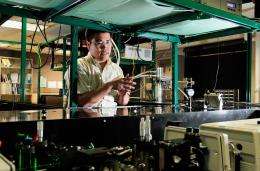
Hui Zhao, assistant professor of physics and astronomy.

Using powerful lasers, Hui Zhao, assistant professor of physics and astronomy at the University of Kansas, and graduate student Lalani Werake have discovered a new way to recognize currents of spinning electrons within a semiconductor.

Their findings could lead the way to development of superior computers and electronics. Results from their work in KU's Ultrafast Laser Lab will be published in the September issue of , a leading peer-reviewed journal, and was posted online in early August.

Zhao and Werake research spin-based electronics, dubbed "spintronics."

"The goal is to replace everything — from computers to — to have higher performance and less ," said Zhao.

The KU investigator said that future advancements to would require a different approach for transmitting the sequences of ones and zeros that make up .

"We have been using the charge of the electron for several decades," said Zhao. "But right now the size of each device is just 30 to 50 nanometers, and you don't have many atoms remaining on that tiny scale. We can't continue that way anymore because we're hitting a fundamental limit."

Instead of using the presence or absence of electronic charges, spintronics relies on the direction of an electron's rotation to convey data.

"Roughly speaking, an electron can be viewed as a tiny ball that spins like a baseball," said Zhao. "The difference is that a baseball can spin at any speed, but an electron can only spin at a certain speed — either counterclockwise or clockwise. Therefore, we can use one spin state to represent 'zero' and another to represent 'one.' Because a single electron can carry this information, this takes much less time and much less energy."

However, one major hurdle for spintronics researchers has been the difficulty in detecting the flow of spinning electrons in real time.

"We haven't been able to monitor the velocity of those spinning electrons, but velocity is associated with the spin current," Zhao said. "So there's been no way to directly detect the spin current so far."

The discovery by Zhao and Werake changes that.

The KU researchers have discovered that shining a laser beam on a piece of semiconductor generates different color lights if the spinning are flowing, and the brightness of the new light is related to the strength of the spin current.

The optical effect, known as "second-harmonic generation," can monitor spin-current in real time without altering the current itself. Zhao compares his new method with a police officer's radar gun, which tracks a car's speed as it passes.

This vastly improves upon spin-current analysis now in use, which the KU researcher says is akin to analyzing still photographs to determine a car's speed, long after the car has sped away.

"Spintronics is still in the research phase, and we hope that this new technology can be used in labs to look at problems that interest researchers," said Zhao. "As become industrialized, we expect this could become a routine technique to check the quality of devices, for example."

Provided by University of Kansas

4.9 /5 (8 votes)  

Rank 4.9 /5 (8 votes)
Related Stories
Relevant PhysicsForums posts
  • Simple Torque from Gravity Problem
    created1 hour ago
  • Books To Inspire a Beginnig Physics Student
    created3 hours ago
  • Pith balls problem
    created3 hours ago
  • Electrostatics
    created3 hours ago
  • what is phase constant
    created3 hours ago
  • Basics In electromagnetic wave
    created3 hours ago
  • More from Physics Forums - General Physics

More news stories

Putting the squeeze on planets outside our solar system

(PhysOrg.com) -- Using high-powered lasers, scientists at Lawrence Livermore National Laboratory and collaborators discovered that molten magnesium silicate undergoes a phase change in the liquid state, abruptly ...

Physics / Condensed Matter

created 14 hours ago | popularity 4.3 / 5 (7) | comments 0 | with audio podcast

Hovering not hard if you're top-heavy, researchers find

Top-heavy structures are more likely to maintain their balance while hovering in the air than are those that bear a lower center of gravity, researchers at New York University's Courant Institute of Mathematical Sciences ...

Physics / General Physics

created 15 hours ago | popularity 5 / 5 (2) | comments 1 | with audio podcast

SLAC, Stanford team focuses on high-energy electrons to treat cancer

Accelerator physicists at SLAC and cancer specialists from Stanford are working on a new technology that could dramatically reduce the time needed for cancer radiation treatments. The team ran an initial experiment ...

Physics / General Physics

created 18 hours ago | popularity 5 / 5 (2) | comments 0

Measurements from high-energy collisions lead to better understanding of why meson particles disappear

For several years, physicists at the Relativistic Heavy Ion Collider (RHIC) at Brookhaven National Laboratory (BNL), USA, have studied an unusual state of matter called the quark–gluon plasma, which they ...

Physics / General Physics

created 19 hours ago | popularity 4.5 / 5 (4) | comments 0

Explained: Sigma

It's a question that arises with virtually every major new finding in science or medicine: What makes a result reliable enough to be taken seriously? The answer has to do with statistical significance -- but ...

Physics / General Physics

created Feb 09, 2012 | popularity 5 / 5 (16) | comments 53


Anonymous knocks CIA website offline (Update)

The website of the Central Intelligence Agency was inaccessible on Friday after the hacker group Anonymous claimed to have knocked it offline.

New error-correcting codes guarantee the fastest possible rate of data transmission

Error-correcting codes are one of the triumphs of the digital age. They’re a way of encoding information so that it can be transmitted across a communication channel — such as an optical fiber o ...

Humans may have helped the decline of African rainforests 3000 years ago

(PhysOrg.com) -- Large areas of rainforests in Central Africa mysteriously disappeared over three thousand years ago, to be replaced by savannas. The prevailing theory has been that the cause was a change ...

New power source discovered

(PhysOrg.com) -- Researchers at the Massachusetts Institute of Technology (MIT) and RMIT University have made a breakthrough in energy storage and power generation.

Small modular reactor design could be a 'SUPERSTAR'

(PhysOrg.com) -- Though most of today's nuclear reactors are cooled by water, we've long known that there are alternatives; in fact, the world's first nuclear-powered electricity in 1951 came from a reactor ...

Google users warned of threat to smartphone wallets

Users of Google smartphone wallets were being warned on Friday that there is a way to crack pass codes intended to thwart thieves from going on illicit shopping sprees.