New study shows how giant tortoises, alligators thrived in High Arctic 50 million years ago
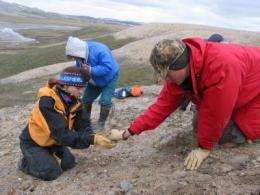
A new study of the High Arctic climate roughly 50 million years ago led by the University of Colorado at Boulder helps to explain how ancient alligators and giant tortoises were able to thrive on Ellesmere Island well above the Arctic Circle, even as they endured six months of darkness each year.
The new study, which looked at temperatures during the early Eocene period 52 to 53 million years ago, also has implications for the impacts of future climate change as Arctic temperatures continue to rise, said University of Colorado at Boulder Associate Professor Jaelyn Eberle of the department of geological sciences, lead author of the study.
The team used a combination of oxygen isotope ratios from fossil bone and tooth enamel of mammals, fish and turtles that lived together on Ellesmere Island to estimate the average annual Eocene temperature for the site. They also were able to tease out temperature estimates for the warmest and coldest months of the year, critical data that should help scientists better understand past and future biodiversity in the High Arctic as the climate warms, including the geographical ranges and species richness of animals and plants.
The team concluded the average temperatures of the warmest month on Ellesmere Island during the early Eocene were from 66 to 68 degrees Fahrenheit (19-20 degrees C), while the coldest month temperature was about 32 to 38 degrees F (0-3.5 degrees C). "Our data gathered from multiple organisms indicate it probably did not get below freezing on Ellesmere Island during the early Eocene, which has some interesting implications," she said.
A paper on the subject was published in this month's issue of Earth and Planetary Science Letters. Co-authors included Henry Fricke from Colorado College, John Humphrey and Logan Hackett from the Colorado School of Mines, Michael Newbrey from University of Alberta, Edmonton, and Howard Hutchison from the University California, Berkeley. The National Science Foundation funded the study.
"This is arguably the most comprehensive data set for the early Eocene High Arctic, and certainly explains how alligators and giant tortoises could live on Ellesmere Island some 52 to 53 million years ago," said Eberle, who also is the curator of fossil vertebrates at the University of Colorado Museum of Natural History.
During the Eocene, Ellesmere Island -- which is adjacent to Greenland -- probably was similar to swampy cypress forests in the southeastern United States today, said Eberle. Eocene fossil evidence collected there in recent decades by various teams indicate the lush landscape hosted giant tortoises, aquatic turtles, large snakes, alligators, flying lemurs, tapirs, and hippo-like and rhino-like mammals.
The bone and tooth enamel of vertebrate fossils contains biogenic apatite -- a mineral that is fossilized after the death of living organisms and which can be used as a "flight recorder" to infer paleoclimate conditions. Since all of the fossil materials were from the same stratigraphic layer and locality, the oxygen isotope ratios from the animals are linked to the temperatures of both ingested river water and precipitation at the time, allowing them to better estimate temperatures in the Eocene both annually and seasonally, she said.
"We use the water that the animals were drinking as a proxy for paleotemperature," said Eberle. "In mammal fossils, for example, we can analyze the oxygen isotope ratios in a sequence along the length of a large fossil tooth and estimate the warm-month and cold-month averages during the Eocene because teeth grow year round. When it comes to oxygen isotope values in tooth enamel, what we found for these creatures is that you are what you drink," she said.
The team looked at teeth from a large, hippo-like mammal known as Coryphodon, as well as bones from bowfin fish and shells and bones from aquatic turtles from the Emydidae family, the largest and most diverse family of contemporary pond turtles. While Coryphodon and bowfins grew throughout the year, the turtles exhibited shell growth only during summer months, much like turtles that live today in non-equatorial areas.
"By looking at a host of animals with different physiologies, we were better able to pin down warm- and cold-month temperatures," she said. "Many aspects of biodiversity and species richness are related more to seasonal temperatures and ranges such as cold-month means rather than to mean annual temperature."
Bowfins -- which have a long dorsal fin and powerful jaws -- inhabit a variety of waters today from the Saint Lawrence River drainage in Quebec south to Florida and Texas. The team also compared the ranges of bowfins, aquatic turtles and giant tortoises of today with their ranges in the Eocene to help them estimate temperatures, according to co-author Newbrey, an expert in both contemporary and extinct fishes.
Eberle said the new study implies Eocene alligators could withstand slightly cooler winters than their present-day counterparts, although data from captive alligators show they are heartier than other members of the crocodilian family and can survive short intervals of subfreezing temperatures by submerging themselves in the water.
In contrast, the existence of large land tortoises in the Eocene High Arctic is still somewhat puzzling, said Eberle, since today's large tortoises inhabit places like the Galapagos Islands where the cold-month average temperature is about 50 degrees F (10 degrees C.)
But during the late Pleistocene period some 10,000 to 50,000 years ago -- when air temperatures were comparable to those today -- large land tortoises were found as far north as present-day Pennsylvania and Illinois, Eberle said. This suggests their present range in the Americas does not represent their fullest geographic range as allowed by climate. Factors like hunting by early Native Americans and the past extent of glaciers probably are playing a role in today's distribution of giant tortoises, she said.
Eberle, who calls the new results "a deep time analogue" for today's rapidly warming Arctic region, said quantitative estimates of early Eocene climate conditions at high latitudes like Ellesmere Island are rare and often contradictory. Previous estimates of the early Eocene mean annual temperatures have ranged from 39 to 68 degrees F (4 to 20 degrees C), a temperature range equivalent to geographic ranges reaching from Canada to Florida.
There is high concern by scientists over a proposal to mine coal on Ellesmere Island at the ancient fossil site by WestStar Resources Inc. headquartered in Vancouver, British Columbia, Eberle said. "Sites like this are unique and extremely valuable resources that are of international importance, and shouldn't be allowed to disappear," she said. "Our concern is that coal mining activities could damage such sites and they will be lost forever."
Today Ellesmere Island is one of the coldest, driest environments on Earth and features tundra, permafrost, ice sheets, sparse vegetation and few mammals. The temperatures range from roughly minus 37 degrees F in winter (minus 38 C) to 48 degrees F (8 degrees C) in summer.
The new study foreshadows the impacts of continuing global warming on Arctic plants and animals, Eberle said. Temperatures in the Arctic are rising twice as fast as those at mid-latitudes as greenhouse gases build up in Earth's atmosphere, due primarily to human activities like fossil fuel burning and deforestation, according to climate scientists.
Provided by University of Colorado at Boulder


