Study shows deepwater oil plume in Gulf degraded by microbes
August 24, 2010 by Lynn Yarris
Study shows deepwater oil plume in Gulf degraded by microbes

Enlarge

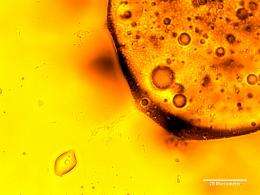
Microbes are degrading oil in the deepwater plume from the BP oil spill in the Gulf, a study by Berkeley Lab researchers has shown. Image from Hoi-Ying Holman group

In the aftermath of the explosion of BP's Deepwater Horizon drilling rig in the Gulf of Mexico, a dispersed oil plume was formed at a depth between 3,600 and 4,000 feet and extending some 10 miles out from the wellhead. An intensive study by scientists with the Lawrence Berkeley National Laboratory (Berkeley Lab) found that microbial activity, spearheaded by a new and unclassified species, degrades oil much faster than anticipated. This degradation appears to take place without a significant level of oxygen depletion.

"Our findings show that the influx of oil profoundly altered the microbial community by significantly stimulating deep-sea psychrophilic (cold temperature) gamma-proteobacteria that are closely related to known petroleum-degrading microbes," says Terry Hazen, a microbial ecologist with Berkeley Lab's Earth Sciences Division and principal investigator with the Energy Biosciences Institute, who led this study. "This enrichment of psychrophilic petroleum degraders with their rapid oil biodegradation rates appears to be one of the major mechanisms behind the rapid decline of the deepwater dispersed oil plume that has been observed."

The uncontrolled oil blowout in the Gulf of Mexico from BP's deepwater well was the deepest and one of the largest oil leaks in history. The extreme depths in the water column and the magnitude of this event posed a great many questions. In addition, to prevent large amounts of the highly flammable Gulf light crude from reaching the surface, BP deployed an unprecedented quantity of the commercial oil dispersant COREXIT 9500 at the wellhead, creating a plume of micron-sized petroleum particles. Although the environmental effects of COREXIT have been studied in surface water applications for more than a decade, its potential impact and effectiveness in the deep waters of the Gulf marine ecosystem were unknown.

Analysis by Hazen and his colleagues of microbial genes in the dispersed oil plume revealed a variety of hydrocarbon-degraders, some of which were strongly correlated with the concentration changes of various oil contaminants. Analysis of changes in the oil composition as the plume extended from the wellhead pointed to faster than expected biodegradation rates with the half-life of alkanes ranging from 1.2 to 6.1 days.

"Our findings, which provide the first data ever on microbial activity from a deepwater dispersed oil plume, suggest that a great potential for intrinsic bioremediation of oil plumes exists in the deep-sea," Hazen says. "These findings also show that psychrophilic oil-degrading microbial populations and their associated play a significant role in controlling the ultimate fates and consequences of deep-sea oil plumes in the Gulf of Mexico."

The results of this research are reported in the journal Science (August 26, 2010 on-line) in a paper titled "Deep-sea oil plume enriches Indigenous oil-degrading bacteria."

Hazen and his colleagues began their study on May 25, 2010.
Study shows deepwater oil plume in Gulf degraded by microbes
Enlarge

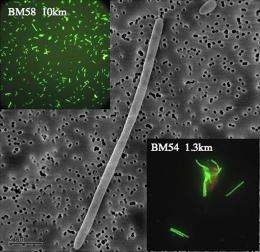
Analysis with Berkeley Lab’s phyloChip revealed the dominant microbe in the dispersed Gulf of Mexico oil plume was a new species, closely related to members of Oceanospirillales family. (Image from Terry Hazen group)

At that time, the deep reaches of the Gulf of Mexico were a relatively unexplored microbial habitat, where temperatures hover around 5 degrees Celsius, the pressure is enormous, and there is normally little carbon present.

"We deployed on two ships to determine the physical, chemical and microbiological properties of the deepwater oil plume," Hazen says. "The oil escaping from the damaged wellhead represented an enormous carbon input to the water column ecosystem and while we suspected that hydrocarbon components in the oil could potentially serve as a carbon substrate for deep-sea microbes, scientific data was needed for informed decisions."

Hazen, who has studied numerous oil-spill sites in the past, is the leader of the Ecology Department and Center for Environmental Biotechnology at Berkeley Lab's Earth Sciences Division. He conducted this research under an existing grant he holds with the Energy Biosciences Institute (EBI) to study microbial enhanced hydrocarbon recovery. EBI is a partnership led by the University of California (UC) Berkeley and including Berkeley Lab and the University of Illinois that is funded by a $500 million, 10-year grant from BP.

Results in the Science paper are based on the analysis of more than 200 samples collected from 17 deepwater sites between May 25 and June 2, 2010. Sample analysis was boosted by the use of the latest edition of the award-winning Berkeley Lab PhyloChip - a unique credit card-sized DNA-based microarray that can be used to quickly, accurately and comprehensively detect the presence of up to 50,000 different species of bacteria and archaea in a single sample from any environmental source, without the need of culturing. Use of the Phylochip enabled Hazen and his colleagues to determine that the dominant microbe in the oil plume is a new species, closely related to members of Oceanospirillales family, particularly Oleispirea antarctica and Oceaniserpentilla haliotis.

Hazen and his colleagues attribute the faster than expected rates of oil biodegradation at the 5 degrees Celsius temperature in part to the nature of Gulf light crude, which contains a large volatile component that is more biodegradable. The use of the COREXIT dispersant may have also accelerated biodegradation because of the small size of the oil particles and the low overall concentrations of oil in the plume. In addition, frequent episodic oil leaks from natural seeps in the Gulf seabed may have led to adaptations over long periods of time by the deep-sea microbial community that speed up hydrocarbon degradation rates.

This video is not supported by your browser at this time.

A public lecture by Terry Hazen entitled “Bioremediation: The Hope and the Hype for Environmental Cleanup”

One of the concerns raised about microbial degradation of the in a deepwater plume is that the microbes would also be consuming large portions of oxygen in the plume, creating so-called "dead-zones" in the water column where life cannot be sustained. In their study, the Berkeley Lab researchers found that oxygen saturation outside the plume was 67-percent while within the plume it was 59-percent.

"The low concentrations of iron in seawater may have prevented oxygen concentrations dropping more precipitously from biodegradation demand on the petroleum, since many hydrocarbon-degrading enzymes have iron as a component," Hazen says. "There's not enough iron to form more of these enzymes, which would degrade the carbon faster but also consume more oxygen."

Provided by Lawrence Berkeley National Laboratory (news : web)

4.9 /5 (10 votes)  

Filter


Move the slider to adjust rank threshold, so that you can hide some of the comments.


Display comments: newest first

Caliban
Aug 24, 2010

Rank: 3.7 / 5 (3)
If these results stand as expected, then this is a tiny ray of sunshine in an otherwise gloomy forecast.
No mention of homogeneity of microbial degradation throughout the plume, estimates of percentage of plume degraded, how toxic these bacteria become, themselves, especially after death, nor any information regarding what parts, if any of the oil and corexit left over from metabolic activity of the bacteria remain in the water column as toxic residue.

These are questions that one would expect, and for perfectly obvious reasons, to be addressed in any such research.

Perhaps I'm only being cynical, but this smacks a bit too much of the same mendacity as the gov report that all but 25% of the oil was already "gone".

The fact that the research is funded by BP doesn't help either, though the research may well be -and one hopes is- conducted rigorously, objectively, and without influence.

I would expect some tank studies at pressure and temp, with full input/output analysis.
solrey
Aug 24, 2010

Rank: 2.6 / 5 (5)
Their research would seem to contradict the results of about half a dozen other studies.

What do these two scientists have to say?
http://www.youtub...embedded

Underwater plume the size of Manhattan.
http://blogs.disc...-mexico/

Raising the estimates.
http://www.grist....l-in-th/

When one study reaches opposite conclusions as all the rest, I say follow the money.

"EBI is a partnership led by the University of California (UC) Berkeley and including Berkeley Lab and the University of Illinois that is funded by a $500 million, 10-year grant from BP."

LBNL is a US DOE national lab. Should we trust anything BP or the government has to say about the Gulf at this point? The government has done nothing but cover BP's oily backside to shield them from liability/responsibility.
toyo
Aug 24, 2010

Rank: 5 / 5 (3)
Solrey,
can you point to these "...results of about half a dozen other studies." ?
Just curious....
ArtflDgr
Aug 24, 2010

Rank: 2.9 / 5 (8)
so much for the fragile ecosystem assumption
cmn
Aug 24, 2010

Rank: 5 / 5 (3)
And when these oil loving microbes run out of food (oil) and start dieing off, what then? Will there be any toxic side effects, much like there are when other microbial bacteria die off?

http://en.wikiped...reaction
deatopmg
Aug 24, 2010

Rank: 3.7 / 5 (3)
So the situation is no where as bad as some people, like solrey, wish. Clearly this v. rapid biodegradation could have been surmised from the results of the similar sized IXTOC release in the gulf some 30 yrs ago.

These hydrocarbons are "free lunch" for these organisms.
Shootist
Aug 25, 2010

Rank: 3.7 / 5 (3)
And when these oil loving microbes run out of food (oil) and start dieing off, what then? Will there be any toxic side effects, much like there are when other microbial bacteria die off?

http://en.wikiped...reaction


There might be. There might be some other critter that specializes in eating the dead critters. Time will tell.

The important thing is; the greens and their panicky allies, were wrong, again.

Not sayin' we shouldn't be "stewards" of the environment and all that, just not at the cost of sitting in the dark and freezing.
Noumenon
Aug 25, 2010

Rank: 4.6 / 5 (30)
When one study reaches opposite conclusions as all the rest, I say follow the money.


You can say that about either side; the tree-hugging anti-oil environMentalists are funded in a big way. Where's the oil then? This is similar to the AGW industry hysteria, in that it is most likely over blown non sense,... and in the end science learns why their estimates where so exaggerated.
Eric_B
Aug 25, 2010

Rank: 5 / 5 (3)
Did anyone bother to read the fine print?

"EBI is a partnership led by the University of California (UC) Berkeley and including Berkeley Lab and the University of Illinois that is funded by a $500 million, 10-year grant from BP."

How EXACTLY is it possible that any other slant to the conclusions would be reached in this study? Does it take $50 a year to study these mudbugs? Only when the conclusion is foregone.
Noumenon
Aug 25, 2010

Rank: 4.7 / 5 (27)
The study is to determine what happened to the oil. Where is it? Where are the constant barrage of images of oil covered birds, and slick shores full of dead fish, one would expect from the environmentalist anti-big-oil backing media? Kind of hard for BP to hide that amount of oil.

So let's say BP paid off the researchers at the Berkeley lab and the who study is corrupt, where is the oil then? What's the alternative conclusion?
3432682
Aug 25, 2010

Rank: 2.3 / 5 (3)
The Gulf is good at eating oil. Natural seeps leak 50-100 million gallons/year of oil. We knew the oil was being digested. Now we know more about how. Sorry to disappoint the greenie propaganda industry, and those scientists who are trying to get hundreds of millions of dollars to study what happened to the "22 mile plume".
Skeptic_Heretic
Aug 25, 2010

Rank: 5 / 5 (2)
Before everyone lands the plane on the carrier and declares "Mission Accomplished" remember that the fallout from the Alaskan gulf spills is still being tallied and that was almost 20 years ago.

Similar headlines abounded then as well.
HealingMindN
Aug 25, 2010

Rank: 3 / 5 (2)
A $500 million grant to the University of California, Berkeley, Lawrence Berkeley National Laboratory, and the University of Illinois at Urbana-Champaign, to create an Energy Biosciences Institute has recently come under attack, over concerns about the global impacts of the research and privatisation of public universities...
http://en.wikiped.../wiki/BP

No, sorry, I prefer an unbiased report. Then again, with all the "grants" that bp is making, is there an objective, truly scientific report available?

Here's an interesting story: "Oil spill taints UC Berkeley's BP-funded research" http://www.boston...esearch/
Skeptic_Heretic
Aug 26, 2010

Rank: 1 / 5 (1)
A $500 million grant to the University of California, Berkeley, Lawrence Berkeley National Laboratory, and the University of Illinois at Urbana-Champaign, to create an Energy Biosciences Institute has recently come under attack, over concerns about the global impacts of the research and privatisation of public universities...
http://en.wikiped.../wiki/BP

I don't disagree with your standpoint, but, you said I prefer an unbiased source, then you linked to one of the most biased rags ever printed in Massachusetts.

The Globe is deeply in the pockets of activists, they're very deeply biased.
mosahlah
Aug 28, 2010

Rank: 1 / 5 (1)
The oil spill hysteria was reminicent of our recent financial collapse hysteria that contributed to the great stimulus/embezzlement travesty.
Rank 4.9 /5 (10 votes)
Relevant PhysicsForums posts
  • Wind Waves in Reservoir ~ Wind run-up and Wind set-up
    created12 hours ago
  • Balance of oxygen in the atmosphere
    createdFeb 01, 2012
  • The case for a methanol-based economy
    createdJan 30, 2012
  • Weather in a rotating cylinder
    createdJan 25, 2012
  • Importance of difference between SVP over ice and water?
    createdJan 19, 2012
  • Ozone and atmosphere sampling
    createdJan 16, 2012
  • More from Physics Forums - Earth

More news stories

Study shows global glaciers, ice caps, shedding billions of tons of mass annually

Earth's glaciers and ice caps outside of the regions of Greenland and Antarctica are shedding roughly 150 billion tons of ice annually, according to a new study led by the University of Colorado Boulder.

Space & Earth / Earth Sciences

created 2 hours ago | popularity 5 / 5 (1) | comments 2 | with audio podcast

Building mountains in a bottle

(PhysOrg.com) -- Scientists are preparing to launch a 10-year project to study water resources, gas exchange and carbon cycling in three man-made landscapes built in a half-acre laboratory at the University ...

Space & Earth / Environment

created 6 hours ago | popularity 4 / 5 (1) | comments 0 | with audio podcast

VLT takes most detailed infrared image of the Carina Nebula

(PhysOrg.com) -- ESO's Very Large Telescope has delivered the most detailed infrared image of the Carina Nebula stellar nursery taken so far. Many previously hidden features, scattered across a spectacular ...

Space & Earth / Astronomy

created 7 hours ago | popularity 5 / 5 (5) | comments 3 | with audio podcast

NASA looking for more space taxis

NASA is looking for more ways to get astronauts to the International Space Station. The space agency put out a call today for commercial space companies to submit bids as part of the latest round of the Commercial ...

Space & Earth / Space Exploration

created 5 hours ago | popularity 4.3 / 5 (4) | comments 3

When stars play planetary pinball

Many of us remember playing pinball at the local arcade while growing up; it turns out that some stars like it as well. Binary stars can play tug-of-war with an unfortunate planet, flinging it into a wide ...

Space & Earth / Astronomy

created 5 hours ago | popularity 4 / 5 (1) | comments 0


Short fasting cycles work as well as chemotherapy in mice

Man may not live by bread alone, but cancer in animals appears less resilient, judging by a study that found chemotherapy drugs work better when combined with cycles of short, severe fasting.

Physicists build highly efficient 'no-waste' laser

A team of University of California, San Diego researchers has built the smallest room-temperature nanolaser to date, as well as an even more startling device: a highly efficient, "thresholdless" laser that ...

Study shows how DNA finds its match

It's been more than 50 years since James Watson and Francis Crick showed that DNA is a double helix of two strands that complement each other. But how does a short piece of DNA find its match, out of the millions ...

Transparent iron? For the first time, an experiment shows that atomic nuclei can become transparent

At the high-brilliance synchrotron light source PETRA III, a team of DESY scientists headed by Dr. Ralf Röhlsberger has succeeded in making atomic nuclei transparent with the help of X-ray light. At the ...

'Explorers,' who embrace the uncertainty of choices, use specific part of cortex

Life shrouds most choices in mystery. Some people inch toward a comfortable enough spot and stick close to that rewarding status quo. Out to dinner, they order the usual. Others consider their options systematically ...

Scientists delve into the brain roots of hunger and eating

Synaptic plasticity – the ability of the synaptic connections between the brain's neurons to change and modify over time -- has been shown to be a key to memory formation and the acquisition of new learning behaviors. ...