Robots learning from experience (w/ Video)
August 24, 2010
Robots learning from experience

Software that enables robots to move objects about a room, building up ever-more knowledge about their environment, is an important step forward in artificial intelligence.

Some objects can be moved, while others cannot. Balls can be placed on top of boxes, but boxes cannot be stably stacked on top of balls. A typical one-year-old child can discover this kind of information about its environment very quickly. But it is a massive challenge for a robot - a machine - to learn concepts such as ‘movability’ and ‘stability’, according to Björn Kahl, a researcher at the Bonn-Rhein-Sieg University and a member of the Xpero robotics research project team.

The aim of the Xpero project was to develop a cognitive system for a robot that would enable it to explore the world around it and learn through physical experimentation.

Logically testing hypotheses

The first step was to create an that enabled the robot to discover its environment from data it received from its sensors.  The Xpero researchers installed some very basic predefined ‘knowledge’ into the robot. That knowledge is based on logic. The robot believes that things are either true or false - there are no ‘maybes’.  The robot uses the data from its sensors as it moves about to test that knowledge. When the robot finds that an expectation is false it starts to experiment to find out why it is false and to correct its hypotheses.

Picking out the important factors in the massive and continuous flow of data from the robot’s created one challenge for the EU-funded Xpero project team. Finding a way for a logic-based system to deal with the concept of time was a second challenge.

Initially the robot has no useful vision of the probable future, but with each observation it learns better hypotheses that it can use to predict the effects of its actions. If an experiment showed that one of its hypotheses was false, then there were literally an infinite number of possibilities of what the correct solution might be. The team had to find ways to short-circuit the process to stop the robot spending an infinite amount of time testing each possibility.

Part of the Xpero team’s solution was to ignore some of the flow of data coming in every millisecond and instead to get the robot to compare snapshots of the situation after a few seconds. When an expectation proved false they also cut down the possible number of solutions by getting the robot to build a new hypothesis that kept the logic connectors from its old hypothesis, simply changing the variables. That drastically reduced the number of possible solutions.

Building a store of knowledge

An important development from Xpero is the robot’s ability to build its knowledge base. “It makes no distinction between previous knowledge and learnt knowledge,” explains Kahl. “That it can re-use is very important. Without that there would be no incremental learning.”

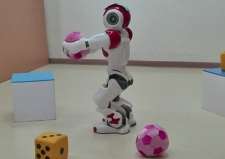
In award-winning demonstrations, robots with the Xpero cognitive system on board have moved about, pushed and placed objects, learning all the time about their environment. In an exciting recent development the robot has started to use objects as tools. It has used one object to move or manipulate another object that it cannot reach directly.

This video is not supported by your browser at this time.

The robot notices new objects in his world. Some are boxes and some are balls. They are smaller then the other ones, so he tries to grab them. Achieving this, he goes even further and starts placing objects on top of each other. Experimenting this way, he learns that structures built by placing objects on boxes are stable, whereas the ones where he places objects on balls are not.

This video is not supported by your browser at this time.

The objects in the world interest the robot. He would like to see if he can manipulate them, so he attempts to push around each individual object. Some stand firm, others he manages to move. Using the knowledge from these experiments, he induces the concept of movability, by describing the two possible outcomes of his pushing action.

While exploring robots makes great theatre, the most exciting developments to come out of Xpero are what the team learnt about the process of learning itself, says Kahl. “We gained a lot of insight into what the challenges in learning are and how machine-learning really works. Just getting the robot to figure out that something is not right required major insights from a research point of view.”

They are planning a new project that will run one or two robots for a much longer time - perhaps months - to see how they advance.

The Xpero project lays the first cornerstones for a technology that has the potential to become a key technology for the next generation of so-called service robots, which clean our houses and mow our lawns - replacing the rather dumb, pre-programmed devices on the market today. A robotics manufacturer is already planning to use parts of the Xpero platform in the edutainment market.

“But while Xpero advances machine learning, it is still far short of the capabilities of a baby,” says Kahl. “Of course, the can now learn the concept of movability. But it does not understand in the human sense what movability means.”

More information: Xpero project - http://www.xpero.org/

Provided by ICT Results (news : web)

4.2 /5 (13 votes)  

Filter


Move the slider to adjust rank threshold, so that you can hide some of the comments.


Display comments: newest first

trekgeek1
Aug 24, 2010

Rank: 4.8 / 5 (4)
The pre-programmed "thought process" was a little much. Other than that, it was interesting. I just remind myself that just a few years ago, bending down and picking up a box would have been the entire article.
toyo
Aug 24, 2010

Rank: 3 / 5 (1)
The monologue is a little bit too much...
steve_brule
Aug 24, 2010

Rank: 2 / 5 (1)
Anyone else notice that the article refers to the robot as "He"?
NickFun
Aug 24, 2010

Rank: 5 / 5 (2)
Perhaps the robot has a removable male appendage.
DamienS
Aug 25, 2010

Rank: 4 / 5 (1)
Quite cute. Perhaps if they injected a bit of fuzzy logic (as in the Bayesian logic chip recently in the news), instead of just relying on Boolean true/false logic, it might be able to improve its world modeling & learning behaviour.

I just wish there was a more coordinated and on-going effort in this type of research rather then continually seeing individual teams doing some 'cool' snippets of research which is quickly forgotten before another team tries something else from scratch.

I remember reading ages ago about Shakey the robot (SRI International) doing something similar (exploring a room) some 44 years ago!
hagureinu
Aug 25, 2010

Rank: 2 / 5 (2)
they call this "an important step forward in artificial intelligence"? very disappointing. to me it looks like regular pre-programmed stuff.
DamienS
Aug 25, 2010

Rank: 5 / 5 (1)
they call this "an important step forward in artificial intelligence"? very disappointing. to me it looks like regular pre-programmed stuff.

How can you tell the nature of the software just by looking at a robot video?
sr_villarreal
Aug 25, 2010

Rank: 4 / 5 (1)
Well, at least for me, it is impressive.
hagureinu
Aug 25, 2010

Rank: 3.4 / 5 (5)
How can you tell the nature of the software just by looking at a robot video?

well, it's very easy to deduce from the video. especially for a software engeneer. its behaviour is split into cycles consisting of obvious stages, like looking around, recognizing objects and matching them against database, moving into position that allows picking up an object, picking it up and performing some predefined action against some other object, analyzing the result basing on predefined algorithm and saving it into database. they call it "learning". i'd call it "performing automated tests". it has nothing to do with a "real" AI.
BrettC
Aug 25, 2010

Rank: 2 / 5 (2)
I Agree. The reason children don't spend an infinite time on a task is because they lose interest. There's a mental reward mechanism in everything we do. Trying new things that interest us causes a mental reward (good feeling). Eventually that wains, and we lose interest. The good feeling is triggered by chemical reactions that make us physically feel good. It's millions of years of complex evolution that brought us a balance of these interactions and feelings. Trying to mimic that is not AI. Reproducing it is AI.
DamienS
Aug 25, 2010

Rank: 4.5 / 5 (2)
hagureinu, you make it sound like 'looking around, recognizing objects and matching them against a database [memory], moving into position that allows picking up an object' aren't functions that a person performs, even if they make no conscious thought in doing it (having been learned).

it has nothing to do with a "real" AI.

I'd like to know what 'real' AI is. Yes, it's obvious that the robot has some preset kinematic movements, like kneeling down to move a box, but the smarts isn't so much in locomotion but in learned rules and inferences that it makes about its environment using its senses. And that, you can't really see in the video, which is why the somewhat cheesy voice-over is used (to explain what is happening behind the scenes, the AI bit).
HealingMindN
Aug 25, 2010

Rank: 5 / 5 (3)
They should face off a bunch of these robots, so they can have "robot stacking wars."
hagureinu
Aug 26, 2010

Rank: 3 / 5 (1)
I'd like to know what 'real' AI is.

in essence, intelligence is is something that allows organism to predict future and choose actions that lead to successfull adaptation in the environment. the key point is abitilty to build and learn models of things that happen in the world around. e.g. if that robot was able to grasp the concept of 'stable' on the fly without preliminary hard-coding it into its algorithm set, then it defenitely would be intelligent. but at the moment it is not even close.
Truth
Aug 26, 2010

Rank: 2.7 / 5 (3)
If this robot is what we can do today in the year 2010, then imagine what will be possible in just 100 years. Better yet, imagine what an alien civilization, of which there are thousands in the Universe, can create if sufficiently advanced, which, according to recent mathematical calculations, should be about one-tenth of all civilizations out there, namely HUNDREDS!
BrianH
Aug 27, 2010

Rank: 3 / 5 (2)
It's obvious. Boxes with light blue tops are immovable! Everyone knows that.

:-D
Au-Pu
Aug 30, 2010

Rank: 5 / 5 (1)
This is not even remotely close to intelligence.
Intelligence is creative and intuitive.
This is simply a complex set of decision gates pretending to simulate intelligence.
Will the computer industry ever become honest or is that an impossibility?
Rank 4.2 /5 (13 votes)
Related Stories
Relevant PhysicsForums posts
  • Calling function with no input argument
    created7 hours ago
  • Force free body diagram problem on gym equipment
    created8 hours ago
  • Empirical data regarding shower heads and water
    created16 hours ago
  • feed hold button on CNC lathe
    createdFeb 09, 2012
  • RFAC in Fortran
    createdFeb 09, 2012
  • dynamics 2/32
    createdFeb 08, 2012
  • More from Physics Forums - General Engineering

More news stories

Japan scientist makes 'Avatar' robot

A Japanese-developed robot that mimics the movements of its human controller is bringing the Hollywood blockbuster "Avatar" one step closer to reality.

Electronics / Robotics

created 13 hours ago | popularity 5 / 5 (5) | comments 5

Intel packs performance and reliability into its latest SSD 520 series

Intel Corporation announced today its fastest, most robust client/consumer solid-state drive (SSD) to date, the Intel Solid-State Drive 520 Series (Intel SSD 520), a 6 gigabit-per-second (gbps) SATA III SSD ...

Electronics / Hardware

created Feb 07, 2012 | popularity 5 / 5 (1) | comments 4

Google rumored to have built Heads-Up-Display glasses prototype

(PhysOrg.com) -- 9to5Google is reporting that they have received a tip from someone they believe to be a reliable source saying that Google is working on a Heads-Up-Display (HUD) pair of eye-glasses. The per ...

Electronics / Consumer & Gadgets

created Feb 08, 2012 | popularity 4.3 / 5 (8) | comments 2 | with audio podcast weblog

Apple to debut 'iPad 3' in March: report

Apple will unveil a new version of its market-ruling iPad table computer in March, according to a report in Dow Jones-owned technology blog All Things D.

Electronics / Consumer & Gadgets

created Feb 09, 2012 | popularity 2 / 5 (20) | comments 0

New Kindle Touch is an impressive e-reader

When it comes to reading digital books, tablets are all the rage. But there's a lot to like about simple e-readers, which over the past year have become both a lot cheaper and a lot less clunky.

Electronics / Consumer & Gadgets

created Feb 09, 2012 | popularity 5 / 5 (3) | comments 1


Google users warned of threat to smartphone wallets

Users of Google smartphone wallets were being warned on Friday that there is a way to crack pass codes intended to thwart thieves from going on illicit shopping sprees.

Anonymous knocks CIA website offline (Update)

The website of the Central Intelligence Agency was inaccessible on Friday after the hacker group Anonymous claimed to have knocked it offline.

Complex wiring of the nervous system may rely on a just a handful of genes and proteins

Researchers at the Salk Institute have discovered a startling feature of early brain development that helps to explain how complex neuron wiring patterns are programmed using just a handful of critical genes. ...

NASA sees wide-eyed cyclone Jasmine

Cyclone Jasmine's eye has opened wider on NASA satellite imagery, as it moves through the Southern Pacific Ocean.

NASA sees Giovanna reach cyclone strength, threaten Madagascar

Tropical Storm 12S built up steam and became a cyclone on February 10, 2012 as NASA's Terra satellite passed overhead. Residents of east-central Madagascar should prepare for this cyclone to make landfall ...

Putting the squeeze on planets outside our solar system

(PhysOrg.com) -- Using high-powered lasers, scientists at Lawrence Livermore National Laboratory and collaborators discovered that molten magnesium silicate undergoes a phase change in the liquid state, abruptly ...