New architectures for nano brushes: Bitty structures can be tailored in many shapes
August 24, 2010 By Richard Merritt
New Architectures for Nano Brushes

Enlarge

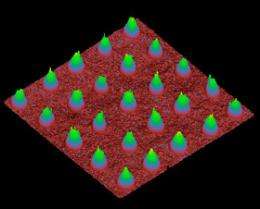
An atomic force microscopy topographic image of the nano-brushes. The relative heights of the brushes can be tailored by changing the substrate and initiators. Credit: Stefan Zauscher, Pratt School of Engineering

(PhysOrg.com) -- Just as cilia lining the lungs help keep passages clear by moving particles along the tips of the tiny hair-structures, man-made miniscule bristles known as nano-brushes can help reduce friction along surfaces at the molecular level, among other things.

In their latest series of experiments, Duke University engineers have developed a novel approach to synthesize these nano-brushes, which could improve their versatility in the future. These polymer brushes are currently being used in biologic sensors and microscopic devices, such as microcantilevers, and they will play an important role in the future drive to miniaturization, the researchers said.

Nano-brushes are typically made of grown on flat surfaces with strands of the molecules growing up and out from a surface, much like hairs on a brush. Polymers are large man-made molecules ubiquitous in the manufacture of everyday products.

Like microscopic orchard keepers, the Duke scientists have grafted bundles of polymer “limbs” on flat surfaces known as substrates, already covered with brush bristles. In their approach, two dissimilar brushes can be joined and patterned on the . Because the “limbs” can be made out of a different substance than the substrate, the scientists believe these are able to significantly modify the properties of a given surface.

To make such a nano-brush, scientists add a chemical known as an initiator to the flat surface, which spurs the growth of the strands.

“One of the common ways of growing brushes is much like a dot matrix printer, with an initiator being the ink ‘printed’ onto an inorganic substrate, such as a silicon wafer or a , which then causes the brush bristles to grow in specified patterns,” said Stefan Zauscher, Alfred M. Hunt Faculty Scholar and associate professor of mechanical engineering and materials science at Duke’s Pratt School of Engineering.

“In our patterning approach we are now also able to initiate polymer brush growth on existing brush substrates and thus obtain patterned block copolymer brushes, just like grafts, on polymeric substrates,” Zauscher said. “The ability to create more intricate brush structures provides the potential for using them in biomedical applications as sensors for the detection of proteins or glucose.”

The results of his team’s experiments were published online in the journal Small. The research is supported by the National Science Foundation.

Zauscher said this new approach could be readily expanded to many other types of polymers, and to make either single or double layers of brushes. These nano-brushes, he said, would have many potential uses, and would open up the possibilities for building more complicated polymer architectures, which are much in demand for current and future technologies.

In recent research, published earlier in the journal Advanced Materials, Zauscher showed that stimulus-responsive nano-brushes resemble and act like sea anemones, which have a multitude of arms reaching up from an attached base. In the same fashion as these sea animals, nano-brushes can be used to capture and release micro-particles as they move across a surface.

“These microstructures have a potential use in microfluidic systems -- such as labs-on-a-chip -- to capture and release particles at predefined locations, much like the sea anemones capture their prey and guide it to their mouths,” Zauscher said.

Other Duke members of the team are Tao Chen and Debby Chang.

Provided by Duke University (news : web)

Filter


Move the slider to adjust rank threshold, so that you can hide some of the comments.


Display comments: newest first

AdrianMiller
Aug 26, 2010

Rank: not rated yet
Thanks for featuring this work! We've set the original scientific article free to access for the next month, so if anyone would like to know more you can find it here: http://www.materi...hes.html
Rank not rated yet
Relevant PhysicsForums posts
  • polymer nanocomposites
    created22 hours ago
  • Corrosion Tests on Magnesium
    createdFeb 09, 2012
  • polyethylene copper nanocomposite
    createdFeb 09, 2012
  • Output of xrd analysis
    createdFeb 08, 2012
  • Transport phenomena problem based on problems 18.B11 and 19B.6 from Bird, stewart, lw
    createdFeb 06, 2012
  • Help with material selection - Car Piston
    createdFeb 05, 2012
  • More from Physics Forums - Materials & Chemical Engineering

More news stories

What lies beneath: Mapping hidden nanostructures

The ability to diagnose and predict the properties of materials is vital, particularly in the expanding field of nanotechnology. Electron and atom-probe microscopy can categorize atoms in thin sheets of material, ...

Nanotechnology / Nanophysics

created 14 hours ago | popularity 5 / 5 (3) | comments 1

New kind of solar cell could capture significantly more energy than current cells

New solar cells could increase the maximum efficiency of solar panels by over 25%, according to scientists from the University of Cambridge.

Nanotechnology / Nanophysics

created Feb 08, 2012 | popularity 4.5 / 5 (12) | comments 14 | with audio podcast

Nanoshell whispering galleries improve thin solar panels

Visitors to Statuary Hall in the U.S. Capitol Building may have experienced a curious acoustic feature that allows a person to whisper softly at one side of the cavernous, half-domed room and for another on ...

Nanotechnology / Nanomaterials

created Feb 07, 2012 | popularity 4.3 / 5 (6) | comments 6 | with audio podcast

'Dark plasmons' transmit energy

Microscopic channels of gold nanoparticles have the ability to transmit electromagnetic energy that starts as light and propagates via "dark plasmons," according to researchers at Rice University.

Nanotechnology / Nanophysics

created Feb 09, 2012 | popularity 4.7 / 5 (7) | comments 1 | with audio podcast

Revealing how a battery material works

Since its discovery 15 years ago, lithium iron phosphate (LiFePO4) has become one of the most promising materials for rechargeable batteries because of its stability, durability, safety and ability to deliver ...

Nanotechnology / Nanomaterials

created Feb 08, 2012 | popularity 5 / 5 (5) | comments 0 | with audio podcast


Google users warned of threat to smartphone wallets

Users of Google smartphone wallets were being warned on Friday that there is a way to crack pass codes intended to thwart thieves from going on illicit shopping sprees.

Anonymous knocks CIA website offline (Update)

The website of the Central Intelligence Agency was inaccessible on Friday after the hacker group Anonymous claimed to have knocked it offline.

New error-correcting codes guarantee the fastest possible rate of data transmission

Error-correcting codes are one of the triumphs of the digital age. They’re a way of encoding information so that it can be transmitted across a communication channel — such as an optical fiber o ...

Humans may have helped the decline of African rainforests 3000 years ago

(PhysOrg.com) -- Large areas of rainforests in Central Africa mysteriously disappeared over three thousand years ago, to be replaced by savannas. The prevailing theory has been that the cause was a change ...

New power source discovered

(PhysOrg.com) -- Researchers at the Massachusetts Institute of Technology (MIT) and RMIT University have made a breakthrough in energy storage and power generation.

Complex wiring of the nervous system may rely on a just a handful of genes and proteins

Researchers at the Salk Institute have discovered a startling feature of early brain development that helps to explain how complex neuron wiring patterns are programmed using just a handful of critical genes. ...