Smallest U-M logo demonstrates advanced display technology
August 24, 2010
Smallest U-M logo demonstrates advanced display technology

Enlarge

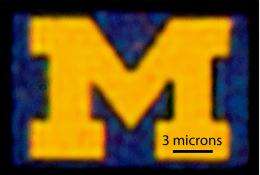
An optical microscopy image of a 12-by-9-micron U-M logo produced with this new color filter process. Credit: Jay Guo

In a step toward more efficient, smaller and higher-definition display screens, a University of Michigan professor has developed a new type of color filter made of nano-thin sheets of metal with precisely spaced gratings.

The gratings, sliced into metal-dielectric-metal stacks, act as resonators. They trap and transmit light of a particular color, or , said Jay Guo, an associate professor in the Department of Electrical Engineering and Computer Science. A dielectric is a material that does not conduct electricity.

"Simply by changing the space between the slits, we can generate different colors," Guo said. "Through nanostructuring, we can render white light any color."

A paper on the research is published Aug. 24 in Nature Communications.

His team used this technique to make what they believes is the smallest color U-M logo. At about 12-by-9 microns, it's about 1/6 the width of a human hair.

Conventional LCDs, or , are inefficient and manufacturing-intensive to produce. Only about 5 percent of their back-light travels through them and reaches our eyes, Guo said. They contain two layers of polarizers, a color filter sheet, and two layers of electrode-laced glass in addition to the liquid crystal layer. Chemical colorants for red, green and blue pixel components must be patterned in different regions on the screen in separate steps.

Guo's acts as a polarizer simultaneously, eliminating the need for additional polarizer layers. In Guo's displays, reflected light could be recycled to save much of the light that would otherwise be wasted.
Smallest U-M logo demonstrates advanced display technology
Enlarge

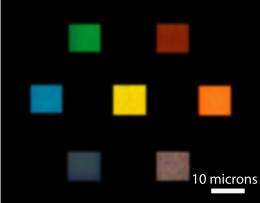
An optical microscopy image of seven color filters illuminated by white microscope light. Credit: Jay Guo

Because these new displays contain fewer layers, they would be simpler to manufacture, Guo said. The new color filters contain just three layers: two metal sheets sandwiching a dielectric. Red, green and blue pixel components could be made in one step by cutting arrays of slits in the stack. This structure is also more robust and can endure higher- powered light.

Red light emanates from slits set around 360 nanometers apart; green from those about 270 nanometers apart and blue from those approximately 225 nanometers apart. The differently spaced gratings essentially catch different wavelengths of light and resonantly transmit through the stacks.

"Amazingly, we found that even a few slits can already produce well-defined color, which shows its potential for extremely high-resolution display and spectral imaging," Guo said.

The pixels in Guo's displays are about an order of magnitude smaller than those on a typical computer screen. They're about eight times smaller than the pixels on the iPhone 4, which are about 78 microns. He envisions that this pixel size could make this technology useful in projection displays, as well as wearable, bendable or extremely compact displays.

The paper is called "Plasmonic nano-resonators for high resolution color filtering and spectral imaging."

Guo is also an associate professor in the Department of Macromolecular Science and Engineering. This research is supported in part by the Air Force Office of Scientific Research and the Defense Advanced Research Projects Agency. The university is pursuing patent protection for the intellectual property and is seeking commercialization partners to help bring the technology to market.

Provided by University of Michigan (news : web)

4.9 /5 (20 votes)  

Filter


Move the slider to adjust rank threshold, so that you can hide some of the comments.


Display comments: newest first

Parsec
Aug 24, 2010

Rank: not rated yet
NICE! Sounds like display technology is getting close to the resolution to be able to reproduce color holographic displays in real time. Give how fast computers are, hopefully we will see true 3D displays coming soon.
trekgeek1
Aug 24, 2010

Rank: not rated yet
I am very curious when displays will reach "real" resolution, i.e. you couldn't tell the difference between a screen and an open window. That will really be something. I suppose this will also be restricted by the max resolution of cameras too. Unless of course you use only computer generated images.
billyswong
Aug 25, 2010

Rank: not rated yet
Well, trekgeek1, I don't think your vision is that doable. To achieve "open window" level reality, one need not only a high resolution, but also a angle-dependent ray emission to imitate the distance of objects. That is asking for a 180° semi-spherical projector for each "pixel", each projecting a high definition image, such that light of an "object" come to the eye from multiple pixels in accordance to the position of the eye. Yes, "far away" objects must be blurry to short-sighted eyes and vice-versa. Those "3D-glasses" would never cut it.

What's actually achievable in near future is printing level resolution, so that when the screen image is not moving, you can't distinguish it from printed-out photographs. But that's already good enough for most purposes.
nevdka
Aug 25, 2010

Rank: not rated yet
there's more to holography than resolution. Looking from different angles would need to make it look different, and smaller pixels can't help. Holography works by encoding both amplitude (like 2D photography) and phase. You start getting into Fourier optics with this, but the amplitude and phase information combined give a true 3D image. Of course, you still need high resolution, but I suspect that 1080p would be acceptable.

The reason this hasn't been done so far (at least outside of a lab or physicist's garage) is because the Fourier optics is hard, and most holography needs coherent light. But it is technically possible, and now I've got an idea for a new weekend project...
DamienS
Aug 25, 2010

Rank: not rated yet
I am very curious when displays will reach "real" resolution, i.e. you couldn't tell the difference between a screen and an open window. That will really be something.

It has already happened - iPhone 4's retina display (at 326 dpi) exceeds the eye's ability (20/20 vision) to resolve its pixels at normal viewing distances.
Rank 4.9 /5 (20 votes)
Relevant PhysicsForums posts
  • Liverpool vs Manchester United
    created1 hour ago
  • Wearing black in a desert
    created1 hour ago
  • Did space exist before mass?
    created1 hour ago
  • How can E&M Waves be polarized?
    created1 hour ago
  • Does light travel for ever?
    created2 hours ago
  • Infinity by Particles
    created3 hours ago
  • More from Physics Forums - General Physics

More news stories

What lies beneath: Mapping hidden nanostructures

The ability to diagnose and predict the properties of materials is vital, particularly in the expanding field of nanotechnology. Electron and atom-probe microscopy can categorize atoms in thin sheets of material, ...

Nanotechnology / Nanophysics

created 12 hours ago | popularity 5 / 5 (1) | comments 1

New kind of solar cell could capture significantly more energy than current cells

New solar cells could increase the maximum efficiency of solar panels by over 25%, according to scientists from the University of Cambridge.

Nanotechnology / Nanophysics

created Feb 08, 2012 | popularity 4.5 / 5 (12) | comments 14 | with audio podcast

Nanoshell whispering galleries improve thin solar panels

Visitors to Statuary Hall in the U.S. Capitol Building may have experienced a curious acoustic feature that allows a person to whisper softly at one side of the cavernous, half-domed room and for another on ...

Nanotechnology / Nanomaterials

created Feb 07, 2012 | popularity 4.3 / 5 (6) | comments 6 | with audio podcast

'Dark plasmons' transmit energy

Microscopic channels of gold nanoparticles have the ability to transmit electromagnetic energy that starts as light and propagates via "dark plasmons," according to researchers at Rice University.

Nanotechnology / Nanophysics

created Feb 09, 2012 | popularity 5 / 5 (6) | comments 1 | with audio podcast

Revealing how a battery material works

Since its discovery 15 years ago, lithium iron phosphate (LiFePO4) has become one of the most promising materials for rechargeable batteries because of its stability, durability, safety and ability to deliver ...

Nanotechnology / Nanomaterials

created Feb 08, 2012 | popularity 5 / 5 (5) | comments 0 | with audio podcast


Google users warned of threat to smartphone wallets

Users of Google smartphone wallets were being warned on Friday that there is a way to crack pass codes intended to thwart thieves from going on illicit shopping sprees.

Anonymous knocks CIA website offline (Update)

The website of the Central Intelligence Agency was inaccessible on Friday after the hacker group Anonymous claimed to have knocked it offline.

Complex wiring of the nervous system may rely on a just a handful of genes and proteins

Researchers at the Salk Institute have discovered a startling feature of early brain development that helps to explain how complex neuron wiring patterns are programmed using just a handful of critical genes. ...

New error-correcting codes guarantee the fastest possible rate of data transmission

Error-correcting codes are one of the triumphs of the digital age. They’re a way of encoding information so that it can be transmitted across a communication channel — such as an optical fiber o ...

The power of estrogen -- male snakes attract other males

A new study has shown that boosting the estrogen levels of male garter snakes causes them to secrete the same pheromones that females use to attract suitors, and turned the males into just about the sexiest ...

Humans may have helped the decline of African rainforests 3000 years ago

(PhysOrg.com) -- Large areas of rainforests in Central Africa mysteriously disappeared over three thousand years ago, to be replaced by savannas. The prevailing theory has been that the cause was a change ...