Space detector prepares to scour universe for secrets (Update)
August 25, 2010
The AMS detector is due to reach the space station on the last US Space Shuttle mission towards the end of February 2011

Enlarge

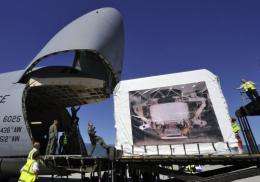
The European Organisation for Nuclear Research's (CERN) Alpha Magnetics Spectrometer (AMS), is loaded onto a US Air Force C-5 Galaxy cargo plane at Geneva's internatioal airport. The huge physics detector that will scour outer space for clues to the origins of the universe began the first stage of its voyage to the International Space Station at Geneva airport.

A huge physics detector that will scour outer space for clues to the origins of the universe began the first stage of its voyage to the International Space Station at Geneva airport on Wednesday.

The European Organisation for Nuclear Research (CERN) loaded the Alpha Magnetic Spectrometer (AMS) onto a giant C5 Galaxy US military transport plane, which will fly it to the Kennedy Space Centre in Florida on Thursday.

"The AMS left the research centre on Tuesday and was loaded onto an aircraft specially sent by the US air force on Wednesday," CERN spokesman James Gillies told AFP.

The AMS detector is due to reach the space station on the last US Space Shuttle mission towards the end of February 2011, he added.

The AMS is meant to complement attempts by the world's biggest atom smasher at CERN, the Large Hadron Collider, to unravel some of the secrets of the creation of the universe and add to its scientific data.

The detector's main target is the search for and antimatter, two of the mysterious missing links in human knowledge of the universe and life on earth.

The AMS "must notably find where antimatter came from", Gillies explained, by searching for stars in far flung galaxies that scientists believe to be entirely made of .

Under the theoretical standard laws of physics, for every type of ordinary particle -- matter -- a corresponding "antiparticle" exists.

Despite the huge precautions and scientific precision surrounding the experiment, loading was delayed on Wednesday because of trouble squeezing the container into the aircraft.

The top of the container was eventually removed and covered with plastic to fit into the plane, said.

(c) 2010 AFP

4.8 /5 (12 votes)  

Rank 4.8 /5 (12 votes)
Related Stories
Relevant PhysicsForums posts
  • Titan's lack of impact craters
    created21 hours ago
  • Real pictures of black hole eating a star?
    createdFeb 08, 2012
  • Hypothetical way to travel faster than light, but not technically exceed lightspeed
    createdFeb 06, 2012
  • How do scientists monitor the Sun's activity?
    createdFeb 05, 2012
  • Search patterns in observational studies
    createdFeb 05, 2012
  • Derivation of Pogson's law
    createdFeb 03, 2012
  • More from Physics Forums - General Astronomy

More news stories

Mars Science Laboratory computer issue resolved

(PhysOrg.com) -- Engineers have found the root cause of a computer reset that occurred two months ago on NASA's Mars Science Laboratory and have determined how to correct it.

Space & Earth / Space Exploration

created 43 minutes ago | popularity 5 / 5 (1) | comments 1 | with audio podcast

Clam fields found at deep, low-temperature Mariana vents

(PhysOrg.com) -- Scientists have marveled at the unusual life forms thriving at high temperature hydrothermal vents of the deep ocean.

Space & Earth / Earth Sciences

created 18 minutes ago | popularity not rated yet | comments 0 | with audio podcast

Streams need trees to withstand climate change

(PhysOrg.com) -- More than twenty years of biological monitoring have confirmed the importance of vegetation for protecting Australia's freshwater streams and rivers against the ravages of drought and climate ...

Space & Earth / Environment

created 27 minutes ago | popularity not rated yet | comments 0

The turbulent birth of super star clusters in galaxy mergers

By combining two of the most advanced telescopes in the world -- the new Atacama Large Millimeter Array (ALMA) and the Very Large Telescope (VLT) of ESO -- a team of French astronomers from the Institut d'astrophysique ...

Space & Earth / Astronomy

created 9 minutes ago | popularity not rated yet | comments 0

Putin receives 'prehistoric' water from Antarctic lake

Prime Minister Vladimir Putin was given a water sample Friday taken from a pristine lake hidden under Antarctic ice for over a million years, after Russian scientists drilled down to its surface.

Space & Earth / Earth Sciences

created 49 minutes ago | popularity 5 / 5 (1) | comments 0


A frank discussion of the power law and linking correlation to causation

(PhysOrg.com) -- Michael Stumpf a mathematics professor at Imperial College in London, and Mason Porter a lecturer at Oxford have teamed together to write and publish a perspective piece in Science regarding the in ...

Advanced power-grid model finds low-cost, low-carbon future in West

(PhysOrg.com) -- The least expensive way for the Western U.S. to reduce greenhouse gas emissions enough to help prevent the worst consequences of global warming is to replace coal with renewable and other ...

Small modular reactor design could be a 'SUPERSTAR'

(PhysOrg.com) -- Though most of today's nuclear reactors are cooled by water, we've long known that there are alternatives; in fact, the world's first nuclear-powered electricity in 1951 came from a reactor ...

Seeing colors in music, tasting flavors in shapes may happen in life's early months

Famed violinist Itzhak Perlman sees a deep forest green whenever he plays a B-flat on his Stradivarius' G string. The A on the E string is red.

The question of life in the ancient world

There’s a general feeling that we don’t get the Greeks – ancient or modern. Many, including heads of state like Angela Merkel, visibly shake their head in exasperation, rightly or wrongly, at ...

Study suggests girls can 'rewire' brains to ward off depression

(Medical Xpress) -- What if you could teach your brain to respond differently to things that make you feel sad, down or stressed out? What if doing that helped ward off depression?