Measuring the universe
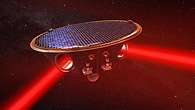
A unique antenna which could help unveil a new window on the universe by observing thousands of gravitational waves should be one of NASA's next space missions according to a group of leading US experts.
The US National Research Council (NRC) has recommended that the Laser Interferometer Space Antenna (LISA) as one of NASA's next two major space missions, to start in 2016 and collaboration with the European Space Agency.
LISA, developed by a team of international scientists from the US and Europe including experts in gravitational wave research from the School of Physics and Astronomy, consists of three spacecraft in a triangular configuration with 5-millionkilometer arms (12.5 times the distance from the Earth to the moon), moving in an Earth like orbit around the sun.
University scientists, as members of the LISA International Science Community, have helped make the science case for LISA and shown how LISA could help measure the expansion of the universe and test Einstein's theory of relativity.
Gravitational waves from sources throughout the universe will produce slight oscillations in the arm lengths - changes as small as about 10 picometers, or 10 million millionths of a meter, a length smaller than the diameter of the smallest atom.
LISA captures motion using laser links to monitor the displacements of gold-platinum test masses floating inside the spacecraft and observe gravitational waves in a lower frequency band (0.1 milliHertz to 1 Hertz) than that detectable by LIGO and other ground-based instruments, which are designed to sense sources at frequencies above 10 Hertz.
Professor Bernard F Schutz, School of Physics and Astronomy, and Director of the Institute for Gravitational Physics (Albert Einstein Institute) in Germany, said: "This strong endorsement by America's leading astronomers makes it official: LISA has the potential to become one of the most important astronomical observatories of our time.
"When LISA was adopted by the ESA in 1995, it was because its observations of gravitational waves would provide powerful insight into the fundamentals of gravity, of Einstein's theory and all its predictions.
"In the last 15 years, astronomers also have learned how LISA can open up hidden chapters in the history of the universe, by listening to the waves made by the very first stars, the earliest black holes, and by some of the oldest stars in existence today.
"By seeing how the waves from early black holes are stretched out as they move toward us through the expanding universe, LISA can even study the mysterious dark energy."
The Laser Interferometer Space Antenna (LISA) LISA is designed to be complementary to the ground-based observatories (the Laser Interferometer Gravitational-Wave Observatory, or LIGO, in the United States, and Virgo and GEO-600 in Europe).
The existence of the waves was predicted by Albert Einstein in 1916 in his general theory of relativity.
Professor Sathyaprakash, School of Physics and Astronomy, and an expert in gravitational waves, said: “The endorsement takes us closer to the realisation of the mission and we are truly excited about the prospects of doing fundamental physics, astronomy and cosmology with LISA.
“LISA is a fantastic mission for exploring the geometrical and dynamical properties of the Universe and to test predictions of Einstein's general theory of relativity near black holes and other exotic objects.
“If NASA chooses to follow the advice of the NRC, LISA should unravel the nature of dark energy, the origin of black holes at galactic nuclei and understand ultra-strong gravity near black hole horizons.”
In the "Astro2010" decadal survey, the panel of experts was convened to look at the coming decade and prioritize all research activities in astronomy and astrophysics, as well as at the interface of these disciplines with physics.
The survey recommended LISA highly because of the expectation that observations of gravitational waves in space will answer key scientific questions about the astrophysics of the cosmic dawn and the physics of the universe.
Because gravitational waves are moving ripples in the curvature of space, and because LISA will sense ripples coming simultaneously from tens of thousands of sources in every direction, the instrument acts more like a microphone listening to sound than like a telescope or a camera taking a picture.
This new kind of observing tells us directly about the motion of invisible masses, complementing traditional astronomical observations of light, which reveal only visible atoms.
LISA's hardware is expected to be first tested in space with the launch of LISA Pathfinder by ESA by 2013 which will include a thorough test of a crucial component of LISA's technology: drag-free operation, whereby the spacecraft shield the test masses from external disturbances by precisely monitoring their motions and moving around them to preserve their free fall.
Karsten Danzmann, European chair of the LISA International Science Team said: "We are looking forward to unveiling a new window on the universe by observing thousands of gravitational wave sources.
"This recommendation and our excellent reputation in the scientific community encourages us a lot. With LISA we will open up an entirely new way of observing the universe, with immense potential to enlarge our understanding of physics and astronomy in unforeseen ways."
More information: Laser Interferometer Space Antenna (LISA): www.lisa.aei-hannover.de/?page … isa&sub=lisa&lang=en
Provided by Cardiff University


