Microneedle, quantum dot study opens door to new clinical cancer tools
August 25, 2010
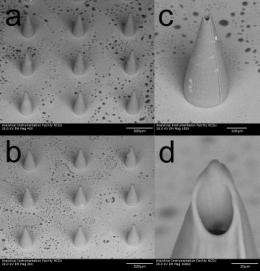
Hollow microneedles open the door to new techniques for diagnosing and treating a variety of medical conditions, including skin cancer. Credit: Roger Narayan, Faraday Discussions, http://dx.doi.org/10.1039/C005374K - Reproduced by permission of the Royal Society of Chemistry.
Researchers from North Carolina State University have developed extremely small microneedles that can be used to deliver medically-relevant nanoscale dyes called quantum dots into skin - an advance that opens the door to new techniques for diagnosing and treating a variety of medical conditions, including skin cancer.
"We were able to fabricate hollow, plastic microneedles using a laser-based rapid-prototyping approach," says Dr. Roger Narayan, one of the lead researchers, "and found that we could deliver a solution containing quantum dots using these microneedles." Microneedles are very small needles in which at least one dimension - such as length - is less than one millimeter. Narayan is a professor in the joint biomedical engineering department of NC State's College of Engineering and the University of North Carolina at Chapel Hill.
"The motivation for the study was to see whether we could use microneedles to deliver quantum dots into the skin," Narayan says. "Our findings are significant, in part, because this technology will potentially enable researchers to deliver quantum dots, suspended in solution, to deeper layers of skin. That could be useful for the diagnosis and treatment of skin cancers, among other conditions." Quantum dots are nanoscale crystals with unique properties in terms of light emission. They hold promise as a tool in medical diagnosis.
The researchers created the plastic microneedles and tested them using pig skin, which has characteristics closely resembling human skin. Using a water-based solution containing quantum dots, the researchers were able to capture images of the quantum dots entering the skin using multiphoton microscopy. These images show the mechanism by which the quantum dots enter the layers of skin, allowing the researchers to verify the effectiveness of the microneedles as a delivery mechanism for quantum dots.
The imaging method used in this study, multiphoton microscopy, may have clinical applications for real-time imaging of dyes - such as quantum dots - in the skin. This could contribute to more rapid diagnosis of cancers or other medical problems.
The study is also significant because it shows that a laser-based rapid prototyping approach allows for the creation of microneedles of varying lengths and shapes. This will allow physicians to create microneedles that are customized for treatment of a specific condition.
Specifically, the microneedles were created using two-photon polymerization, an approach pioneered by NC State and Laser Zentrum Hannover for use in medical device applications. Two-photon polymerization allowed the researchers to create hollow, plastic microneedles with specific design characteristics. "Our use of this fabrication technology highlights its potential for other small-scale medical device applications," Narayan says.
More information: A paper describing the study, "Multiphoton microscopy of transdermal quantum dot delivery using two photon polymerization-fabricated polymer microneedles," will be published in the September issue of Faraday Discussions.
-
Ceramic hybrid needles take the sting out of shots
Jan 07, 2008 |
not rated yet |
0
-
New microneedle antimicrobial techniques may foster medical tech innovation
May 19, 2010 |
not rated yet |
0
-
Microneedles Could Replace Syringe
Mar 10, 2008 |
not rated yet |
0
-
New genre of sugar-coated 'quantum dots' for drug delivery
Mar 04, 2009 |
not rated yet |
0
-
Coupling of Single Quantum Dots to Smooth Metal Films
Jul 20, 2009 |
not rated yet |
0
-
Engineers build first sub-10-nm carbon nanotube transistor
Feb 01, 2012 |
4.9 / 5 (31) |
30
-
Something old, something new: Evolution and the structural divergence of duplicate genes
Jan 31, 2012 |
4.6 / 5 (7) |
1
-
The hidden nanoworld of ice crystals: Revealing the dynamic behavior of quasi-liquid layers
Jan 30, 2012 |
5 / 5 (3) |
1
-
Stock market network reveals investor clustering
Jan 27, 2012 |
3.9 / 5 (23) |
8
-
Of microchemistry and molecules: Electronic microfluidic device synthesizes biocompatible probes
Jan 26, 2012 |
5 / 5 (1) |
0
-
Mitosis
2 hours ago
-
Stem cell question.
3 hours ago
-
Protease cleavage
10 hours ago
-
Pertubance in a model
16 hours ago
-
Cancer drugs and Alzheimer's, Oh my!
Feb 09, 2012
-
Squishing cells
Feb 09, 2012
- More from Physics Forums - Biology
More news stories
What lies beneath: Mapping hidden nanostructures
The ability to diagnose and predict the properties of materials is vital, particularly in the expanding field of nanotechnology. Electron and atom-probe microscopy can categorize atoms in thin sheets of material, ...
14 hours ago |
5 / 5 (3) |
1
New kind of solar cell could capture significantly more energy than current cells
New solar cells could increase the maximum efficiency of solar panels by over 25%, according to scientists from the University of Cambridge.
Feb 08, 2012 |
4.5 / 5 (12) |
14
|
Nanoshell whispering galleries improve thin solar panels
Visitors to Statuary Hall in the U.S. Capitol Building may have experienced a curious acoustic feature that allows a person to whisper softly at one side of the cavernous, half-domed room and for another on ...
Nanotechnology / Nanomaterials
Feb 07, 2012 |
4.3 / 5 (6) |
6
|
'Dark plasmons' transmit energy
Microscopic channels of gold nanoparticles have the ability to transmit electromagnetic energy that starts as light and propagates via "dark plasmons," according to researchers at Rice University.
Feb 09, 2012 |
4.7 / 5 (7) |
1
|
Revealing how a battery material works
Since its discovery 15 years ago, lithium iron phosphate (LiFePO4) has become one of the most promising materials for rechargeable batteries because of its stability, durability, safety and ability to deliver ...
Nanotechnology / Nanomaterials
Feb 08, 2012 |
5 / 5 (5) |
0
|
Google users warned of threat to smartphone wallets
Users of Google smartphone wallets were being warned on Friday that there is a way to crack pass codes intended to thwart thieves from going on illicit shopping sprees.
Anonymous knocks CIA website offline (Update)
The website of the Central Intelligence Agency was inaccessible on Friday after the hacker group Anonymous claimed to have knocked it offline.
New error-correcting codes guarantee the fastest possible rate of data transmission
Error-correcting codes are one of the triumphs of the digital age. Theyre a way of encoding information so that it can be transmitted across a communication channel such as an optical fiber o ...
Humans may have helped the decline of African rainforests 3000 years ago
(PhysOrg.com) -- Large areas of rainforests in Central Africa mysteriously disappeared over three thousand years ago, to be replaced by savannas. The prevailing theory has been that the cause was a change ...
New power source discovered
(PhysOrg.com) -- Researchers at the Massachusetts Institute of Technology (MIT) and RMIT University have made a breakthrough in energy storage and power generation.
Complex wiring of the nervous system may rely on a just a handful of genes and proteins
Researchers at the Salk Institute have discovered a startling feature of early brain development that helps to explain how complex neuron wiring patterns are programmed using just a handful of critical genes. ...