Russian gas tanker forges Arctic passage to China
August 25, 2010 by Alissa de Carbonnel
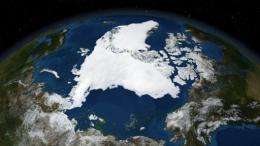
A NASA-issued photo shows the end of the Arctic's melt season. A Russian gas tanker is this month making a historic voyage across the famed Northeast passage as receding ice opens up an elusive trade route from Asia to the West sought for centuries by explorers.
A Russian gas tanker is this month making a historic voyage across the famed Northeast passage as receding ice opens up an elusive trade route from Asia to the West sought for centuries by explorers.
The 114,564-tonne tanker Baltica, escorted by the world's two most powerful nuclear ice breakers, sailed from Russia's northernmost port of Murmansk on August 14.
The largest vessel to ever navigate once-impassable route, the Baltica is due to deliver its cargo of gas condensate to China in the first weeks of September.
Russian television has shown the tanker making cautious progress through chunky sheets of ice in the wake of the steel-rimmed ice breakers, as a polar bear loped across ice floes within shouting distance of the ships.
"Never before has a ship of this size passed via the Northeast sea passage," said Captain Alexander Nikiforov in an interview with Russian channel NTV.
The trailblazing voyage by Russian state-owned shipping giant Sovcomflot is the latest Kremlin bid to mark out its stake over the energy-rich Arctic, where retreating ice cover amid global warming is opening new strategic trade routes.
Russia hopes to make the Arctic route a competitor to the Suez Canal and increase cargo traffic along its Siberian coast from two millions tonne a year now to 30 million tonnes -- profiting off taxes and the lease of its unique fleet of nuclear ice breakers.
The Northeast passage is tens of thousands of kilometres shorter than existing routes, stretching 13,000 kilometres along Russian shores to Asia compared to the 22,000-kilometres passage via the Suez Canal, Sovcomflot said.
"The aim of the voyage is to determine the feasibility of delivering energy on a regular, economically viable and safe basis along the Northern Sea Route from the Barents and Kara Seas to the markets of Southeast Asia," Sovcomflot said in statement.
But mariners admit many obstacles remain before Russia's shipping route might steal business from established southern thoroughfares -- not least because of a summer that lasts just a few weeks.
Sovcomflot said it must find new deep-water routes to steer heavy tankers through the perilous coastal waters and contend with free-floating icebergs that make the route hard to time and unreliable.
"The summer in Arctic waters lasts 2-2.5 months. It's winter the rest of the time," chief engineer Boris Abakhov told NTV, bundled in a parka and wool hat aboard the mighty ice-breaker Rossiya.
As the tanker neared the most precarious stretch of its journey -- via the Vilkitsky Strait, leading around Siberia's northernmost tip -- mariners floated a wreath in memory of sailors who died in the icy waters, television showed.
The shallow, ice-choked strait, named after Russian explorer Boris Vilkitsky who mapped it in 1913, separates the Kara Sea from the Laptev Sea about halfway along the Siberian coastline.
In 1553, the British adventurer Sir Hugh Willoughby perished with his crew in the Arctic waters on an expedition to discover a northern route to China.
While Russia has long shipped small cargo along its sprawling Arctic shores, two German cargo ships made the first commercial trip last summer from South Korea to the Netherlands even as UN secretary General Ban Ki-moon warned the Arctic may be ice-less as soon as 2037.
Since a Russian expedition planted a flag at the North Pole in 2007, the five Arctic nations -- Russia, the United States, Norway, Denmark and Canada -- have grown more vocal in their competing claims over swaths of the energy-rich territory.
(c) 2010 AFP
-
Arctic sea ice annual freeze-up underway
Oct 03, 2008 |
not rated yet |
0
-
Arctic sea ice may be at 'tipping point'
Sep 16, 2005 |
not rated yet |
0
-
Russia, Canada To Use Space Technologies For Rescue In Arctic
Sep 05, 2005 |
not rated yet |
0
-
China sets sail for the Arctic
Jun 30, 2010 |
not rated yet |
0
-
Record-setting Arctic Ocean trip completed
Nov 01, 2005 |
not rated yet |
0
-
Engineers build first sub-10-nm carbon nanotube transistor
Feb 01, 2012 |
4.9 / 5 (31) |
30
-
Something old, something new: Evolution and the structural divergence of duplicate genes
Jan 31, 2012 |
4.6 / 5 (7) |
1
-
The hidden nanoworld of ice crystals: Revealing the dynamic behavior of quasi-liquid layers
Jan 30, 2012 |
5 / 5 (3) |
1
-
Stock market network reveals investor clustering
Jan 27, 2012 |
3.9 / 5 (23) |
8
-
Of microchemistry and molecules: Electronic microfluidic device synthesizes biocompatible probes
Jan 26, 2012 |
5 / 5 (1) |
0
-
Discrepancy between oxygen and carbon-dioxide levels
Feb 09, 2012
-
where gems are found in the world
Feb 09, 2012
-
Wind Waves in Reservoir ~ Wind run-up and Wind set-up
Feb 08, 2012
-
Balance of oxygen in the atmosphere
Feb 01, 2012
-
The case for a methanol-based economy
Jan 30, 2012
-
Weather in a rotating cylinder
Jan 25, 2012
- More from Physics Forums - Earth
More news stories
Humans may have helped the decline of African rainforests 3000 years ago
(PhysOrg.com) -- Large areas of rainforests in Central Africa mysteriously disappeared over three thousand years ago, to be replaced by savannas. The prevailing theory has been that the cause was a change ...
Could Venus be shifting gear?
(PhysOrg.com) -- ESAs Venus Express spacecraft has discovered that our cloud-covered neighbour spins a little slower than previously measured. Peering through the dense atmosphere in the infrared, the ...
Space & Earth / Space Exploration
13 hours ago |
5 / 5 (7) |
7
|
NASA sees wide-eyed cyclone Jasmine
Cyclone Jasmine's eye has opened wider on NASA satellite imagery, as it moves through the Southern Pacific Ocean.
Space & Earth / Earth Sciences
5 hours ago |
3.5 / 5 (2) |
1
NASA budget will axe Mars deal with Europe: scientists
US President Barack Obama's budget proposal to be submitted next week for 2013 will cut NASA's budget by 20 percent and eliminate a major partnership with Europe on Mars exploration, scientists said Thursday.
Space & Earth / Space Exploration
16 hours ago |
5 / 5 (2) |
18
Mars Science Laboratory computer issue resolved
(PhysOrg.com) -- Engineers have found the root cause of a computer reset that occurred two months ago on NASA's Mars Science Laboratory and have determined how to correct it.
Space & Earth / Space Exploration
14 hours ago |
4.7 / 5 (6) |
3
|
Google users warned of threat to smartphone wallets
Users of Google smartphone wallets were being warned on Friday that there is a way to crack pass codes intended to thwart thieves from going on illicit shopping sprees.
Anonymous knocks CIA website offline (Update)
The website of the Central Intelligence Agency was inaccessible on Friday after the hacker group Anonymous claimed to have knocked it offline.
Complex wiring of the nervous system may rely on a just a handful of genes and proteins
Researchers at the Salk Institute have discovered a startling feature of early brain development that helps to explain how complex neuron wiring patterns are programmed using just a handful of critical genes. ...
New error-correcting codes guarantee the fastest possible rate of data transmission
Error-correcting codes are one of the triumphs of the digital age. Theyre a way of encoding information so that it can be transmitted across a communication channel such as an optical fiber o ...
The power of estrogen -- male snakes attract other males
A new study has shown that boosting the estrogen levels of male garter snakes causes them to secrete the same pheromones that females use to attract suitors, and turned the males into just about the sexiest ...
New power source discovered
(PhysOrg.com) -- Researchers at the Massachusetts Institute of Technology (MIT) and RMIT University have made a breakthrough in energy storage and power generation.