'Greening' your flat screen TV
August 25, 2010
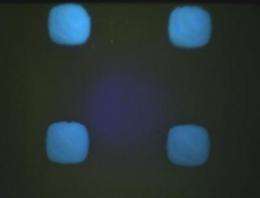
Organic LED lights were created in the Tel Aviv University lab. Credit: AFTAU
Electronic products pollute our environment with a number of heavy metals before, during and after they're used. In the U.S. alone, an estimated 70% of heavy metals in landfill come from discarded electronics. With flat screen TVs getting bigger and cheaper every year, environmental costs continue to mount.
To counter this, a new Tel Aviv University solution applies a discovery in nanotechnology, based on self-assembled peptide nanotubes, to "green" the optics and electronics industry. Researchers Nadav Amdursky and Prof. Gil Rosenman of Tel Aviv University's Department of Electrical Engineering say their technology could make flat screen TV production green and can even make medical equipment -- like subcutaneous ultrasound devices -- more sensitive.
Inspired by a biomaterial involved in Alzheimer's disease research discovered by Prof. Ehud Gazit of the university's Department of Microbiology and Biotechnology, the scientists developed a new nano-material, applying the scientific disciplines of both biology and physics. This biological material is the basis for their new, environmentally-friendly variety of light-emitting diodes (LED) used in both consumer and medical electronics.
TV in a test tube?
Their new invention is more than a clean, green way to create light, the researchers say. It also generates a strong signal that can be used in other applications in the nano-world of motors, actuators and ultrasound.
"We are growing our own light sources," says Amdursky, a doctoral student working under Prof. Rosenman's supervision. The organic nano-lightsticks he and his supervisors have developed using organic chemistry are made from carbon, making them cheap as well as environmentally friendly.
Unlike conventional light sources, the biologically-derived light source has a nanoscale architecture, easing the integration into light-emitting devices such as LED TVs and improving the resolution of the picture as well. The Tel Aviv University team has recently written a patent to cover their "organic LED" lights.
From living rooms to hospital rooms
According to Amdursky, the light emitted by the new light sticks is not appreciably different than that which emanates from today's inorganically engineered LED lights.
"We don't need a special plant, bacterium or a big machine to grow these structures in," says Amdursky, who says the applications of the technology are wider than the widest screen television. The core technology and structures, described in Advanced Materials, Nano Letters, and ACS Nano, exhibit "piezoelectric characteristics," necessary for the development of tiny nano-ultrasound machines that could scan cells from inside the body. Piezoelectric motors or actuators are only dozens of nanometers wide, which can lead to their application in energy harvesting systems as super-capacitors -- large energy storage devices, necessary for the solar energy and wind energy business.
-
A (nano-) window that washes itself?
Dec 03, 2009 |
not rated yet |
0
-
Tiny 'lab-on-a-chip' detects pollutants, disease and biological weapons
Feb 17, 2009 |
not rated yet |
0
-
A pinch of light: Laser 'tweezers' for medicine, communications and harvesting energy
Jul 06, 2010 |
not rated yet |
0
-
A new energy source from the common pea
Mar 04, 2010 |
not rated yet |
0
-
New material for nanoscale computer chips
Aug 17, 2009 |
not rated yet |
0
-
Engineers build first sub-10-nm carbon nanotube transistor
Feb 01, 2012 |
4.9 / 5 (31) |
30
-
Something old, something new: Evolution and the structural divergence of duplicate genes
Jan 31, 2012 |
4.6 / 5 (7) |
1
-
The hidden nanoworld of ice crystals: Revealing the dynamic behavior of quasi-liquid layers
Jan 30, 2012 |
5 / 5 (3) |
1
-
Stock market network reveals investor clustering
Jan 27, 2012 |
3.9 / 5 (23) |
8
-
Of microchemistry and molecules: Electronic microfluidic device synthesizes biocompatible probes
Jan 26, 2012 |
5 / 5 (1) |
0
-
polymer nanocomposites
22 hours ago
-
Corrosion Tests on Magnesium
Feb 09, 2012
-
polyethylene copper nanocomposite
Feb 09, 2012
-
Output of xrd analysis
Feb 08, 2012
-
Transport phenomena problem based on problems 18.B11 and 19B.6 from Bird, stewart, lw
Feb 06, 2012
-
Help with material selection - Car Piston
Feb 05, 2012
- More from Physics Forums - Materials & Chemical Engineering
More news stories
What lies beneath: Mapping hidden nanostructures
The ability to diagnose and predict the properties of materials is vital, particularly in the expanding field of nanotechnology. Electron and atom-probe microscopy can categorize atoms in thin sheets of material, ...
14 hours ago |
5 / 5 (3) |
1
New kind of solar cell could capture significantly more energy than current cells
New solar cells could increase the maximum efficiency of solar panels by over 25%, according to scientists from the University of Cambridge.
Feb 08, 2012 |
4.5 / 5 (12) |
14
|
Nanoshell whispering galleries improve thin solar panels
Visitors to Statuary Hall in the U.S. Capitol Building may have experienced a curious acoustic feature that allows a person to whisper softly at one side of the cavernous, half-domed room and for another on ...
Nanotechnology / Nanomaterials
Feb 07, 2012 |
4.3 / 5 (6) |
6
|
'Dark plasmons' transmit energy
Microscopic channels of gold nanoparticles have the ability to transmit electromagnetic energy that starts as light and propagates via "dark plasmons," according to researchers at Rice University.
Feb 09, 2012 |
4.7 / 5 (7) |
1
|
Revealing how a battery material works
Since its discovery 15 years ago, lithium iron phosphate (LiFePO4) has become one of the most promising materials for rechargeable batteries because of its stability, durability, safety and ability to deliver ...
Nanotechnology / Nanomaterials
Feb 08, 2012 |
5 / 5 (5) |
0
|
Google users warned of threat to smartphone wallets
Users of Google smartphone wallets were being warned on Friday that there is a way to crack pass codes intended to thwart thieves from going on illicit shopping sprees.
Anonymous knocks CIA website offline (Update)
The website of the Central Intelligence Agency was inaccessible on Friday after the hacker group Anonymous claimed to have knocked it offline.
New error-correcting codes guarantee the fastest possible rate of data transmission
Error-correcting codes are one of the triumphs of the digital age. Theyre a way of encoding information so that it can be transmitted across a communication channel such as an optical fiber o ...
Humans may have helped the decline of African rainforests 3000 years ago
(PhysOrg.com) -- Large areas of rainforests in Central Africa mysteriously disappeared over three thousand years ago, to be replaced by savannas. The prevailing theory has been that the cause was a change ...
New power source discovered
(PhysOrg.com) -- Researchers at the Massachusetts Institute of Technology (MIT) and RMIT University have made a breakthrough in energy storage and power generation.
Complex wiring of the nervous system may rely on a just a handful of genes and proteins
Researchers at the Salk Institute have discovered a startling feature of early brain development that helps to explain how complex neuron wiring patterns are programmed using just a handful of critical genes. ...