Scientists develop the first atomic view of key genetic processes (w/ Video)
August 25, 2010
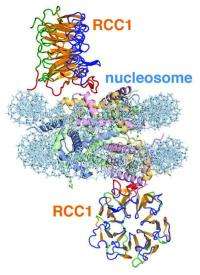
Scientists at Penn State University have created the first 3-D picture of genetic processes that happen inside every cell of our bodies. The picture is the first-ever image of a protein interacting with DNA in its tightly packed "nucleosome" form. The research, which reveals new information about genetic processes, is expected to aid future investigations into diseases such as cancer. This 2-D image illustrates the RCC1 chromatin protein interacting with the nucleosome. Credit: Song Tan lboratory, Penn State University
In a landmark study to be published in the journal Nature, scientists have been able to create the first picture of genetic processes that happen inside every cell of our bodies. Using a 3-D visualization method called X-ray crystallography, Song Tan, an associate professor of biochemistry and molecular biology at Penn State University, has built the first-ever image of a protein interacting with the nucleosome -- DNA packed tightly into space-saving bundles organized around a protein core. The research is expected to aid future investigations into diseases such as cancer.
As the genetic blueprint of life, DNA must be deciphered or "read," even when densely packed into nucleosomes. The nucleosome is therefore a key target of genetic processes in a cell and a focus of scientific investigations into how normal and diseased cells work. Previous studies at Penn State and other research institutions led to the discovery of chromatin enzymes -- proteins that act to turn specific genes on or off by binding to the nucleosome. Since the three-dimensional structure of the nucleosome was determined 13 years ago, scientists have wondered how chromatin enzymes recognize and act on the nucleosome to regulate gene expression and other processes in a cell. "We needed to visualize how these enzymes are able to read such a complicated structure as the nucleosome," Tan said.
This video is not supported by your browser at this time.
Scientists at Penn State University have created the first 3-D picture of genetic processes that happen inside every cell of our bodies. The picture is the first-ever image of a protein interacting with DNA in its tightly packed "nucleosome" form. The research, which reveals new information about genetic processes, is expected to aid future investigations into diseases such as cancer. This 3-D animation illustrates the RCC1 chromatin protein interacting with the nucleosome. Credit: Song Tan laboratory, Penn State University
To tackle this problem, Ravindra D. Makde, a postdoctoral member of the research team led by Tan, grew molecular crystals of the protein RCC1 (regulator of chromosome condensation, a protein critical for proper separation of chromosomes during cell division) bound to the nucleosome, and used X-ray crystallography to determine the atomic structure of the complex. "Our results showed that the RCC1 protein binds to opposite sides of the nucleosome -- similar to pedals positioned on a tricycle wheel." The structure provides atomic details of how an enzyme can recognize both DNA and components of the protein core of the nucleosome. Unexpectedly, the structure also showed how DNA can stretch as it wraps into a nucleosome. "These findings provide the basis for understanding how RCC1 and other chromatin enzymes interact with DNA as it is packaged into chromatin in our cells," Tan said.The investigations were performed at the Penn State Center for Eukaryotic Gene Regulation, a multidisciplinary center focused on understanding the molecular basis for how genes are turned off and on in our bodies. "For years, the research community has been at an impasse," said Frank Pugh, Director of the center and the Willaman Professor in Molecular Biology at Penn State. "We were limited to only speculating how cellular proteins might bind the nucleosome. Now, with this structure, we are one step closer to understanding how cells read chromatin to regulate gene expression."
After nearly a decade of working to this goal, Tan and his team are excited to see the intricate interactions between a chromatin protein and the nucleosome. They are, however, even more enthusiastic about future prospects. "Our goal now is to determine the structures of other biologically and medically important chromatin enzymes bound to the nucleosome," said Tan. "We anticipate such studies will explain fundamental genetic processes and provide the basis for new therapeutics against human diseases such as cancer."
-
UCSD Engineer Provides Insights to Decades-Old DNA Squabble
Jul 31, 2009 |
not rated yet |
0
-
Researchers 'unzip' molecules to measure interactions keeping DNA packed in cells
Jan 28, 2009 |
not rated yet |
0
-
Roles of DNA packaging protein revealed
Feb 12, 2009 |
not rated yet |
0
-
Stem cell researchers uncover previously unknown patterns in DNA methylation
Jun 02, 2010 |
not rated yet |
0
-
Researchers determine the composition of centromeric chromatin
Sep 28, 2009 |
not rated yet |
0
-
Engineers build first sub-10-nm carbon nanotube transistor
Feb 01, 2012 |
4.9 / 5 (31) |
30
-
Something old, something new: Evolution and the structural divergence of duplicate genes
Jan 31, 2012 |
4.6 / 5 (7) |
1
-
The hidden nanoworld of ice crystals: Revealing the dynamic behavior of quasi-liquid layers
Jan 30, 2012 |
5 / 5 (3) |
1
-
Stock market network reveals investor clustering
Jan 27, 2012 |
3.9 / 5 (23) |
8
-
Of microchemistry and molecules: Electronic microfluidic device synthesizes biocompatible probes
Jan 26, 2012 |
5 / 5 (1) |
0
-
Stoichiometry
21 hours ago
-
Boiling and melting point of impure substances
22 hours ago
-
Safe nitrogen compound to decompose a 500 deg C in a furnace?
Feb 09, 2012
-
[ask]electron inside drinking water
Feb 08, 2012
-
How to avoid formation of Lithium Chromate ???
Feb 08, 2012
-
how to choose a reduced or oxidated form in a redox
Feb 08, 2012
- More from Physics Forums - Chemistry
More news stories
Fool's gold may prove an unlikely alternative to overexploited catalytic materials
Catalytic materials, which lower the energy barriers for chemical reactions, are used in everything from the commercial production of chemicals to catalytic converters in car engines. However, with current catalytic materials ...
13 hours ago |
4.3 / 5 (7) |
5
|
Unpicking HIV’s invisibility cloak
Drug researchers hunting for alternative ways to treat human immunodeficiency virus (HIV) infections may soon have a novel targetits camouflage coat. HIV hides inside a cloak unusually rich in a sugar ...
13 hours ago |
5 / 5 (4) |
0
No entry without protein recycling: Researchers discover new coherence in enzyme transport
The group of Prof. Dr. Ralf Erdmann at the Ruhr-Universität Bochum, Germany, discovered a connection of peroxisomal protein import and receptor export. In the Journal of Biological Chemistry, they disclo ...
13 hours ago |
not rated yet |
0
Hydrogen from acidic water: Researchers develop potential low cost alternative to platinum for splitting water
A technique for creating a new molecule that structurally and chemically replicates the active part of the widely used industrial catalyst molybdenite has been developed by researchers with the Lawrence Berkeley ...
Feb 09, 2012 |
5 / 5 (12) |
13
|
Under the microscope #7
In this video Dr Ingrid Graz shows us a thin layer of gold on top of rubber. Cracks in the gold allow it to stretch and we can use this for stretchable electronics.
15 hours ago |
not rated yet |
0
Anonymous knocks CIA website offline (Update)
The website of the Central Intelligence Agency was inaccessible on Friday after the hacker group Anonymous claimed to have knocked it offline.
Google users warned of threat to smartphone wallets
Users of Google smartphone wallets were being warned on Friday that there is a way to crack pass codes intended to thwart thieves from going on illicit shopping sprees.
New error-correcting codes guarantee the fastest possible rate of data transmission
Error-correcting codes are one of the triumphs of the digital age. Theyre a way of encoding information so that it can be transmitted across a communication channel such as an optical fiber o ...
Complex wiring of the nervous system may rely on a just a handful of genes and proteins
Researchers at the Salk Institute have discovered a startling feature of early brain development that helps to explain how complex neuron wiring patterns are programmed using just a handful of critical genes. ...
Humans may have helped the decline of African rainforests 3000 years ago
(PhysOrg.com) -- Large areas of rainforests in Central Africa mysteriously disappeared over three thousand years ago, to be replaced by savannas. The prevailing theory has been that the cause was a change ...
The power of estrogen -- male snakes attract other males
A new study has shown that boosting the estrogen levels of male garter snakes causes them to secrete the same pheromones that females use to attract suitors, and turned the males into just about the sexiest ...