First super-massive black holes were born 'soon' after Big Bang (w/ Video)
August 25, 2010
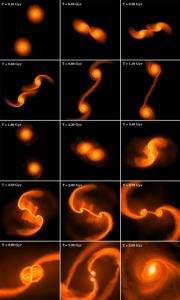
In the image, the panel illustrates the complexity of dynamical evolution in a typical collision between two equal-mass disk galaxies. The simulation follows dark matter, stars, gas, and supermassive black holes, but only the gas component is visualized. Brighter colors indicate regions of higher gas density and the time corresponding to each snapshot is given by the labels. The first 10 panel images measure 100 kpc on a side, roughly five times the diameter of the visible part of the Milky Way galaxy. The next five panels represent successive zooms on the central region. The final frame shows the inner 300 pc of the nuclear region at the end of the simulation. Credit: Ohio State University
Astronomers believe they have discovered the origin of our universe's first super-massive black holes, which formed some 13 billion years ago.
The discovery fills in a missing chapter of our universe's early history, and could help write the next chapter -- in which scientists better understand how gravity and dark matter formed the universe as we know it.
In the journal Nature, Ohio State University astronomer Stelios Kazantzidis and colleagues describe computer simulations in which they modeled the evolution of galaxies and black holes during the first few billion years after the Big Bang.
Our universe is thought to be 14 billion years old. Other astronomers recently determined that big galaxies formed much earlier in the universe's history than previously thought -- within the first 1 billion years, Kazantzidis explained.
These new computer simulations show that the first-ever super-massive black holes were likely born when those early galaxies collided and merged together.
"Our results add a new milestone to the important realization of how structure forms in the universe," he said.
For more than two decades, the prevailing wisdom among astronomers has been that galaxies evolved hierarchically -- that is, gravity drew small bits of matter together first, and those small bits gradually came together to form larger structures.
Kazantzidis and his team turn that notion on its head.
"Together with these other discoveries, our result shows that big structures -- both galaxies and massive black holes -- build up quickly in the history of the universe," he said. "Amazingly, this is contrary to hierarchical structure formation."
The paradox is resolved once one realizes that dark matter grows hierarchically, but ordinary matter doesn't," he continued. "The normal matter that makes up visible galaxies and super-massive black holes collapses more efficiently, and this was true also when the universe was very young, giving rise to anti-hierarchical formation of galaxies and black holes."
For Kazantzidis and other astronomers, our Milky Way galaxy is small compared to others.
So when it comes to normal matter, big bits like giant galaxies and super-massive black holes come together quickly, and smaller bits like our own Milky Way galaxy -- and the comparatively small black hole at its center -- form more slowly. The galaxies that formed those first super-massive black holes are still around, Kazantzidis added.
"One of them is likely our neighbor in the Virgo Cluster, the elliptical galaxy M87," he said. "The galaxies we saw in our simulation would be the biggest galaxies known today, about 100 times the size of the Milky Way. M87 fits that description."
This video is not supported by your browser at this time.
On two accompanying videos -- during the interaction, violent tidal forces tear the galactic disks apart, generating spectacular tidal tails, plumes and prominent bridges of material connecting the two galaxies. The ultimate outcome of a series of increasingly close encounters is the inevitable merger of the disk galaxies into a single structure and the formation of a nuclear disk as shown in the last panel. The simulated nuclear disks have masses of approximately a billion solar masses and exhibit prominent non-axisymmetric features known to produce strong gas inflows. The gas inflows are likely responsible for fueling the central black hole, but even higher resolution will be needed to study this process in detail. Nevertheless, the simulations carried out by Kazantzidis and his collaborators provide the first direct evidence that gas originally in galaxies separated by hundreds of kiloparsecs is collected to sub-parsec scales simply as a result of the dynamics and hydrodynamics involved in the merger process. Credit: University of Zürich
This video is not supported by your browser at this time.
They started their simulations with two giant primordial galaxies -- ones made of the kinds of stars that were around at the beginning of the universe. Astronomers believe that back then, all stars would have been much more massive than present-day stars -- up to 300 times the mass of our sun.Then the astronomers simulated the galaxies colliding and merging together.
The astronomers were able to make their discovery because they used supercomputers to provide a high-resolution view of what happened next.
Previous simulations showed details of the merged galaxy down to only about 300 light-years across. A light-year is the distance that light travels in year, about six trillion miles.
These new simulations contained features that were 100 times smaller, and revealed details in the heart of the merged galaxies on a scale of less than a light year.
The astronomers saw two things happen. First, gas and dust in the center of the galaxies condensed to form a tight nuclear disk. Then the disk became unstable, and the gas and dust contracted again, to form an even denser cloud that eventually spawned a super-massive black hole.
The implications for cosmology are far-reaching, Kazantzidis said.
"For example, the standard idea -- that a galaxy's properties and the mass of its central black hole are related because the two grow in parallel -- will have to be revised. In our model, the black hole grows much faster than the galaxy. So it could be that the black hole is not regulated at all by the growth of the galaxy. It could be that the galaxy is regulated by the growth of the black hole."
He and his cohorts also hope that their work will aid astronomers who are searching the skies for direct evidence of Einstein's theory of general relativity: gravitational waves.
According to general relativity, any ancient galaxy mergers would have created massive gravitational waves -- ripples in the space-time continuum -- the remnants of which should still be visible today.
New gravitational wave detectors, such as NASA's Laser Interferometer Space Antenna, were designed to detect these waves directly, and open a new window into astrophysical and physical phenomena that cannot be studied in other ways.
Scientists will need to know how super-massive black holes formed in the early universe and how they are distributed in space today in order interpret the results of those experiments. The new computer simulations should provide a clue.
-
Supermassive black holes: hinting at the nature of dark matter?
Mar 22, 2010 |
not rated yet |
0
-
Rogue Black Holes May Roam the Milky Way
Apr 29, 2009 |
not rated yet |
0
-
Massive black holes 'switched on' by galaxy collision
Jun 15, 2010 |
not rated yet |
0
-
Black Holes Lead Galaxy Growth
Jan 06, 2009 |
not rated yet |
0
-
Monster black holes grow after galactic mergers
Jan 10, 2006 |
not rated yet |
0
-
Engineers build first sub-10-nm carbon nanotube transistor
Feb 01, 2012 |
4.9 / 5 (31) |
30
-
Something old, something new: Evolution and the structural divergence of duplicate genes
Jan 31, 2012 |
4.6 / 5 (7) |
1
-
The hidden nanoworld of ice crystals: Revealing the dynamic behavior of quasi-liquid layers
Jan 30, 2012 |
5 / 5 (3) |
1
-
Stock market network reveals investor clustering
Jan 27, 2012 |
3.9 / 5 (23) |
8
-
Of microchemistry and molecules: Electronic microfluidic device synthesizes biocompatible probes
Jan 26, 2012 |
5 / 5 (1) |
0
-
Scale of the Universe
13 hours ago
-
Titan's lack of impact craters
Feb 09, 2012
-
Real pictures of black hole eating a star?
Feb 08, 2012
-
Hypothetical way to travel faster than light, but not technically exceed lightspeed
Feb 06, 2012
-
How do scientists monitor the Sun's activity?
Feb 05, 2012
-
Search patterns in observational studies
Feb 05, 2012
- More from Physics Forums - General Astronomy
More news stories
Humans may have helped the decline of African rainforests 3000 years ago
(PhysOrg.com) -- Large areas of rainforests in Central Africa mysteriously disappeared over three thousand years ago, to be replaced by savannas. The prevailing theory has been that the cause was a change ...
Could Venus be shifting gear?
(PhysOrg.com) -- ESAs Venus Express spacecraft has discovered that our cloud-covered neighbour spins a little slower than previously measured. Peering through the dense atmosphere in the infrared, the ...
Space & Earth / Space Exploration
20 hours ago |
5 / 5 (7) |
8
|
NASA budget will axe Mars deal with Europe: scientists
US President Barack Obama's budget proposal to be submitted next week for 2013 will cut NASA's budget by 20 percent and eliminate a major partnership with Europe on Mars exploration, scientists said Thursday.
Space & Earth / Space Exploration
23 hours ago |
5 / 5 (2) |
20
Mars Science Laboratory computer issue resolved
(PhysOrg.com) -- Engineers have found the root cause of a computer reset that occurred two months ago on NASA's Mars Science Laboratory and have determined how to correct it.
Space & Earth / Space Exploration
21 hours ago |
4.7 / 5 (6) |
4
|
Two new moons for Jupiter
Advances in technology have lead to the discovery of new planets outside of our Solar System, and now even new moons in our own backyard.
Space & Earth / Space Exploration
20 hours ago |
4 / 5 (1) |
7
Anonymous knocks CIA website offline (Update)
The website of the Central Intelligence Agency was inaccessible on Friday after the hacker group Anonymous claimed to have knocked it offline.
New error-correcting codes guarantee the fastest possible rate of data transmission
Error-correcting codes are one of the triumphs of the digital age. Theyre a way of encoding information so that it can be transmitted across a communication channel such as an optical fiber o ...
Small modular reactor design could be a 'SUPERSTAR'
(PhysOrg.com) -- Though most of today's nuclear reactors are cooled by water, we've long known that there are alternatives; in fact, the world's first nuclear-powered electricity in 1951 came from a reactor ...
New power source discovered
(PhysOrg.com) -- Researchers at the Massachusetts Institute of Technology (MIT) and RMIT University have made a breakthrough in energy storage and power generation.
The power of estrogen -- male snakes attract other males
A new study has shown that boosting the estrogen levels of male garter snakes causes them to secrete the same pheromones that females use to attract suitors, and turned the males into just about the sexiest ...
Google users warned of threat to smartphone wallets
Users of Google smartphone wallets were being warned on Friday that there is a way to crack pass codes intended to thwart thieves from going on illicit shopping sprees.
Aug 25, 2010
Rank: 5 / 5 (5)
In before Kevinrtrs makes a thinly veiled attempt to convince us god winked all this into existence.
Aug 25, 2010
Rank: 5 / 5 (4)
The reference here is to the yet unseen Population III stars that are thought to be the first stars to form in the universe. The actual mass of Pop III stars is still much in doubt, possibly being as small as one solar mass. Most recent modeling has used higher mass estimates of 150-300 solar masses, as did this simulation.
"it could be that the black hole is not regulated at all by the growth of the galaxy. It could be that the galaxy is regulated by the growth of the black hole"
This feedback mechanism is one of several tantalizing findings of this current study.
Aug 25, 2010
Rank: not rated yet
Super-massive POP III stars are theorized to have first formed during the Cosmological Dark Ages, maybe 200 million years after the Big Bang, but I think I have heard that black holes may have been formed before the first stars. Is it not possible for the first super-massive black holes to have formed from super-massive POP III stars before the reionization period about 500 million sooner than the article mentions?
Aug 25, 2010
Rank: 1 / 5 (1)
How did God create the Big Bang?
Aug 25, 2010
Rank: 1 / 5 (9)
Next please.
Aug 25, 2010
Rank: 5 / 5 (2)
"Is it not possible for the first super-massive black holes to have formed from super-massive POP III stars before the reionization period about 500 million sooner than the article mentions?"
Current models of Pop III stars have upper limits ~300 solar masses, so the question then shifts to how long until enough stellar mass black holes coalesce into a SMBH (lower mass ~10E5 to 10E6 solar masses). Galaxy collisions can speed things along. In some models of Pop III stars, a black hole producing supernova would ensue within a few hundred years of the star's 'ignition'. Events may proceed rather quickly, given proper initial conditions.
Aug 26, 2010
Rank: 2 / 5 (1)
"In some models of Pop III stars, a black hole producing supernova would ensue within a few hundred years of the star's 'ignition'. Events may proceed rather quickly, given proper initial conditions."
So why is it impossible for several, lets call them POP III Black Holes, to collide to form a Super-massive Black Hole? Maybe it could be many POP III Black Holes drawn together by, lets call it Super-Dark Matter or something, before the reionization period?
If it is a really dumb question, then please forgive me.
Aug 26, 2010
Rank: 4 / 5 (1)
I read your answer incorrectly.
Aug 26, 2010
Rank: 1 / 5 (5)
Space dont expanding at all.
There is moving very small particle inside nucleus of atoms and this particle emit energy for nucleus of atoms all a time.
Thats why nucleus of atoms and also particle like neutriinos and photons expanding all a time.
Also entropy working with particle like neutriinos and photons all a time.
Galaxys born inside to outside.
Galaxy centre huge energyconcentration expanding / exploding and emit energywaves who have a nature on atoms and that the way, nature of new stars.
Google: Etimespace
Thanks
.
Aug 26, 2010
Rank: 1 / 5 (6)
Those energyconcentration expanding all a time.
Also there is pressure outside this energyconcentration and this pressure pushing themselfs near eachother.
Same time this energyconcentration shade, adumbrate, darken, screen, tail, sleuth, overshadow, shadow, track
space, you know.
They stop this energya who get pressure outside and pushing themselfs near eachother, you know.
There is no gravity at all.
And thats the way it is, you know.
Etimespace
.
Aug 26, 2010
Rank: 5 / 5 (3)
That sounds crazy, MrPressure!
Aug 26, 2010
Rank: 1 / 5 (5)
"That sounds crazy, MrPressure!"
maybe i am crazy, or maybe i am not.
Check out my forum, onesimpleprinciple com
Google: Scoop from Savo
and you found my forum sraight.
.
Aug 26, 2010
Rank: 1 / 5 (6)
Energy been here ever and last 14 billion years that energy is exploding / expanding in space who dont expanding at all.
I know what way and why energyconcdentration exploding all a time.
.
Aug 26, 2010
Rank: 5 / 5 (9)
While that axiom is true I doubt that you're in a position to know that the inputs were garbage. Simulation is a risky business but that doesn't mean it isn't worthwhile. If you can answer these questions by creating your own real universe and watching what happens then more power to you.
Aug 26, 2010
Rank: 5 / 5 (2)
To more directly answer your question on early SMBHs, some current simulations allow for early(non-SMBH) black hole formation totally independent of and prior to Pop III stars (Primordial Black Holes). Models vary greatly in the numbers of PBHs formed (early models produced nothing but black holes!) and produce a wide range of masses (micro-black holes to Intermediate Mass Black Holes). So it is possible that SMBHs may have formed by coalescence of PBHs, stellar mass black holes from Pop III stars, or a combination of the two types. Precise mechanisms for the formation of SMBHs is still (obviously) up for debate. Same with when SMBHs formed. Models like this one should help us interpret data from, for example, future gravity wave observations when they become available.
Aug 26, 2010
Rank: not rated yet
Very interesting! I will check out onesimpleprinciple.com links.
I wish your english was better!
Aug 26, 2010
Rank: 1 / 5 (2)
This may sound dumb, but could black holes (micro and SMBHs) have gobbled up photons, or whatever, during the Cosmic Dark Ages thereby giving rise to the title Cosmic Dark Ages?
Aug 27, 2010
Rank: not rated yet
I like some of your ideas, but I also like Albert Einstein's gravity waves.
Perhaps there is more than one type of gravity?
This may sound crazy, but, maybe there is another form of gravity that is actually non-gravity disguised in the form of gravity that people have been looking for?
I have not read your forum (onesimpleprinciple.com) yet.
Have you integrated any of these ideas into Dense Aether Theory or M-theory, or something else?
Aug 27, 2010
Rank: 1.7 / 5 (6)
http://blogs.disc...-review/
http://dafix.uark...eree.pdf
The concept of massive black holes existing briefly after Big Bang supports dense aether theory well, because it assumes, Big Bang didn't happen and some of large black holes existed well before their light arrived to us. Whereas Big Bang theory should explain in reliable way, how is it possible, so large amount of matter concentrates so briefly after inflation in nearly homogeneous Universe (we can observe well separated galaxies even in most distant parts of Hubble depth field).
Aug 27, 2010
Rank: not rated yet
Aug 27, 2010
Rank: not rated yet
Search for the keywords "POP III Stars" and you should be able to find the answer.
Aug 27, 2010
Rank: not rated yet
I do like gravity waves. They should be able to be eventually detected. I do not see much use for cosmic gravity waves to power a gravity engine.
Could you give a simple explanation of how Dense Aether Theory works?
I wrote Aether Theory off years ago, but some people talk about Dense Aether Theory as if it is the hot new thing.
I am more of a M-theory person with my own ideas mixed in.
I love Big Bang Theory!
Aug 27, 2010
Rank: 4 / 5 (4)
Xaero, Alizee, Tahoma, Zephir.....
Aug 27, 2010
Rank: not rated yet
Alizee if I remember correctly had some interesting ideas on Modified Gravity.
Aug 27, 2010
Rank: not rated yet
No, it was not Alizee, it was "iFujita". iFujita has some interesting ideas about modified gravity that can be found at the following link:
http://www.geocit...y01.html
Some of the aforementioned Physorg.com members may be one person blogging under several names?
Aug 27, 2010
Rank: 4 / 5 (4)
Aug 27, 2010
Rank: 1 / 5 (1)
lets start my forum text
Scoop from Savo
It is latest / newest text.
My pages text mide be over three years old text, it is not so good.
google also: Etimespace, youtube videos
Thank you
.
Aug 28, 2010
Rank: 1 / 5 (1)
The word "gravity" is easier to say, even though gravitational waves would be more correct. The word magnetism is incorrect.
Aug 29, 2010
Rank: 5 / 5 (1)
Aug 29, 2010
Rank: 1 / 5 (4)
Genastropsychicalst.blogspot, 2 'C' rgb particles.
Aug 29, 2010
Rank: not rated yet
I suppose this implies that, however massive they may be, most particles of dark matter have a very small cross section