'Dry water' could make a big splash commercially
August 25, 2010
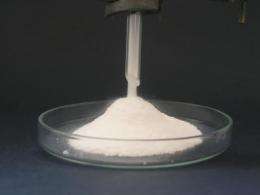
Powdered material called "dry water" could provide a new way to store carbon dioxide in an effort to fight global warming. Credit: Ben Carter
An unusual substance known as "dry water," which resembles powdered sugar, could provide a new way to absorb and store carbon dioxide, the major greenhouse gas that contributes to global warming, scientists reported today at the 240th National Meeting of the American Chemical Society.
The powder shows bright promise for a number of other uses, they said. It may, for instance, be a greener, more energy-efficient way of jumpstarting the chemical reactions used to make hundreds of consumer products. Dry water also could provide a safer way to store and transport potentially harmful industrial materials.
"There's nothing else quite like it," said Ben Carter, Ph.D., researcher for study leader Professor Andrew Cooper. "Hopefully, we may see 'dry water' making waves in the future."
Carter explained that the substance became known as "dry water" because it consists of 95 percent water and yet is a dry powder. Each powder particle contains a water droplet surrounded by modified silica, the stuff that makes up ordinary beach sand. The silica coating prevents the water droplets from combining and turning back into a liquid. The result is a fine powder that can slurp up gases, which chemically combine with the water molecules to form what chemists term a hydrate.
Dry water was discovered in 1968 and got attention for its potential use in cosmetics. Scientists at the University of Hull, U.K. rediscovered it in 2006 in order to study its structure, and Cooper's group at the University of Liverpool has since expanded its range of potential applications.
One of the most recent involves using dry water as a storage material for gases, including carbon dioxide. In laboratory-scale research, Cooper and co-workers found that dry water absorbed over three times as much carbon dioxide as ordinary, uncombined water and silica in the same space of time. This ability to absorb large amounts of carbon dioxide gas as a hydrate could make it useful in helping to reduce global warming, the scientists suggested.
Cooper and colleagues demonstrated in previous studies that dry water is also useful for storing methane, a component of natural gas, and may help expand its use as a future energy source. In particular, they hope that engineers can use the powder to collect and transport stranded deposits of natural gas. This also exists on the ocean floor in the form of gas hydrates, a form of frozen methane also known as the "ice that burns." The powder could also provide a safer, more convenient way to store methane fuel for use in vehicles powered by natural gas. "A great deal of work remains to be done before we could reach that stage," Carter added.
In another potential new application, the scientists also showed that dry water is a promising means to speed up catalyzed reactions between hydrogen gas and maleic acid to produce succinic acid, a feedstock or raw material widely used to make drugs, food ingredients, and other consumer products. Manufacturers usually have to stir these substances together to get them to react. By developing dry water particles that contain maleic acid, Cooper and colleagues showed that they could speed up the acid's reaction with hydrogen without any stirring, resulting in a greener, more energy-efficient process.
"If you can remove the need to stir your reactions, then potentially you're making considerable energy savings," Carter said.
Prof. Cooper's team describes an additional new application in which dry water technology shows promise for storing liquids, particularly emulsions. Emulsions are mixtures of two or more unblendable liquids, such as the oil and water mixture in mayonnaise. The scientists showed that they could transform a simple emulsion into a dry powder that is similar to dry water. The resulting powder could make it safer and easier for manufacturers to store and transport potentially harmful liquids.
Carter noted that he and his colleagues are seeking commercial or academic collaboration to further develop the dry water technology. The U.K. Engineering and Physical Sciences Research Council (EPSRC) and the Center for Materials Discovery provided funding and technical support for this study.
-
Cousin of the 'ice that burns' emerges as greener new way to fight fires
Apr 23, 2009 |
not rated yet |
0
-
ORNL super water repellent could cause big wave in market
Nov 29, 2007 |
not rated yet |
0
-
Oceans could slurp up carbon dioxide to fight global warming
Nov 19, 2007 |
not rated yet |
0
-
Cold storage solution for global warming?
Feb 07, 2007 |
not rated yet |
0
-
Scrubbing sulfur: New process removes sulfur components, CO2 from power plant emissions (w/ Video)
Aug 18, 2009 |
not rated yet |
0
-
Engineers build first sub-10-nm carbon nanotube transistor
Feb 01, 2012 |
4.9 / 5 (31) |
30
-
Something old, something new: Evolution and the structural divergence of duplicate genes
Jan 31, 2012 |
4.6 / 5 (7) |
1
-
The hidden nanoworld of ice crystals: Revealing the dynamic behavior of quasi-liquid layers
Jan 30, 2012 |
5 / 5 (3) |
1
-
Stock market network reveals investor clustering
Jan 27, 2012 |
3.9 / 5 (23) |
8
-
Of microchemistry and molecules: Electronic microfluidic device synthesizes biocompatible probes
Jan 26, 2012 |
5 / 5 (1) |
0
-
Stoichiometry
14 hours ago
-
Boiling and melting point of impure substances
15 hours ago
-
Safe nitrogen compound to decompose a 500 deg C in a furnace?
22 hours ago
-
[ask]electron inside drinking water
Feb 08, 2012
-
How to avoid formation of Lithium Chromate ???
Feb 08, 2012
-
how to choose a reduced or oxidated form in a redox
Feb 08, 2012
- More from Physics Forums - Chemistry
More news stories
Fool's gold may prove an unlikely alternative to overexploited catalytic materials
Catalytic materials, which lower the energy barriers for chemical reactions, are used in everything from the commercial production of chemicals to catalytic converters in car engines. However, with current catalytic materials ...
5 hours ago |
4.7 / 5 (3) |
2
|
Unpicking HIV’s invisibility cloak
Drug researchers hunting for alternative ways to treat human immunodeficiency virus (HIV) infections may soon have a novel targetits camouflage coat. HIV hides inside a cloak unusually rich in a sugar ...
5 hours ago |
5 / 5 (2) |
0
Flexible paper robots
(PhysOrg.com) -- These inexpensive robots can stretch, bend and twist under control, and lift objects up to 120 times their own weight. Being soft, they can apply gentle and even pressure, and adapt to varied ...
23 hours ago |
5 / 5 (5) |
4
|
No entry without protein recycling: Researchers discover new coherence in enzyme transport
The group of Prof. Dr. Ralf Erdmann at the Ruhr-Universität Bochum, Germany, discovered a connection of peroxisomal protein import and receptor export. In the Journal of Biological Chemistry, they disclo ...
5 hours ago |
not rated yet |
0
New method makes culture of complex tissue possible in any lab
Scientists at the University of California, San Diego have developed a new method for making scaffolds for culturing tissue in three-dimensional arrangements that mimic those in the body. This advance, published online in ...
22 hours ago |
5 / 5 (4) |
0
|
Human cognitive performance suffers following natural disasters, researchers find
Not surprisingly, victims of a natural disaster can experience stress and anxiety, but a new study indicates that it might also cause them to make more errors - some serious - in their daily lives. In their upcoming Human Fa ...
The power of estrogen -- male snakes attract other males
A new study has shown that boosting the estrogen levels of male garter snakes causes them to secrete the same pheromones that females use to attract suitors, and turned the males into just about the sexiest ...
New error-correcting codes guarantee the fastest possible rate of data transmission
Error-correcting codes are one of the triumphs of the digital age. Theyre a way of encoding information so that it can be transmitted across a communication channel such as an optical fiber o ...
Both maternal and paternal age linked to autism
Older maternal and paternal age are jointly associated with having a child with autism, according to a recently published study led by researchers at The University of Texas Health Science Center at Houston (UTHealth).
Putting the squeeze on planets outside our solar system
(PhysOrg.com) -- Using high-powered lasers, scientists at Lawrence Livermore National Laboratory and collaborators discovered that molten magnesium silicate undergoes a phase change in the liquid state, abruptly ...
Curry spice component may help slow prostate tumor growth
Curcumin, an active component of the Indian curry spice turmeric, may help slow down tumor growth in castration-resistant prostate cancer patients on androgen deprivation therapy (ADT), a study from researchers ...
Aug 25, 2010
Rank: 5 / 5 (1)
Sounds good - but is it? It all depends on just how much CO2 a droplet of normal water can contain, then multiply by three. If A normal drop holds a tiny tiny bit then multiply by three and you still get a tiny tiny bit.
Aug 25, 2010
Rank: 4.7 / 5 (3)
Aug 29, 2010
Rank: not rated yet
Aug 29, 2010
Rank: 1 / 5 (1)
Methane actually decomposes the dry water, because it decreases surface tension of water, so that dry water is not a viable way for storage of methane.
http://www.liv.ac...ice.html
Cooper says that, by using salts dissolved in water, his group has recently developed hydrates that remain stable at room temperature. But it's hard to make stable 'dry water' from this mixture. That's the next step, which Cooper admits is "very difficult".
Another problem is that the droplets start to coalesce and therefore react more slowly with methane after several cycles of gas uptake and release.