Electricity collected from the air could become the newest alternative energy source
August 25, 2010
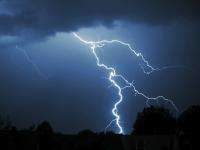
Powering homes with electricity collected from the air may be possible after scientists report solving a centuries old riddle about how moisture in the atmosphere becomes electrically charged. Credit: Martin Fischer
Imagine devices that capture electricity from the air ― much like solar cells capture sunlight ― and using them to light a house or recharge an electric car. Imagine using similar panels on the rooftops of buildings to prevent lightning before it forms. Strange as it may sound, scientists already are in the early stages of developing such devices, according to a report presented today at the 240th National Meeting of the American Chemical Society (ACS).
"Our research could pave the way for turning electricity from the atmosphere into an alternative energy source for the future," said study leader Fernando Galembeck, Ph.D. His research may help explain a 200-year-old scientific riddle about how electricity is produced and discharged in the atmosphere. "Just as solar energy could free some households from paying electric bills, this promising new energy source could have a similar effect," he maintained.
"If we know how electricity builds up and spreads in the atmosphere, we can also prevent death and damage caused by lightning strikes," Galembeck said, noting that lightning causes thousands of deaths and injuries worldwide and millions of dollars in property damage.
The notion of harnessing the power of electricity formed naturally has tantalized scientists for centuries. They noticed that sparks of static electricity formed as steam escaped from boilers. Workers who touched the steam even got painful electrical shocks. Famed inventor Nikola Tesla, for example, was among those who dreamed of capturing and using electricity from the air. It's the electricity formed, for instance, when water vapor collects on microscopic particles of dust and other material in the air. But until now, scientists lacked adequate knowledge about the processes involved in formation and release of electricity from water in the atmosphere, Galembeck said. He is with the University of Campinas in Campinas, SP, Brazil.
Scientists once believed that water droplets in the atmosphere were electrically neutral, and remained so even after coming into contact with the electrical charges on dust particles and droplets of other liquids. But new evidence suggested that water in the atmosphere really does pick up an electrical charge.
Galembeck and colleagues confirmed that idea, using laboratory experiments that simulated water's contact with dust particles in the air. They used tiny particles of silica and aluminum phosphate, both common airborne substances, showing that silica became more negatively charged in the presence of high humidity and aluminum phosphate became more positively charged. High humidity means high levels of water vapor in the air ― the vapor that condenses and becomes visible as "fog" on windows of air-conditioned cars and buildings on steamy summer days.
"This was clear evidence that water in the atmosphere can accumulate electrical charges and transfer them to other materials it comes into contact with," Galembeck explained. "We are calling this 'hygroelectricity,' meaning 'humidity electricity'."
In the future, he added, it may be possible to develop collectors, similar to the solar cells that collect the sunlight to produce electricity, to capture hygroelectricity and route it to homes and businesses. Just as solar cells work best in sunny areas of the world, hygroelectrical panels would work more efficiently in areas with high humidity, such as the northeastern and southeastern United States and the humid tropics.
Galembeck said that a similar approach might help prevent lightning from forming and striking. He envisioned placing hygroelectrical panels on top of buildings in regions that experience frequent thunderstorms. The panels would drain electricity out of the air, and prevent the building of electrical charge that is released in lightning. His research group already is testing metals to identify those with the greatest potential for use in capturing atmospheric electricity and preventing lightning strikes.
"These are fascinating ideas that new studies by ourselves and by other scientific teams suggest are now possible," Galembeck said. "We certainly have a long way to go. But the benefits in the long range of harnessing hygroelectricity could be substantial."
-
Research helps electric utilities and manufacturers protect against lightning
Feb 05, 2009 |
not rated yet |
0
-
Keeping cool using the summer heat
Jan 23, 2009 |
not rated yet |
0
-
The future of electricity may be found in environmentally-friendly, thermoelectric cells
Oct 14, 2009 |
not rated yet |
0
-
Self-cleaning technology from Mars can keep terrestrial solar panels dust free
Aug 22, 2010 |
not rated yet |
0
-
A traveling-wave engine to power deep space travel
Sep 17, 2004 |
not rated yet |
0
-
Engineers build first sub-10-nm carbon nanotube transistor
Feb 01, 2012 |
4.9 / 5 (29) |
30
-
Something old, something new: Evolution and the structural divergence of duplicate genes
Jan 31, 2012 |
4.6 / 5 (7) |
1
-
The hidden nanoworld of ice crystals: Revealing the dynamic behavior of quasi-liquid layers
Jan 30, 2012 |
5 / 5 (3) |
1
-
Stock market network reveals investor clustering
Jan 27, 2012 |
3.9 / 5 (23) |
8
-
Of microchemistry and molecules: Electronic microfluidic device synthesizes biocompatible probes
Jan 26, 2012 |
5 / 5 (1) |
0
-
feed hold button on CNC lathe
3 hours ago
-
Mechanics of Solids ( Final exam question) plz help!
5 hours ago
-
RFAC in Fortran
7 hours ago
-
dynamics 2/32
13 hours ago
-
dynamics
13 hours ago
-
Vibration Absorbtion Problem
18 hours ago
- More from Physics Forums - General Engineering
More news stories
Google launches Chrome browser for Android smartphones
With more and more people connecting to the Internet through a phone or a tablet instead of a PC, Google Inc. is bringing its fast-growing browser, Chrome, to the newest Android-powered mobile devices.
15 minutes ago |
not rated yet |
0
Kodak to stop making cameras, digital frames
Kodak says it will stop making digital cameras, pocket video cameras and digital picture frames in order to focus on its more profitable businesses.
19 minutes ago |
not rated yet |
0
Oracle to pay $1.9B for personnel software co.
(AP) -- Oracle is paying $1.9 billion for Taleo Corp., a company that helps businesses manage their employees.
4 minutes ago |
not rated yet |
0
Soraa LED light may dim 50-watt halogen rivals
(PhysOrg.com) -- Soraa, a Fremont, California company founded in 2008, this week launched its first product, a light that uses LEDS (light emitting diodes). The "Soraa LED MR16 lamp" is the "perfect" replacement for traditional ...
Samsung can continue selling Galaxy tabs in Germany: court
South Korea's Samsung Electronics can continue to sell its Galaxy Tab 10.1N tablet computer in Germany, a German court ruled Thursday, rejecting a bid by arch-rival Apple to have them banned.
1 hour ago |
not rated yet |
1
New Zealand team finds early plant arrivers dominated landscape
(PhysOrg.com) -- It seems intuitive that not all plant species could have taken a foothold on land at the same time all those millions of years ago as conditions on Earth evolved to the point where they could survive; some ...
Black holes and star formation
(PhysOrg.com) -- It has long been recognized that galaxy mergers or even close interactions can play a vital role in shaping the morphology of galaxies. One way they can do so, it is thought, is by triggering ...
Deciding to go left or right: Researchers use device to determine that lower animals can navigate too
For decades, scientists have associated binary decision making opting to go left or right with higher-ranking animals, including humans. A team of Harvard researchers, however, is rewriting that ...
New target for Alzheimer's drugs
(Medical Xpress) -- Biomedical scientists at the University of California, Riverside have identified a new link between a protein called beta-arrestin and short-term memory that could open new doors for the ...
Chemists harvest light to create 'green' tool for pharmaceuticals
(PhysOrg.com) -- A team of University of Arkansas researchers, including an Honors College undergraduate student, has created a new, "green" method for developing medicines. The researchers used energy from ...
Researchers develop gene therapy to boost brain repair for demyelinating diseases
(Medical Xpress) -- Our bodies are full of tiny superheroesantibodies that fight foreign invaders, cells that regenerate, and structures that ensure our systems run smoothly. One such structure is myelina ...
Aug 25, 2010
Rank: 5 / 5 (4)
All the energy we could ever need is right below our feet in the mammoth thermal energy battery that is the Earth's interior. We just need to master accessing it.
Aug 25, 2010
Rank: 4 / 5 (5)
Probably all true. But can you imagine all those energy hungry people of the future? Sucking all the heat out of the planet digging ever deeper until we are sitting on a solid rock with no magnetic field?
Aug 25, 2010
Rank: 5 / 5 (1)
Aug 25, 2010
Rank: 5 / 5 (2)
Aug 25, 2010
Rank: 4 / 5 (3)
insufficient.
Maybe a better method would be to have long extended electrical cables 85 to 200 mi into the ionisphere where electron densities are significant having Kev to Tev energies that would use electromotive energy generated by earth rotation through the ionisphere essentially a short circuit to ground for infinite constant electron current energy capture.
http://en.wikiped...here.svg
Aug 25, 2010
Rank: 5 / 5 (1)
With geothermal something just doesn't sit right with me when we're talking about removing heat from inside the earth. The increase in earth quakes also screams out - back off!
With this 'extraction of energy from the air', if we've learned anything we've learned nature doesn't usually do ANYTHING without a reason. If the air IS charged with usable and extractable energies I'm thinking that the planet might want/need/expect it to be there.
Hey I'm all for ridding our dependance on oil ASAP! However, I'm deathly afraid that we as a society might embrace alternative energies donning rose colored glasses and then be stuck with problems far worse than we have now.
If I've learned anything, it's that things can ALWAYS get worse.
Aug 25, 2010
Rank: 5 / 5 (2)
I doubt we'll get enough from the air to be really useful.
I agree things can always get worse, especially if we just sit on our duffs and do nothing.
Aug 25, 2010
Rank: 3 / 5 (1)
Aug 25, 2010
Rank: not rated yet
Aug 25, 2010
Rank: 3.5 / 5 (4)
Aug 26, 2010
Rank: 2.7 / 5 (3)
Aug 26, 2010
Rank: 5 / 5 (3)
Much work has gone into the study of energy producing space tethers over the years. Also, tether research has been carried out aboard the Space Shuttle and the ISS.
http://en.wikiped...c_tether
http://en.wikiped..._mission
Aug 26, 2010
Rank: 4 / 5 (1)
The electrons collected could not only be used to transmit microwave energy but a source for propulsion to maintain orbit in LEO.
The cable idea would be less costly and safer.
Aug 26, 2010
Rank: not rated yet
Aug 26, 2010
Rank: 2.7 / 5 (3)
Aug 26, 2010
Rank: not rated yet
"A moderate thunderstorm generates several hundred megawatts of electrical power."
Please see:
http://hyperphysi...ng2.html
The major problem is storing the energy from a lightning strike. All that energy needs to be dumped into a massive capacitor bank. It is similar to how a strobe light or a camera flash works. The other problem is the erratic discharge of a lightning strike.
Aug 26, 2010
Rank: 4 / 5 (4)
Because fusion is still an "if". Putting all your eggs in one basket is a bad idea.
Aug 26, 2010
Rank: not rated yet
Plus, you'd be shutting down one of the primary generators of Ozone, reducing the ozone layer.
Aug 26, 2010
Rank: not rated yet
-please don't rate this statement --
Aug 28, 2010
Rank: not rated yet
A small CFL uses around 20 watts.
20 watts = 120 volts x 0.167 amps.
A megawatt is 1,000,000,000 watts.
The lightning strike happens in a less than a second. So it would light 50,000,000 CFLs for less than a second.
Aug 28, 2010
Rank: 5 / 5 (1)
That may be true Ioboy, but when gauging a power source you also need a time unit to arrive at the total energy. Because just citing the power rating is like saying 'a typical lightning storm will power a 500-megawatt laser.' Which doesn't mean much if you can't say -for how long- it will power that laser.
Actually that's a gigawatt, a megawatt is 1,000,000 watts. But like I said, you need an interval. Here, check this out:
(continued)
Aug 28, 2010
Rank: not rated yet
http://en.wikiped...g_energy
Aug 28, 2010
Rank: 1 / 5 (1)
Any power you generate is going to have some effect on the environment. Even (enough) fusion is going to generate so much waste heat that the Earth will start to "shine" like the sun...talk about global warming.
We really need to stop worrying so much about WHETHER or not we're going to effect the environment, but instead how we're going to nullify or mitigate those effects we're most certainly going to have.
Aug 28, 2010
Rank: not rated yet
My bad. Got a little anxious with the zeroes.
I did state that it would happen in less than a second.
Aug 28, 2010
Rank: 5 / 5 (1)
Aug 29, 2010
Rank: not rated yet
LOL, I came in here to say this exact same thing!
Great Minds think alike huh?
Aug 29, 2010
Rank: not rated yet
I think this guy is a lunatic for suggesting that we stop lightning from striking.
Aug 29, 2010
Rank: 5 / 5 (4)
Aug 30, 2010
Rank: 5 / 5 (1)
Great Scott! :o
Aug 30, 2010
Rank: not rated yet
Sep 01, 2010
Rank: 1 / 5 (2)
Not just ozone, but the very soil nitrates that plants need to grow are created in large part from lightning. This idea of leaching the atmosphere of its charge is a bit short sighted - unless you just don't like eating.
Sep 01, 2010
Rank: 3 / 5 (2)
Complete bunk, nitrates come from bacteria in the soil which produce them from nitrogen (ammonium).
Sep 02, 2010
Rank: 5 / 5 (1)
Lighting is part of the cycle for producing HNO3 (nitric acid) - a plant nutrient. Yes, bacteria and algae are significant sources in the nitrogen fixation cycle. Decomposed animal wastes also return to the earth as nitrates. For much of the world commercial fertilizers are either too expensive or unavailable. The point is; this is a natural source of the nitrates that plants require - why mess with it?
http://www.elmhur...cle.html
Sep 22, 2010
Rank: not rated yet
The Second Law of Thermodynamics states that energy has quality - a measure known as entropy. A thunderstorm has a lot of energy. But it is extremely chaotic - high entropy. The techno-world of iPhones and HDTVs demands energy of utmost quality, highest order, and lowest entropy. Even "old faithful" coal and oil have to be "upgraded" in a power plant or engine before they are capable of being used for anything more than heating. In these cases the expense of tossing out the chaos and keeping the order is 66% or more of the energy being dumped as waste heat, either up the cooling towers or out the exhaust pipe.