Frog skin may provide 'kiss of death' for antibiotic-resistant germs
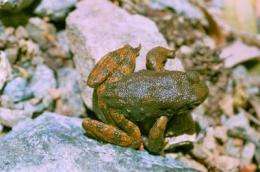
Kissing a frog won't turn it into a prince — except in fairy tales — but frogs may be hopping toward a real-world transformation into princely allies in humanity's battle with antibiotic-resistant infections that threaten millions of people worldwide. Scientists today reported that frog skin contains natural substances that could be the basis for a powerful new genre of antibiotics.
In a report at the 240th National Meeting of the American Chemical Society, the team of stalwart frog-fanciers described enlisting colleagues worldwide to ship secretions from hundreds of promising frog skins to their laboratory in the United Arab Emirates. Using that amphibious treasure trove, they identified more than 100 antibiotic substances in the skins of different frog species from around the world. One even fights "Iraqibacter," the bacterium responsible for drug-resistant infections in wounded soldiers returning from Iraq.
Michael Conlon, Ph.D., who reported on the research, noted that the emergence of drug-resistant bacteria, which have the ability to shrug off conventional antibiotics, is a growing problem worldwide. As a result, patients need new types of antibiotics to replace drugs that no longer work.
"Frog skin is an excellent potential source of such antibiotic agents," said Conlon, a biochemist at the United Arab Emirates University in Al-Ain, Abu Dhabi Emirate. "They've been around 300 million years, so they've had plenty of time to learn how to defend themselves against disease-causing microbes in the environment. Their own environment includes polluted waterways where strong defenses against pathogens are a must."
Scientists have known for years that the skin of frogs is a rich source of chemicals capable of killing bacteria, viruses, and fungi. Researchers have attempted to isolate those germ-fighting chemicals and make them suitable for development into new antibiotics. Success, however, has been elusive because froggy antibiotics tend to be toxic to human cells and certain chemicals in the bloodstream easily destroy them.
Conlon and colleagues described an approach to overcome these problems. They discovered a way to tweak the molecular structure of frog skin antibiotic substances, making them less toxic to human cells but more powerful germ killers. Similarly, the scientists also discovered other tweaks that enabled the frog skin secretions to shrug off attack by destructive enzymes in the blood. The result was antibiotics that last longer in the bloodstream and are more likely to be effective as infection fighters, Conlon noted.
The antibiotic substances work in an unusual way that makes it very difficult for disease-causing microbes to develop resistance, Conlon said.
The scientists are currently screening skin secretions from more than 6,000 species of frogs for antibiotic activity. So far, they have purified and determined the chemical structure of barely 200, leaving a potential bonanza of antibiotic substances awaiting discovery.
"Many people are working with me, giving me samples of frog skin secretions," said Conlon, who has a dozen research collaborators in Japan, France, the United States, and other countries. "We only actually use the frogs to get the chemical structure of the antibiotic, and then we make it in the lab. We take great care not to harm these delicate creatures, and scientists return them to the wild after swabbing their skin for the precious secretions."
One substance isolated from the skin secretions of the Foothill Yellow-legged Frog — a species once common in California and Oregon but now facing extinction — shows promise for killing methicillin-resistant Staphylococcus aureus (MRSA) bacteria. MRSA is a "superbug," infamous for causing deadly outbreaks of infection among hospitalized patients. Now it is occurring in settings outside hospitals, including schools, nursing homes, and day care centers.
The skin of the mink frog, likewise, contains secretions that show promise for fighting "Iraqibacter," caused by multidrug-resistant Acinetobacter baumanni.
Some of the substances could make their way into clinical trials within the next five years, Conlon predicted. He envisions that pharmaceutical companies could develop the chemicals as creams or ointments for treating skin infections or as injectable drugs for treating drug-resistant infections throughout the body. The United Arab Emirates University provided funding for the study.
"The research also is important because it underscores the importance of preserving biodiversity," Conlon pointed out. "Some frog species — including those that may contain potentially valuable medicinal substances — are in jeopardy worldwide due to loss of habitat, water pollution, and other problems."
The Skinny on Frog Skin
• Frogs and toads have a "Lycra" type skin that protects them from injury and disease. It comes in a rainbow of color and patterns.
• Frog skin is water permeable, letting water in and out. Frogs seldom drink with their mouths. Rather, they absorb water through their skin. A "seat pouch" on their bellies absorbs water.
• Many species have skin glands that produce toxins and other substances to repel predators. Scientists are studying some as potential pain medications.
• Skin colors and patterns are protective devices that warn predators that the frog may be poisonous. Some frogs change the color of their skin to absorb or reflect heat and thus control their body temperature. Patterned skin can help camouflage the frog, so it sinks into the background, hidden from predators.
• Frogs regularly shed their skin. Most eat the shed skin.
(Source, thefrog.org)
Provided by American Chemical Society


