Bird-friendly glass looks like spider web to birds
August 26, 2010 by Lin Edwards report
Bird-friendly glass looks like spider web to birds

Enlarge

(PhysOrg.com) -- A new bird-friendly glass has been developed that could prevent the deaths and serious injuries of countless birds that fly at high speed into glass windows.

Birds do not see transparent glass, but are misled by the landscape reflected in the window or seen through it into thinking their way is clear of obstacles. Stickers attached to the glass have been shown to have almost no effect, and have even been taken off the market in Switzerland. Stickers are only really effective if they cover a significant portion of the glass.

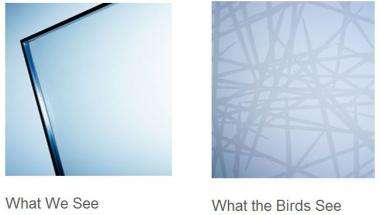
A new product, called Ornilux Mikado glass, addresses the issue. The insulating glass was developed by German company Arnold Glas and is glass sheeting with a special ultraviolet (UV) reflective coating that is almost invisible to the human eye, but looks like a spider's web to birds. Birds are able to see a broader spectrum of wavelengths than humans, and can easily see the UV lines on the coating.

The glass is claimed to reduce bird collisions by 76%. The spider web design is just barely visible to the human eye when the glass is viewed against a backlight, but ordinarily does not spoil the view, and the coating makes no reduction in the glass's transparency. The product was named after the game Mikado or pick-up sticks, since the pattern bears a resemblance to the game.

The glass was developed by Arnold Glas in conjuction with the Max Planck Institute for Ornithology, and was tested on 19 species of garden birds in a flight tunnel at the Radolfzell Bird Sanctuary. Wild birds were captured and released into the flight tunnel, where they could choose to fly towards a sheet of plain glass or a sheet of Ornilux glass. Of the 108 test flights, 82 of the flew towards the plain glass and avoided the Ornilux.

Ornilux Mikado is the latest version of bird-friendly insulating glass. The first installation consisted of 152 sheets of Ornilux Mikado's predecessor, the Ornilux SB 1, for the 250 square meter glass facade of an enclosed swimming pool in Plauen, Germany, during its modernization in early 2006.

Arnold Glas, based in Merkendorf, Germany, recently won an International design award, the Design Zentrum Nordrhein Westfalen, in Essen, Germany, for the bird-friendly glass.

More information: http://www.ornilux.de/

© 2010 PhysOrg.com

4.4 /5 (11 votes)  

Filter


Move the slider to adjust rank threshold, so that you can hide some of the comments.


Display comments: newest first

L_Joyce
Aug 26, 2010

Rank: 3 / 5 (4)
"claimed to reduce bird collisions by 76%"
"Of the 108 test flights, 82 of the birds flew towards the plain glass and avoided the Ornilux."

82 of 108 appears to be the 76% value being quoted, but it seems to me that if the new glass was no better than regular glass, 50% of the birds would already avoid it since they had two options, making the improvement less significant.
proceed
Aug 29, 2010

Rank: 5 / 5 (1)
thank you, L. Joyce....Once again,science marred by poor statistical analysis......is this corruption,or just stupidity?......clearly, of the 108 test flights,if both options were equal to the birds,54 flights would have been in each direction....but there was a reduction in the direction of the Omnilux of 28/54-or 52%...not the quoted 76%.........I wonder also if the flights quoted were sometimes of the same birds being tested repeatedly...maybe they remembered hitting a wall previously?....not to say that don't endorse the concept...but maybe they should go back to the drawing board/glass on this......
jt81ma
Sep 14, 2010

Rank: not rated yet
Not only that, they didn't test with the glass in the opposite locations, or setup a control with no pane on either side to see if one direction was preferred. Sloppy!
Rank 4.4 /5 (11 votes)
Relevant PhysicsForums posts
  • Cis-trans Selectivity in Wittig Reactions
    created4 hours ago
  • Chemical Kinetics
    created4 hours ago
  • heat-driven chemical reaction and thermodynamics
    created11 hours ago
  • phenol to benzene
    created15 hours ago
  • TQM, QA and QC
    created15 hours ago
  • oxidising power
    created22 hours ago
  • More from Physics Forums - Chemistry

More news stories

Flesh-eating bacteria inspire superglue

(PhysOrg.com) -- A bio-inspired superglue has been developed by Oxford University researchers that can’t be matched for sticking molecules together and not letting go.

Chemistry / Biochemistry

created 21 hours ago | popularity 5 / 5 (8) | comments 3 | with audio podcast

Scientists create potent molecules aimed at treating muscular dystrophy

While RNA is an appealing drug target, small molecules that can actually affect its function have rarely been found. But now scientists from the Florida campus of The Scripps Research Institute have for the first time designed ...

Chemistry / Biochemistry

created 10 hours ago | popularity 5 / 5 (4) | comments 0 | with audio podcast

Researchers discover what cancer cells need to travel

(PhysOrg.com) -- Cancer cells must prepare for travel before invading new tissues, but new Cornell research has found a possible way to stop these cells from ever hitting the road.

Chemistry / Biochemistry

created 20 hours ago | popularity 4.9 / 5 (12) | comments 0 | with audio podcast

New microfluidic device could be used to diagnose and monitor cancer and other diseases

Separating complex mixtures of cells, such as those found in a blood sample, can offer valuable information for diagnosing and treating disease. However, it may be necessary to search through billions of other ...

Chemistry / Analytical Chemistry

created 20 hours ago | popularity 5 / 5 (2) | comments 0 | with audio podcast

New way to tap largest remaining treasure trove of potential new antibiotics

Scientists are reporting use of a new technology for sifting through the world's largest remaining pool of potential antibiotics to discover two new antibiotics that work against deadly resistant microbes, ...

Chemistry / Biochemistry

created 13 hours ago | popularity 5 / 5 (4) | comments 0


Researchers build first physical 'metatronic' circuit

(PhysOrg.com) -- The technological world of the 21st century owes a tremendous amount to advances in electrical engineering, specifically, the ability to finely control the flow of electrical charges using ...

Spitzer finds solid buckyballs in space

(PhysOrg.com) -- Astronomers using data from NASA's Spitzer Space Telescope have, for the first time, discovered buckyballs in a solid form in space. Prior to this discovery, the microscopic carbon spheres ...

Faster than light neutrinos? More like faulty wiring

You can shelf your designs for a warp drive engine (for now) and put the DeLorean back in the garage; it turns out neutrinos may not have broken any cosmic speed limits after all.

Physicists surprised by disappearing and reappearing superconductivity in iron selenium chalcogenides

Superconductivity is a rare physical state in which matter is able to conduct electricity -- maintain a flow of electrons -- without any resistance. This phenomenon can only be found in certain materials at low temperatures, ...

Stanford research team cracks animated NuCaptcha

(PhysOrg.com) -- The research team from Stanford University, led by Elie Bursztein, that previously had cracked regular CAPTCHAs and then audio CAPTCHAs, now has also successfully cracked the animated version called NuCapt ...

Going up: Japan builder eyes space elevator

A Japanese construction firm claimed Wednesday it could execute an out-of-this-world plan to put tourists in space within 40 years by building an elevator that stretches a quarter of the way to the moon.