Ultralow-power memory uses orders of magnitude less power than other devices
August 26, 2010 By Lisa Zyga feature
Ultralow-power memory uses orders of magnitude less power than other devices

Enlarge

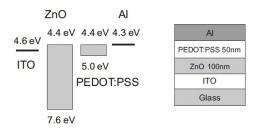
The device structure and energy level diagram of the WORM memory, which can be programmed at power densities that are orders of magnitude lower than previously reported ultralow-power WORM devices. Image credit: Wang, et al. ©2010 American Institute of Physics.

(PhysOrg.com) -- As RFID tags are becoming more widespread for tracking and identifying almost anything, researchers are continuing to develop cheap, ultralow-power memory devices for these applications. In a recent study, scientists from Cambridge have taken another step forward in this area by developing a write-once-read-many-times (WORM) memory device that requires just a fraction of the power needed by previous devices. In principle, the low-power memory can be used in any organic electronic circuit where the operation power is low.

The researchers, Jianpu Wang, Feng Gao, and Neil Greenham from the Cavendish Laboratory at Cambridge, have published their study in a recent issue of . As the scientists explain, require a that can be programmed and read using only the small amount of power taken from the field. In addition to requiring a very low current consumption and operating voltage, disposable RFIDs also require memory devices that are inexpensive.

The Cambridge researchers’ WORM memory satisfies both these requirements. The electron-only design is fabricated by solution processing, making it less expensive than other techniques, such as those that require . To write data, the device uses ZnO semiconductor nanoparticles to inject into a conducting polymer. The injected electrons can be used to program the memory by permanently decreasing the conductivity of the polymer, producing an insulating state. The researchers demonstrated that the devices could be programmed at power densities of less than 0.1 W/cm2, which is orders of magnitude lower than previously reported ultralow-power WORM devices, which typically require at least 10 W/cm2.

The scientists explain that the low power of the devices is a consequence of the efficiency of the injected electrons in dedoping the previously doped polymer. The conducting polymer, called PEDOT:PSS, is already positively doped (with PSS), giving it a positive charge. When the electrons are injected by the nanoparticles, they dedope the polymer, reducing its conductivity.

“By using the wide bandgap ZnO nanoparticles, the electron-only device structure allows us to block the hole current,” Wang told PhysOrg.com. “Meanwhile, the injected electrons can dedope the PEDOT effectively, leading to an insulating state.”

Although the researchers are still investigating the details of the dedoping mechanism, their experiments show that water in the polymer film, which may be absorbed from the atmosphere, plays an important role in the dedoping process. In experiments performed under a nitrogen atmosphere, the low power density could not permanently change the polymer’s conductivity. The researchers also hope to make some further improvements to the device.

“The current structure still requires a thermal evaporation process to deposit metal electrodes,” Wang said. “Our ongoing research is to make an entirely solution-processed low-power WORM. We currently have some encouraging results on these extremely low-cost, low-power WORM devices.”

More information: Jianpu Wang, Feng Gao, and Neil C. Greenham. “Low-power write-once-read-many-times memory devices.” Applied Physics Letters 97, 053301 (2010). DOI:10.1063/1.3473775

Copyright 2010 PhysOrg.com.
All rights reserved. This material may not be published, broadcast, rewritten or redistributed in whole or part without the express written permission of PhysOrg.com.


Rank 4 /5 (12 votes)
Relevant PhysicsForums posts
  • Question on Kirchoff's Laws
    created4 hours ago
  • Changes in Water Weight
    created6 hours ago
  • Some superconductor help
    created6 hours ago
  • perturbance in a model
    created6 hours ago
  • Combustion: where does the heat come from?
    created8 hours ago
  • How does dynamic pressure affect static pressure?
    created8 hours ago
  • More from Physics Forums - General Physics

More news stories

'Dark plasmons' transmit energy

Microscopic channels of gold nanoparticles have the ability to transmit electromagnetic energy that starts as light and propagates via "dark plasmons," according to researchers at Rice University.

Nanotechnology / Nanophysics

created 3 hours ago | popularity 5 / 5 (3) | comments 0 | with audio podcast

Nanotube therapy takes aim at breast cancer stem cells

Wake Forest Baptist Medical Center researchers have again proven that injecting multiwalled carbon nanotubes (MWCNTs) into tumors and heating them with a quick, 30-second laser treatment can kill them.

Nanotechnology / Bio & Medicine

created 8 hours ago | popularity 5 / 5 (1) | comments 0 | with audio podcast

Inspired by steel, nanomanufacturing gets wear-resistant carbide tip

(PhysOrg.com) -- Scientists at the University of Pennsylvania, the University of Wisconsin-Madison and IBM Research - Zurich have fabricated an ultrasharp silicon carbide tip possessing such high strength ...

Nanotechnology / Nanophysics

created 13 hours ago | popularity 5 / 5 (2) | comments 1 | with audio podcast

New technology platform for molecule-based electronics

Researchers at the Nano-Science Center at the University of Copenhagen have developed a new nano-technology platform for the development of molecule-based electronic components using the wonder material graphene. At the same ...

Nanotechnology / Nanomaterials

created 10 hours ago | popularity 5 / 5 (2) | comments 0

Australians risking skin cancer to avoid nanoparticles

More than three in five Australians are concerned enough about the health implications of nanoparticles in sunscreens to want to know more about their impact. And while the initial scientific information released suggests ...

Nanotechnology / Bio & Medicine

created 11 hours ago | popularity 5 / 5 (1) | comments 0


Ultraviolet protection molecule in plants yields its secrets

Lying around in the sun all day is hazardous not just for humans but also for plants, which have no means of escape. Ultraviolet (UV) radiation from the sun can damage proteins and DNA inside cells, leading ...

Anyone can learn to be more inventive, cognitive researcher says

There will always be a wild and unpredictable quality to creativity and invention, says Anthony McCaffrey, a cognitive psychology researcher at the University of Massachusetts Amherst, because an "Aha moment" is rare and ...

Hydrogen from acidic water: Researchers develop potential low cost alternative to platinum for splitting water

A technique for creating a new molecule that structurally and chemically replicates the active part of the widely used industrial catalyst molybdenite has been developed by researchers with the Lawrence Berkeley ...

FDA-approved drug rapidly clears amyloid from the brain, reverses Alzheimer's symptoms in mice

Neuroscientists at Case Western Reserve University School of Medicine have made a dramatic breakthrough in their efforts to find a cure for Alzheimer's disease. The researchers' findings, published in the journal Science, show t ...

New method makes culture of complex tissue possible in any lab

Scientists at the University of California, San Diego have developed a new method for making scaffolds for culturing tissue in three-dimensional arrangements that mimic those in the body. This advance, published online in ...

Cell biologists describes mechanism by which some people may be more susceptible to colon cancer

An international research team led by cell biologists at the University of California, Riverside has uncovered a new insight into colon cancer, the third leading cause of cancer-related deaths in the United ...