NASA's SOFIA will likely help solve mysteries about our galaxy
(PhysOrg.com) -- How were millions of young stars able to form at the center of our Milky Way galaxy in the presence of an enormous black hole with a mass 4 million times that of the sun? This and other important questions may be answered by the NASA mission SOFIA, which is scheduled to make its first scientific measurements in the next few months.
SOFIA (Stratospheric Observatory for Infrared Astronomy), a modified 747SP jetliner, is the world's largest airborne observatory. It is expected to fly into the stratosphere at altitudes up to 45,000 feet about three to four nights a week for the next 20 years — some 2,800 flights in all. The mission's infrared telescope detects heat radiation rather than visible light. Flown by NASA pilots, most trips will last from eight to 10 hours.
SOFIA's telescope will provide the clearest view of the center of our Milky Way galaxy at wavelengths in the infrared region of the electromagnetic spectrum that are 50 to 100 times longer than those to which the human eye is sensitive. These wavelengths do not get through our atmosphere, but SOFIA's telescope can detect this invisible infrared energy because it flies above 99 percent of the water vapor in the atmosphere.
Most of the radiation from the region around the black hole and the galactic center — some 26,000 light years away — is emitted at these wavelengths. Millions of young stars packed closely together in this region are obscured by enormous quantities of dust but are easier to observe in the infrared because infrared light can penetrate the dust. More star formation is occurring in this region than anywhere else in the galaxy.
"We will look at the galactic center for as long as we can," said Eric Becklin, UCLA professor emeritus of physics and astronomy and chief science adviser for SOFIA. "With SOFIA, we will be getting data that we really couldn't get any other way."
SOFIA's infrared technology far outpaces that used on NASA's Kuiper Airborne Observatory, the world's first major airborne astronomical research laboratory, which made more than 1,400 flights through the Earth's upper atmosphere between 1975 and 1995.
"One of the keys to SOFIA is the new instrumentation," Becklin said. "SOFIA has several hundred infrared imaging detectors and a 2.5-meter telescope. In contrast, on the Kuiper Airborne Observatory, we had maybe 20 detectors and a 0.9-meter telescope. Our ability to do science in the stratosphere has increased dramatically. SOFIA is a sleek observatory."
The Milky Way has "a wimpy galactic center," according to Becklin, who noted that while black holes in the center of other galaxies can be up to billions of times the mass of our sun, ours is only some 4 million times as massive.
"SOFIA gives us an opportunity to understand the physics of what happens there by studying it in detail," Becklin said. "I believe we will do that well with SOFIA."
Studies by UCLA researchers have revealed that star formation is taking place in the immediate presence of the supermassive black hole.
"Our previous assumption was that the black hole would make that star formation next to impossible; the tidal forces would not allow the collapse of a cloud of gas and dust to form a star. But it's happening, within just a light year of the black hole," said Mark Morris, a UCLA professor of physics and astronomy and co-chair of SOFIA's science steering committee, who is scheduled to participate in SOFIA's science flights. "We are trying to understand, through observations using both short and long infrared wavelengths, what happens to the dust and gas that allows stars to form. We have some ideas."
The stars near the black hole can be observed from the ground at shorter wavelengths — from the W.M. Keck observatory in Hawaii, for example — but studying the dust emitted by the radiation from these stars requires the longer infrared wavelengths.
"The dust is the material out of which stars form and the material out of which we formed," Becklin said. "Understanding how stars form in the presence of dust and gas is very important for understanding how our solar system formed and how we are here. Dust and gas are the basic building blocks of planets and our biosphere. They are extremely important."
"We cannot observe planets at the galactic center — it's too far away — but we can see dust around newborn stars and we know that dust is destined to form planets," Morris said. "We can study the dust and see what it is made of, and by knowing what it is made of and how big the dust grains are, we can model the evolutionary history of the dust and determine its fate. Most of the energy coming from the galactic center comes from the dust. The dust absorbs starlight and reemits it as infrared; that's why we are observing it in the infrared. We study the energy pouring out of the galactic center by analyzing the dust."
The amount of dust in the galactic center, which is approximately 500 light years across, is approximately 1 million times the mass of our sun, Morris said.
"I would like us to understand what the effect of the black hole is on the young stars and what is driving the activity there," Becklin said. "We believe it is material falling onto the black hole, but I would like to see if we can quantify that and understand the star formation and how the very young stars get into this region; that has been a puzzle in astronomy for a long time."
"Star formation in this region is quite different from elsewhere in the galaxy because the gas is more turbulent, hotter and denser than in our neck of the woods of the galaxy," Morris said.
"Do clouds of interstellar gas form stars or dissipate? It depends on how much energy is in the cloud," said Morris, who noted that SOFIA observations will measure the energy content of the interstellar medium, the gas and dust that pervade interstellar space.
"SOFIA can do something else that very few observatories can, and that is look at magnetic fields," Becklin said. "There is a lot of interesting physics that occurs right at the center of the galaxy that we don't understand very well. This is an area where Mark (Morris) has done a lot of research. What SOFIA can do is look at magnetic fields in regions of the galactic center where there is dust. I think we're the only platform that has plans to make these measurements."
Star formation is strongly affected by the presence of a magnetic field. A strong enough magnetic field can prevent a cloud from collapsing to form a star, Morris said.
"We know next to nothing about the magnetic fields, except there is a strong magnetic field present in the galactic center," he said. "We want to know how strong it is and what its effects are."
Becklin and Morris also hope to learn what the energy sources at the galactic center are and how those energy sources flow through the interstellar medium, including through the dust, and get radiated away to the rest of the universe.
When new scientific questions arise, "SOFIA will be right there to jump on the new questions and help us answer them," Morris said. "When SOFIA lands, we can put a new instrument on it to always be on the cutting edge."
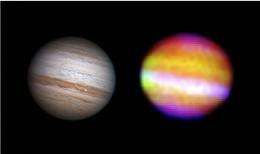
SOFIA's telescope provided its first infrared images on May 26, including one of Jupiter, a composite of several infrared wavelengths in which false colors were assigned. The Jupiter image show's the planet's thermal radiation from the heat in its interior. As can be seen in the online version of this release, the white band is where the astronomers see deepest into the hot interior. The image shows the planet at wavelengths unobservable by either ground-based observatories or other space telescopes.
Becklin and his team will determine each flight plan and flight path with the investigators whose research proposals have been accepted as part of the mission. Becklin hopes to fly on SOFIA.
"Astronomy is exciting from start to finish," Becklin said. "On SOFIA, you become much more a part of the experiment."
Becklin expects that UCLA physics and astronomy graduate students will eventually fly and make discoveries on SOFIA and will experience the thrill of using a research "instrument that moves at 500 miles per hour." The discoveries will improve teaching, Becklin and Morris said.
Other UCLA professors are participating in the SOFIA mission, including professor of physics and astronomy Ian McLean, who is principal investigator for the FLITECAM research imaging instrument, which is scheduled to go on SOFIA by 2012. Hundreds of other scientists and engineers work on the mission.
SOFIA, which takes off from NASA's Dryden Aircraft Operations Facility in Palmdale, Calif., comfortably accommodates 10 to 15 people in a pressurized cabin separated from the telescope. SOFIA is a joint program of NASA and the German Aerospace Center (DLR).
Provided by University of California Los Angeles


