Lethal backfire: Green odor with fatal consequences for voracious caterpillars
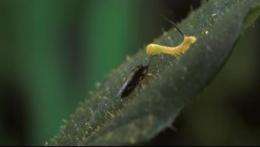
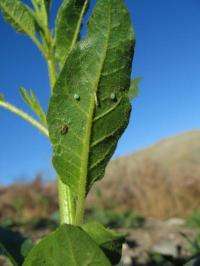
During field studies, scientists at the Max Planck Institute for Chemical Ecology discovered that the oral secretions of tobacco hornworm larvae contain a particular substance that promptly alters a green leaf volatile in tobacco leaves into an odor attractant signal. With this signal, called (E)-2-hexenal, they unintentionally lure their own enemies: carnivorous bugs. These bugs start their piercing attacks not only against freshly hatched caterpillar babies; they also devour eggs laid by the female moths.
Plants have developed a sophisticated defense system. They can not only directly fend off herbivores by producing toxins, but also do so indirectly by emitting odorant molecules into the atmosphere that are perceived by predatory insects; these predators are lured to the attacked plant and feed on the herbivore or parasitize it - thereby providing a benefit for the plant.
Since the discovery of indirect defense strategies in plants, ecologists have been interested in the molecular mechanisms and the course of events underlying them. For example, almost all plants switch on some of their defenses only when an herbivore is actually attacking them. But how does the plant recognize the attack from the herbivore? "The plant cannot see its attacker, but plants can sense the digestive substances that attacking larvae have in their oral secretions when these substances come into contact with the leaves," Silke Allmann, PhD student in the Department of Molecular Ecology, headed by Prof. Ian Baldwin, assumes. Ian Baldwin's department is looking for plant substances, signal transduction chains and metabolic pathways after herbivore attack.
Recently, the scientists' attention was drawn to substances in tobacco plants called "green leaf volatiles" (GLV); GLV are compounds released by plants after mechanical damage. These molecules are responsible for the typical smell of freshly cut grass. Last year the green odorant substances of tobacco were examined more carefully. The scientists found that the amount of a certain GLV, namely (E)-2-hexenal, suddenly increased after oral secretions of Manduca sexta larvae had been applied on wounded leaves. In tobacco plants the aldehyde, hexanal, is present in two isomeric forms: (Z)-3-hexenal and (E)-2-hexenal. Z-E conversions can be catalyzed by specific enzymes, so-called isomerases. "We supposed that the increased occurrence of (E)-2-hexenal may attract the carnivores, because we always discovered Geocoris when young Manduca larvae had just hatched and started feeding on the tobacco leaves," says Ian Baldwin.
To test this assumption, the researchers started a series of experiments using Manduca sexta eggs and different blends of (Z)-3-hexenal and (E)-2-hexenal. The eggs were glued to tobacco plants growing in the field and different mixtures of odorant signals were applied to adjacently located cotton swabs. After 12 and 24 hours, the fate of eggs on the leaves was determined. The result: Plants that had been perfumed with the Z-lure had only 8% of their glued eggs attacked, whereas plants perfumed with the E-lure had lost 24% of the eggs. And the eggs had been eaten by Geocoris. The speed of plants' defense triggering was particularly impressive: it takes less than an hour to trigger the conversion of the Z-lure to the E-lure and less than 24 hours for the predation of the eggs. "Other indirect defense mechanisms of plants require the activation of new metabolic pathways for the release of odorant signals, and these responses are much slower," says Ian Baldwin. The release of (E)-2-hexenal after its rapid and simple conversion from (Z)-3-hexenal is so rapid that it provides the prey-searching predator with enough information to pinpoint the exact location of the feeding herbivore on a plant. And it is this information which makes the release of volatile "alarm calls" an effective defense strategy for plants.
But which substance is betraying the caterpillar? "The simplest assumption is that the larval oral secretions contain a special enzyme, probably an isomerase, which rearranges the Z:E ratio of the aldehyde in favor of (E)-2-hexenal," says Silke Allmann. To test this assumption, the oral secretion was briefly heated and subsequently applied on wounded leaves. (E)-2-hexenal was now no longer produced. Hence the unknown substance is likely an enzyme, because enzymes are typically heat labile. The scientists also determined whether tobacco plants react specifically on Manduca sexta oral secretions or to secretions of other larval species as well. Interestingly, the secretions of two Spodopera species (Spodoptera exigua and S. littoralis) had significantly lower effects.
However, one question remains unanswered: Why does the oral secretion of Manduca sexta larvae contain a substance which endangers the larvae's lives as soon as they start feeding on tobacco leaves? Silke Allmann and Ian Baldwin hypothesize that the production of (E)-2-hexenal protects the larvae against other untested attackers, such as bacteria. Harmful microorganisms, consumed by the larvae every day in large amounts together with the leaf tissue, may be killed quickly and effectively by (E)-2-hexenal, which is known to be a strong antibiotic agent. Hence the detrimental aspects of producing (E)-2-hexenal, that of betraying the precise location of the Manduca sexta larvae to their enemies, may be balanced by the benefits of fewer bacterial infections.
Regardless, the winner in this tritrophic food chain is the carnivore Geocoris, which is well fed as a result of the response - thanks to its highly sensitive antennae which enable it to smell the slightest concentrations of (E)-2-hexenal.
More information: S. Allmann, I. T. Baldwin: Insects betray themselves in nature to predators by rapid isomerization of green leaf volatiles. Science, DOI: 10.1126/science.1191634
Provided by Max Planck Institute


