Octopus mimics flatfish and flaunts it (w/ Video)
August 26, 2010
Octopus mimics flatfish and flaunts it

Enlarge

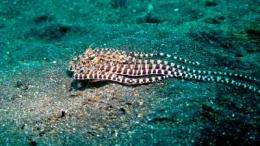
By creatively configuring its limbs, adopting characteristic undulating movements, and displaying conspicuous color patterns, the mimic octopus (Thaumoctopus mimicus) can successfully pass for a number of different creatures that share its habitat, including several toxic flatfish. Credit: Rich Ross, copyright California Academy of Sciences

Paul the Octopus—the eight-legged oracle who made international headlines with his amazingly accurate football forecasting—isn't the only talented cephalopod in the sea. The Indonesian mimic octopus, which can impersonate flatfish and sea snakes to dupe potential predators, may well give Paul a run for his money when it comes to "see-worthy" skills.

By creatively configuring its limbs, adopting characteristic undulating movements, and displaying conspicuous color patterns, the mimic octopus (Thaumoctopus mimicus) can successfully pass for a number of different creatures that share its habitat, several of which are toxic. Now, scientists from the California Academy of Sciences and Conservation International Indonesia have conducted to determine how this remarkable adaptation evolved. The research is reported in the September 2010 issue of the .

This video is not supported by your browser at this time.

A mimic octopus swims like a flatfish to confuse potential predators. Several of the flatfish that share the octopus's Indonesian habitat are toxic, including the peacock sole (Pardachirus pavoninus) and the zebra sole (Zebrias spp.). Credit: Bill Macdonald Productions, (c) California Academy of Sciences

Like its relatives, the mimic octopus is very capable of hiding from hungry predators by blending into its background. However, this talented species often chooses to make itself more conspicuous to predators by mimicking flatfish, or sea snakes that display high-contrast color patterns. This daredevil maneuver is thought to help T. mimicus confuse or scare away predators. Because it is relatively rare for an animal to develop such a high-risk, conspicuous defense strategy, the authors of the recent study hoped to gain insight into the evolutionary forces that fueled this behavior by conducting genetic research on the mimic octopus and its relatives. They focused on the mimic's ability to flatten its arms and head and swim along the like a flatfish, while simultaneously exhibiting a bold, brown-and-white color pattern.

Using to construct a genealogy for the mimic octopus and more than 35 of its relatives, the researchers ascertained the order in which the T. mimicus lineage evolved several key traits: 1) First, T. mimicus ancestors evolved the use of bold, brown-and-white color displays, employed as a secondary "shock" defense to surprise predators if camouflage fails. 2) Next, they developed the flatfish swimming technique and the long arms that facilitate this motion. 3) Finally, T. mimcus began displaying bold color patterns while impersonating a flatfish—both during daily forays away from its den and at rest. In evolutionary terms, this last step represents an extremely risky shift in defense strategy.
Octopus mimics flatfish and flaunts it
Enlarge

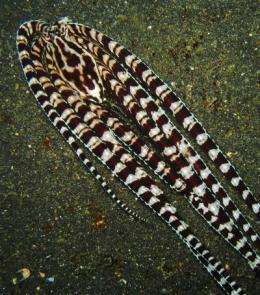
The mimic octopus impersonates a variety of flounders and soles by flattening its head, arranging its arms to form a flatfish silhouette, and adopting characteristic undulating movements. Credit: Crissy Huffard, copyright California Academy of Sciences

"The close relatives of T. mimicus use drab colors and camouflage quite successfully to hide from predators," says Dr. Christine Huffard, Marine Conservation Priorities Advisor at Conservation International Indonesia. "Why does T. mimicus instead draw attention to itself, and repeatedly abandon the camouflage abilities it inherited from its ancestors in favor of a bold new pattern? Somehow, through natural selection, being conspicuous has allowed T. mimicus to survive and reproduce more successfully than some of its less showy ancestors, and eventually evolve into its own lineage."

The researchers suggest several possibilities for why this bold coloration would be advantageous. It may fool predators into thinking the octopus is a toxic flatfish (such as the peacock sole, Pardachirus pavoninus, or the zebra sole, Zebrias spp.); it may obscure the octopus's outline against the black-and-white sandy bottoms; or it may serve as an honest warning sign of the mimic's unpalatable flesh.

"While T. mimicus's imitation of flatfish is far from perfect, it may be 'good enough' to fool predators where it lives, in the world's center of marine biodiversity," says Dr. Healy Hamilton, Director of the Center of Applied Biodiversity Informatics at the California Academy of Sciences. "These octopuses can change their color pattern to look similar to—but not exactly like—numerous toxic and non-toxic flatfishes in their area. In the time it takes a predator to do a double-take, the octopus may be able to get away."

Undescribed by scientists until 1998, much remains unknown about the mimic . Future research will focus on observing T. mimicus in the wild in Indonesia, so that scientists can assess the possible reasons for its bold coloration and better understand the costs and benefits of this strategy.

"This study reminds us that evolution does not have an endgame, but is a continuous process," says Huffard. "These octopuses will continue evolving as long as we can protect them and their habitat from threats like trawling, land reclamation, and run-off."

Provided by California Academy of Sciences


Rank 5 /5 (12 votes)
Relevant PhysicsForums posts
  • Pertubance in a model
    created3 hours ago
  • Cancer drugs and Alzheimer's, Oh my!
    created11 hours ago
  • Squishing cells
    created12 hours ago
  • Any books/articles for evolutionary stable strategy models in humans?
    created23 hours ago
  • Science behind the bore feeling?
    createdFeb 09, 2012
  • Homo Sapien vs. Chimpanzee - Divergence Timeline
    createdFeb 09, 2012
  • More from Physics Forums - Biology

More news stories

The power of estrogen -- male snakes attract other males

A new study has shown that boosting the estrogen levels of male garter snakes causes them to secrete the same pheromones that females use to attract suitors, and turned the males into just about the sexiest ...

Biology / Plants & Animals

created 1 hour ago | popularity not rated yet | comments 0 | with audio podcast

Experts reveal how plants don't get sunburn

(PhysOrg.com) -- Experts at the University of Glasgow have discovered how plants survive the harmful rays of the sun.

Biology / Cell & Microbiology

created 1 hour ago | popularity 5 / 5 (1) | comments 0 | with audio podcast

Miami battling invasion of giant African snails

No one knows how they got there. But an invasion of African giant snails has southern Florida in a panic over potential crop damage, disease and general yuckiness surrounding the slimy gastropods.

Biology / Ecology

created 5 hours ago | popularity not rated yet | comments 2

Ultraviolet protection molecule in plants yields its secrets

Lying around in the sun all day is hazardous not just for humans but also for plants, which have no means of escape. Ultraviolet (UV) radiation from the sun can damage proteins and DNA inside cells, leading ...

Biology / Plants & Animals

created 20 hours ago | popularity 5 / 5 (5) | comments 0 | with audio podcast

Fighting crimes against biodiversity: How to catch a killer weed

Invasive species which have the potential to destroy biodiversity and influence global change could be tracked and controlled in the same way as wanted criminals, according to new research from Queen Mary, University of London.

Biology / Ecology

created 6 hours ago | popularity not rated yet | comments 0


Curry spice component may help slow prostate tumor growth

Curcumin, an active component of the Indian curry spice turmeric, may help slow down tumor growth in castration-resistant prostate cancer patients on androgen deprivation therapy (ADT), a study from researchers ...

Netflix light on flicks as viewers soak up TV shows

Like most fresh faces that arrive in Hollywood, Netflix wanted to be a movie star. But now it's learning what many in Tinseltown have known for decades: Movies are sexy, but the real money is in television.

Antidepressants and pregnancy: Women must consider the impact of drugs on baby, and of depression on baby, themselves

Upon learning they are pregnant, most women dutifully nix the alcohol, sushi and caffeine. But what about antidepressants?

Arthritic knees, but not hips, have robust repair response

Researchers at Duke University Medical Center used new tools they developed to analyze knees and hips and discovered that osteoarthritic knee joints are in a constant state of repair, while hip joints are not.

Fool's gold may prove an unlikely alternative to overexploited catalytic materials

Catalytic materials, which lower the energy barriers for chemical reactions, are used in everything from the commercial production of chemicals to catalytic converters in car engines. However, with current catalytic materials ...

Humans may have helped the decline of African rainforests 3000 years ago

(PhysOrg.com) -- Large areas of rainforests in Central Africa mysteriously disappeared over three thousand years ago, to be replaced by savannas. The prevailing theory has been that the cause was a change ...