Prediction of intrinsic magnetism at silicon surfaces could lead to single-spin magnetoelectronics
August 26, 2010
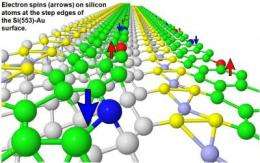
Electron spins (arrows) on silicon atoms at the step edges of the Si(553)-Au surface. Credit: Naval Research Laboratory
The integration of single-spin magnetoelectronics into standard silicon technology may soon be possible, if experiments confirm a new theoretical prediction by physicists at the Naval Research Laboratory and the University of Wisconsin-Madison.
The researchers predict that a family of well-known silicon surfaces, stabilized by small amounts of gold atoms, is intrinsically magnetic despite having no magnetic elements. None of these surfaces has yet been investigated experimentally for magnetism, but the new predictions are already supported indirectly by existing data. The complete findings of the study are published in the August 24, 2010, issue of the journal Nature Communications.
Silicon provides a unique entry point for combining magnetoelectronics based on single spins with standard electronics technology. If a single-spin device can be built on a silicon wafer, input and output electronics can be directly integrated with the magnetic part of the device. This has been an obstacle for current spintronics approaches. For example, spin injection from a metal into silicon is very inefficient unless the metal/semiconductor interface is carefully optimized.
These latest results have the advantage that nature itself guides, by a self-assembly process, the formation of long chains of polarized electron spins with atomically precise structural order. "This integration of structural and magnetic order is crucial for future technologies based on single spins at the atomic level" said Dr. Steven Erwin, a physicist at NRL and lead theorist on the project.
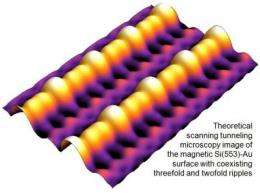
This is a theoretical scanning tunneling microscopy image of the magnetic Si(553)-Au surface with coexisting threefold and twofold ripples. Credit: Naval Research Laboratory
The magnetic silicon surfaces, one of which is illustrated here, naturally form steps which are stabilized by chains of gold atoms (yellow). According to the team's calculations, some of the silicon atoms at the step edges have unpaired electrons that are fully spin polarized and probably magnetically ordered at sufficiently low temperatures.The atom chains on the Si(553)-Au surface were discovered in the group of co-author Dr. Franz Himpsel at the University of Wisconsin-Madison. Several other groups worldwide have been investigating such "one-dimensional" silicon surfaces in recent years. As Himpsel noted, "The idea of creating magnetism in a nonmagnetic material by manipulating its structure has long intrigued scientists. The hope of realizing this idea in silicon has been widely discussed for decades, but so far none of these speculations has held up under scrutiny."
The work of Erwin and Himpsel suggests several experiments, such as spin-polarized scanning tunneling microscopy, to test their predictions directly. But there is already indirect experimental evidence to support the possibility of magnetism at silicon surfaces.
Two research groups, at Yonsei University in Korea and at Oak Ridge National Laboratory in the US, have found that Si(553)-Au develops periodic "ripples" with two different periodicities at low temperatures. One ripple occurs along the silicon step edges with three times the normal periodicity, and the other along the gold chains with two times the normal periodicity. The prediction of Erwin and Himpsel, shown here, reproduces this pattern perfectly. Moreover, this pattern only emerges when magnetism is allowed in the calculation. When magnetism is "turned off" in the theory, the ripples completely vanish. Thus the observation of threefold and twofold ripples offers indirect - if preliminary - confirmation of magnetism.
Linear chains of spin-polarized atoms provide atomically perfect templates for the ultimate memory and logic, in which a single spin represents a bit. One potential application is a "spin shift register" recently proposed theoretically by Gerald D. Mahan, a theoretical physicist at Pennsylvania State University. Another application is the storage of information in single magnetic atoms. Erwin and Himpsel's work also predicts that the magnitude, and even the sign, of the spin coupling can be changed by doping electrons or holes into surface states.
The closely related Si(111)-Au surface can be electron-doped by adsorbates (for example, silicon adatoms) on the surface. By varying this adsorbate population one can perform band-structure engineering with extraordinary precision. The possibility of tuning surface magnetism on Si(553)-Au and its relatives using surface chemistry suggests a fascinating new research direction.
This work was supported by the Office of Naval Research and by National Science Foundation awards.
-
Experiments Prove Existence of Atomic Chain Anchors
Feb 03, 2005 |
not rated yet |
0
-
Spin polarization achieved in room temperature silicon
Nov 27, 2009 |
not rated yet |
0
-
Detecting the spin of a single electron in a standard silicon transistor
Aug 10, 2004 |
not rated yet |
0
-
Spin-polarized electrons on demand
Jan 21, 2009 |
not rated yet |
0
-
Spin-polarized electrons on demand
Jan 15, 2009 |
not rated yet |
0
-
Engineers build first sub-10-nm carbon nanotube transistor
Feb 01, 2012 |
4.9 / 5 (30) |
30
-
Something old, something new: Evolution and the structural divergence of duplicate genes
Jan 31, 2012 |
4.6 / 5 (7) |
1
-
The hidden nanoworld of ice crystals: Revealing the dynamic behavior of quasi-liquid layers
Jan 30, 2012 |
5 / 5 (3) |
1
-
Stock market network reveals investor clustering
Jan 27, 2012 |
3.9 / 5 (23) |
8
-
Of microchemistry and molecules: Electronic microfluidic device synthesizes biocompatible probes
Jan 26, 2012 |
5 / 5 (1) |
0
-
excited U-236 decay time in the U235 fission chain
18 hours ago
-
Polar catastrophe?
21 hours ago
-
Large scale field sonication
Feb 09, 2012
-
states and energy of paired electrons in BCS
Feb 08, 2012
-
difference between longitudinal and transverse refractive indices
Feb 08, 2012
-
Monte Carlo simulation
Feb 07, 2012
- More from Physics Forums - Atomic, Solid State, Comp. Physics
More news stories
Hovering not hard if you're top-heavy, researchers find
Top-heavy structures are more likely to maintain their balance while hovering in the air than are those that bear a lower center of gravity, researchers at New York University's Courant Institute of Mathematical Sciences ...
just added |
not rated yet |
0
|
SLAC, Stanford team focuses on high-energy electrons to treat cancer
Accelerator physicists at SLAC and cancer specialists from Stanford are working on a new technology that could dramatically reduce the time needed for cancer radiation treatments. The team ran an initial experiment ...
3 hours ago |
not rated yet |
0
Measurements from high-energy collisions lead to better understanding of why meson particles disappear
For several years, physicists at the Relativistic Heavy Ion Collider (RHIC) at Brookhaven National Laboratory (BNL), USA, have studied an unusual state of matter called the quarkgluon plasma, which they ...
3 hours ago |
not rated yet |
0
Quantum physicist explains $100K offer for proof scaled-up quantum computing is impossible
(PhysOrg.com) -- MIT researcher Scott Aaronson has certainly riled the physics community with his offer this past Friday, of $100,000 to anyone who can prove that scaled-up quantum computing is impossible. ...
Explained: Sigma
It's a question that arises with virtually every major new finding in science or medicine: What makes a result reliable enough to be taken seriously? The answer has to do with statistical significance -- but ...
Feb 09, 2012 |
5 / 5 (14) |
26
New understanding of DNA repair could eventually lead to cancer therapy
A research group in the Faculty of Medicine & Dentistry at the University of Alberta is hoping its latest discovery could one day be used to develop new therapies that target certain types of cancers.
Zuckerberg's focus drives Facebook's ascent
When Mark Zuckerberg showed up to rent Judy Fusco's Los Altos, Calif., house in the fall of 2004, soon after he'd arrived in Silicon Valley, the landlord was immediately struck by his confidence.
Both maternal and paternal age linked to autism
Older maternal and paternal age are jointly associated with having a child with autism, according to a recently published study led by researchers at The University of Texas Health Science Center at Houston (UTHealth).
Night, weekend delivery OK for babies with birth defects
Weekday delivery is no better than night or weekend delivery for infants with birth defects, according to a new study presented today at The Pregnancy Meeting, the Society for Maternal-Fetal Medicine's annual conference. ...
Sonic Cradle lands spot in TED exhibition
A Simon Fraser University graduate student project that melds music, meditation and modern technology has landed a rare spot as an exhibit at TEDActive 2012 in Palm Springs, California this month.
Drug halts organ damage in inflammatory genetic disorder
A new study shows that Kineret (anakinra), a medication approved for the treatment of rheumatoid arthritis, is effective in stopping the progression of organ damage in people with neonatal-onset multisystem inflammatory disease ...

Aug 26, 2010
Rank: not rated yet