Alpha Magnetic Spectrometer arrives at launch site
August 26, 2010
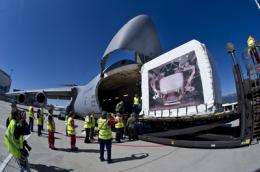
AMS-02 began the first stage of its voyage to the International Space Station from Geneva international airport, in Switzerland. Credits: ESA
(PhysOrg.com) -- One of the most complex space scientific instruments ever built, the Alpha Magnetic Spectrometer (AMS-02) arrived at the Kennedy Space Center in Florida, escorted by astronauts who will fly with it on the Space Shuttle in February 2011.
The antimatter hunter AMS-02 began the first stage of its voyage to the International Space Station (ISS) from Geneva international airport, in Switzerland. During a ceremony organised by the European Organisation for Nuclear Research (CERN), the experiment was loaded onto the US Air Force Galaxy transport aircraft that carried it to Cape Canaveral.
AMS-02 will not only be the largest scientific instrument to be installed on the ISS, but it could also be considered the result of the largest international collaboration for a single experiment in space.
Even before its launch, the Alpha Magnetic Spectrometer has already been hailed as a success with more than a decade of work and cooperation between 56 institutes from 16 different countries. The AMS-02 experiment is led by Nobel Prize Laureate Samuel Ting of the Massachusetts Institute of Technology (MIT).
Searching for the ‘missing Universe’
AMS-02 will help scientists to understand better the fundamental issues on the origin and structure of the Universe by observing antimatter and ‘dark’ matter. With a magnetic field 4000 times stronger than the magnetic field of Earth, this state-of-the-art particle physics detector will examine directly from space each particle passing through it in a programme that is complementary to that of the Large Hadron Collider.
As a by-product, AMS-02 will gather a lot of other information from cosmic radiation sources on stars and galaxies millions of light years from our home galaxy. Not only astronomers, but also particle physicists, are eagerly waiting for its data.
Long life to the AMS-02
The ISS stands out as a unique platform for AMS-02. “It is the only place where it can be installed due to stability reasons, the long-term exposure and also because we can always refurbish the instrument if necessary,” explained Simonetta Di Pippo, ESA’s Human Spaceflight Director..
The experiment is expected to remain active for the entire lifetime of the ISS and will not return back to Earth. “The ISS is set to be utilised for scientific and exploration purposes, so it is important to count on an instrument that can remain fully active for more than a decade,” emphasised Di Pippo.
Exhaustive tests in ESA’s testing facilities at ESTEC, Noordwijk, The Netherlands, played an important role in the decision to replace the original superconducting magnet for a permanent one with a longer life expectancy.
After its arrival at the Kennedy Space Center, AMS will be installed in a clean room for more tests. A few weeks later, the detector will be moved to the Space Shuttle, ready for its last mission.
-
Alpha Magnetic Spectrometer experiment takes off for Kennedy Space Center
Aug 19, 2010 |
not rated yet |
0
-
Dark matter detective arrives at ESTEC
Feb 17, 2010 |
not rated yet |
0
-
AMS experiment embarks on first leg of mission into space
Feb 12, 2010 |
not rated yet |
0
-
Space detector prepares to scour universe for secrets (Update)
Aug 25, 2010 |
not rated yet |
0
-
Space Station to Receive New Anti-Matter Detector Component
Apr 27, 2010 |
not rated yet |
0
-
Engineers build first sub-10-nm carbon nanotube transistor
Feb 01, 2012 |
4.9 / 5 (30) |
30
-
Something old, something new: Evolution and the structural divergence of duplicate genes
Jan 31, 2012 |
4.6 / 5 (7) |
1
-
The hidden nanoworld of ice crystals: Revealing the dynamic behavior of quasi-liquid layers
Jan 30, 2012 |
5 / 5 (3) |
1
-
Stock market network reveals investor clustering
Jan 27, 2012 |
3.9 / 5 (23) |
8
-
Of microchemistry and molecules: Electronic microfluidic device synthesizes biocompatible probes
Jan 26, 2012 |
5 / 5 (1) |
0
-
Titan's lack of impact craters
22 hours ago
-
Real pictures of black hole eating a star?
Feb 08, 2012
-
Hypothetical way to travel faster than light, but not technically exceed lightspeed
Feb 06, 2012
-
How do scientists monitor the Sun's activity?
Feb 05, 2012
-
Search patterns in observational studies
Feb 05, 2012
-
Derivation of Pogson's law
Feb 03, 2012
- More from Physics Forums - General Astronomy
More news stories
Could Venus be shifting gear?
(PhysOrg.com) -- ESAs Venus Express spacecraft has discovered that our cloud-covered neighbour spins a little slower than previously measured. Peering through the dense atmosphere in the infrared, the ...
Space & Earth / Space Exploration
46 minutes ago |
5 / 5 (1) |
0
|
What does a nebula sound like?
What do things sound like out in the cosmos? Of course, sound waves cant travel through the vacuum of space; however, electromagnetic waves can. These electromagnetic waves can be recorded by devices called spectrographs ...
Space & Earth / Space Exploration
53 minutes ago |
5 / 5 (1) |
0
Two new moons for Jupiter
Advances in technology have lead to the discovery of new planets outside of our Solar System, and now even new moons in our own backyard.
Space & Earth / Space Exploration
51 minutes ago |
not rated yet |
2
Sandy streets over the Atlantic
Thick dust from the Sahara blowing over the ocean off the western coast of Africa encounters the islands of Cape Verde, forming a wake of swirling vortex streets visible by satellite.
Space & Earth / Earth Sciences
18 minutes ago |
not rated yet |
0
Humans may have helped the decline of African rainforests 3000 years ago
(PhysOrg.com) -- Large areas of rainforests in Central Africa mysteriously disappeared over three thousand years ago, to be replaced by savannas. The prevailing theory has been that the cause was a change ...
The power of estrogen -- male snakes attract other males
A new study has shown that boosting the estrogen levels of male garter snakes causes them to secrete the same pheromones that females use to attract suitors, and turned the males into just about the sexiest ...
Experts reveal how plants don't get sunburn
(PhysOrg.com) -- Experts at the University of Glasgow have discovered how plants survive the harmful rays of the sun.
Team isolates nerve cells involved in storing long term memory and gene proteins associated with them
(Medical Xpress) -- A research team in Taiwan has succeeded in isolating two nerve cells in fruit fly brains that are believed to be the major players in allowing for the formation of long term memories. Furthermore, ...
Measurements from high-energy collisions lead to better understanding of why meson particles disappear
For several years, physicists at the Relativistic Heavy Ion Collider (RHIC) at Brookhaven National Laboratory (BNL), USA, have studied an unusual state of matter called the quarkgluon plasma, which they ...
SLAC, Stanford team focuses on high-energy electrons to treat cancer
Accelerator physicists at SLAC and cancer specialists from Stanford are working on a new technology that could dramatically reduce the time needed for cancer radiation treatments. The team ran an initial experiment ...
News of plaque-clearing drug tops week of major advances against Alzheimer's disease
In the last eight days, scientists have delivered a powerful one-two punch in the fight to defeat Alzheimer's disease. At the same time, the White House and members of Congress are proposing increases in Alzheimer's research ...