Stretched molecule ends up shorter than it started (w/ Video)
August 26, 2010 By Karl Leif Bates
Stretched polymer snaps back smaller than it started (w/ Video)

Enlarge

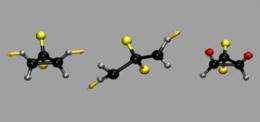
A ring-like polymer called gDFC was stretched (middle) and sprung back to shape smaller than it began

(PhysOrg.com) -- Crazy bands are cool because no matter how long they've been stretched around a kid's wrist, they always return to their original shape, be it a lion or a kangaroo.

Now a Duke and Stanford chemistry team has found a that's so springy it snaps back from stretching much smaller than it was before.

Duke graduate student Jeremy Lenhardt and associate professor Stephen Craig have been systematically hunting through a library of polymers in search of a molecule that might be useful for "self-healing" materials. They hope to find a polymer that can trigger a chemical reaction when it is stretched and enable a material to build its own repairs.

Imagine a sheet of Saran Wrap that could fix a microscopic puncture before the hole ever got big enough to see. This would require that the polymer molecules immediately around the tear could somehow jump into action and perform new chemistry to build bridges across the hole.

To stretch polymers and see what happens to them, Lenhardt uses an apparatus that pumps up and down on a solution filled with polymers, pressurizing it and depressurizing it 20,000 times a second which causes tiny bubbles to form fleetingly. The void created by the bubbles exerts a tug on the ends of some of the polymers in the solution and stretches them, if only for a billionth of a second.

This video is not supported by your browser at this time.

After being stretched by ultrasonication, a ring-shaped gem-difluorocyclopropane (gDFC) forms a transition state 1,3-diradical, and then snaps back to shape smaller than it began. Duke graduate student Jeremy Lenhardt narrates.

"Think of two rafts going down a river with a rope between them," Craig explained. "As the first raft enters a rapids and accelerates forward, that rope - the polymer - gets pulled taught and stretches."

Over and over Lenhardt ran the experiment, characterizing different species that became more reactive when stretched, potentially able to do "stress-induced chemistry."

Then, while looking at polymers that contained tiny ring-shaped molecules called gem-difluorocyclopropanes (gDFC), he was surprised to find that some of these molecules emerged from the stretching noticeably shorter than when they went in.

"I ran up to his office," Lenhardt said. " 'Steve, something funny is going on here. Look at this!' " A technique called nuclear magnetic resonance had revealed the shapes of the rings after pulling and shown that they were, in fact, shorter.

But not only were the gDFCs snapping back smaller than they started, it also appeared that before snapping back they were actually trapped in an unusual stretched state far longer than normal, a reactive state called a 1,3-diradical.

Normally, as a molecule goes through a reaction, it passes through a special point known as a transition state, and stays there for only ten to a hundred femtoseconds, "a tenth of a millionth of a millionth of a second," Craig said. This makes it extraordinary hard to actually watch chemistry happen, so chemists usually can only infer what happens at the transition state by what they've seen before and after.

Work by their Stanford collaborators showed that the trapped 1,3-diradicals are in fact one type of these usually fast-moving transition states, but in Lenhardt's experiments they were essentially stopped in their tracks and trapped for nanoseconds, tens of thousands of times longer than usual.

This might be a window for watching transition states in action, Craig said. "We can trap these things long enough to probe new facets of their reactivity."

Lenhardt has begun doing just that, stretching the polymers to learn more about these transition states and seeing if he can watch other molecules by using this technique as a sort of stop-action camera.

"Every chemical reaction has a high energy state that you have to guess at," Lenhardt said. "But maybe, in some cases, you don't have to guess anymore."

The team's findings appear Aug. 27 in Science.

Provided by Duke University (news : web)

4.7 /5 (6 votes)  

Filter


Move the slider to adjust rank threshold, so that you can hide some of the comments.


Display comments: newest first

gmurphy
Aug 27, 2010

Rank: not rated yet
lol, watching the video reminded me of world of goo http://en.wikiped..._of_Goo. Outstanding observation by the reseracher, I wish him all the best
Rank 4.7 /5 (6 votes)
Relevant PhysicsForums posts
  • Magnet in a AC current solenoid
    created1 hour ago
  • Maxwell's equations outside electrodynamics?
    created3 hours ago
  • Force and Surface Charge on Sphere
    created9 hours ago
  • Trajectory Path from 2 Distance Sensors
    created9 hours ago
  • Conceptual issue with rolling sphere and friction.
    created13 hours ago
  • Conservation of momentum/energy
    created14 hours ago
  • More from Physics Forums - Classical Physics

More news stories

Fool's gold may prove an unlikely alternative to overexploited catalytic materials

Catalytic materials, which lower the energy barriers for chemical reactions, are used in everything from the commercial production of chemicals to catalytic converters in car engines. However, with current catalytic materials ...

Chemistry / Materials Science

created 14 hours ago | popularity 4.4 / 5 (8) | comments 5 | with audio podcast

Unpicking HIV’s invisibility cloak

Drug researchers hunting for alternative ways to treat human immunodeficiency virus (HIV) infections may soon have a novel target—its camouflage coat. HIV hides inside a cloak unusually rich in a sugar ...

Chemistry / Biochemistry

created 14 hours ago | popularity 5 / 5 (5) | comments 0

No entry without protein recycling: Researchers discover new coherence in enzyme transport

The group of Prof. Dr. Ralf Erdmann at the Ruhr-Universität Bochum, Germany, discovered a connection of peroxisomal protein import and receptor export. In the Journal of Biological Chemistry, they disclo ...

Chemistry / Biochemistry

created 14 hours ago | popularity not rated yet | comments 0

Hydrogen from acidic water: Researchers develop potential low cost alternative to platinum for splitting water

A technique for creating a new molecule that structurally and chemically replicates the active part of the widely used industrial catalyst molybdenite has been developed by researchers with the Lawrence Berkeley ...

Chemistry / Materials Science

created Feb 09, 2012 | popularity 4.8 / 5 (14) | comments 14 | with audio podcast

Under the microscope #7

In this video Dr Ingrid Graz shows us a thin layer of gold on top of rubber. Cracks in the gold allow it to stretch and we can use this for stretchable electronics.

Chemistry / Other

created 16 hours ago | popularity not rated yet | comments 0


Google users warned of threat to smartphone wallets

Users of Google smartphone wallets were being warned on Friday that there is a way to crack pass codes intended to thwart thieves from going on illicit shopping sprees.

Anonymous knocks CIA website offline (Update)

The website of the Central Intelligence Agency was inaccessible on Friday after the hacker group Anonymous claimed to have knocked it offline.

New error-correcting codes guarantee the fastest possible rate of data transmission

Error-correcting codes are one of the triumphs of the digital age. They’re a way of encoding information so that it can be transmitted across a communication channel — such as an optical fiber o ...

Humans may have helped the decline of African rainforests 3000 years ago

(PhysOrg.com) -- Large areas of rainforests in Central Africa mysteriously disappeared over three thousand years ago, to be replaced by savannas. The prevailing theory has been that the cause was a change ...

Complex wiring of the nervous system may rely on a just a handful of genes and proteins

Researchers at the Salk Institute have discovered a startling feature of early brain development that helps to explain how complex neuron wiring patterns are programmed using just a handful of critical genes. ...

New power source discovered

(PhysOrg.com) -- Researchers at the Massachusetts Institute of Technology (MIT) and RMIT University have made a breakthrough in energy storage and power generation.