Tuning into cell signals that tell where sensory organs will form inside the ear
August 27, 2010 by Leila Gray
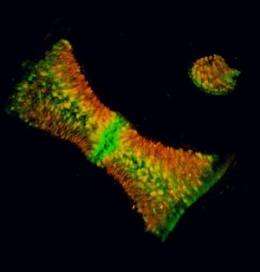
Pictured is a normal sensory patch from one of the balance organs in a mouse inner ear. Right beside it is an additional patch of sensory tissue that has been induced by activation of the Notch pathway -- a particular type of cell-to-cell signaling -- during development. This patch contains both the sensory nerve cells known as hair cells (red) and their associated supporting cells (green). B. Hartman,T. Reh, O. Bermingham-McDonogh
(PhysOrg.com) -- Cell signals guide the anatomical development of hearing and balance structures. These signals disappear early in life, but perhaps could be recharged to restore hearing loss in adults.
Researchers have tracked a cell-to-cell signaling pathway that designates the future location of the ear's sensory organs in embryonic mice. The scientists succeeded in activating this signal more widely across the embryonic tissue that becomes the inner ear. Patches of sensory structures began growing in spots where they don't normally appear.
The structures contained tufted cells, called hair cells, which respond to sound waves and other sensations, and additional nerve cells that amplify or code sounds for the brain to interpret.
The results suggest an avenue for further investigation in restoring hearing loss from nerve damage.
The findings are reported this week in the early online edition of Proceedings of the National Academy of Sciences by researchers Byron H. Hartman, Thomas Reh, and Olivia Bermingham- McDonogh of the Department of Biological Structure at the University of Washington (UW) in Seattle. All three are members of the UW Institute for Stem Cells and Regenerative Medicine. The senior author, Bermingham-McDonogh, is also an affiliate of the UW Virginia Merrill Bloedel Hearing Research Center .
"As the population ages," said Bermingham-McDonogh, "there's a great interest in discovering how to regenerate the inner ear sensory cells that we need for our hearing and balance. Both of these falter as we get older -- we get hard of hearing and unsteady on our feet -- due to accumulated destruction of the sensory cells in the inner ear."
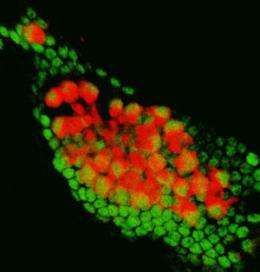
An example of a sensory patch produced when Notch signaling is activated during development. The patch contains the sensory hair cells (red) and their associated supporting cells (green). B. Hartman, T. Reh, O. Bermingham-McDonogh
The goal of their research is to develop ways to restore inner ear sensory hair cells in people who have lost them due to age, excessive noise or other toxic damage. The hair cells do not spontaneously recover after they are lost, and adult stem cells have not been found in the mammalian inner ear. In order to devise a way to restart hair cell formation in the adult ear, Bermingham-McDonogh's group is studying how hair cells are made in the first place during ear development.
The first stage in the normal development of hair cells is called prosensory specification. In the growing embryo, regions of the ear-forming tissue are selected to become the inner ear organs that detect sound and allow for our sense of balance. This action is similar to digging the foundation of a building. All the subsequent, complex steps in the construction of the building require a solid foundation.
Byron Hartman, a postdoctoral fellow in the Bermingham-McDonogh lab, found that a signaling system called the Notch pathway is important in laying the foundation for the inner ear sensory hair cells and their associated supporting cells. The researchers were able to activate the Notch pathway in regions of the inner ear that would normally never make hair cells and convert these regions to patches of new sensory tissue. In other words, they could encourage the formation of new building foundations throughout the inner ear. Once these new sensory patches were made, new hair cells and support cells were properly produced within them. So by starting the ball rolling with the Notch signal, the researchers observed that the rest of the developmental processes followed along correctly.
Notch proteins straddle the inside and outside of the cell membrane. They collect information at the cell surface and report to the cell's operations center, the nucleus. Embryologists and cancer researchers have been studying the Notch pathway for many years. More recently scientists in the regenerative medicine field have begun taking advantage of this key regulatory signal to restart developmental processes in adults.
"The Notch signaling for prosensory specification does not appear to be active in the mature inner ear," the UW researchers noted, "and this could explain their lack of ability to regenerate new hair cells." They are now studying ways of manipulating the Notch pathway in the adult inner ear to see if this will stimulate hair cell regeneration in the hearing and balance organs.
If ways could be found to safely re-start particular Notch signals in adults, therapies might be designed to regenerate specific tissues, like nerves, and thereby repair damage and restore lost function, like hearing. Perhaps this knowledge, they noted, may lead to ideas on how to re-create this earlier state in the mature adult ear to stimulate re-growth of the cells critical to hearing.
More information: http://www.pnas.or … 107.abstract
-
Inner ear cells may be able to regenerate
Jun 21, 2006 |
not rated yet |
0
-
Study shows isolation of stem cells may lead to a treatment for hearing loss
Apr 06, 2007 |
not rated yet |
0
-
Surviving dance club music (noise) with hearing intact
Jan 21, 2009 |
not rated yet |
0
-
Can you hear me now? Stem cells enhance hearing recovery
Jun 25, 2007 |
not rated yet |
0
-
Aiming to cure deafness, Stanford scientists first to create functional inner-ear cells
May 13, 2010 |
not rated yet |
0
-
Engineers build first sub-10-nm carbon nanotube transistor
Feb 01, 2012 |
4.9 / 5 (31) |
30
-
Something old, something new: Evolution and the structural divergence of duplicate genes
Jan 31, 2012 |
4.6 / 5 (7) |
1
-
The hidden nanoworld of ice crystals: Revealing the dynamic behavior of quasi-liquid layers
Jan 30, 2012 |
5 / 5 (3) |
1
-
Stock market network reveals investor clustering
Jan 27, 2012 |
3.9 / 5 (23) |
8
-
Of microchemistry and molecules: Electronic microfluidic device synthesizes biocompatible probes
Jan 26, 2012 |
5 / 5 (1) |
0
-
Is Everyday Technology Killing Us?
Feb 08, 2012
-
Exercise and weight loss
Feb 08, 2012
-
Why do we have head aches? Our brains can't feel anything.
Feb 07, 2012
-
"The end of diseases" by David Agus, interview from Daily Show with Jon Stewart
Feb 04, 2012
-
Oncolytic adenovirus
Feb 04, 2012
-
Nutrition label stuffs and diets
Feb 02, 2012
- More from Physics Forums - Medical Sciences
More news stories
Complex wiring of the nervous system may rely on a just a handful of genes and proteins
Researchers at the Salk Institute have discovered a startling feature of early brain development that helps to explain how complex neuron wiring patterns are programmed using just a handful of critical genes. ...
6 hours ago |
4.9 / 5 (9) |
0
|
Both maternal and paternal age linked to autism
Older maternal and paternal age are jointly associated with having a child with autism, according to a recently published study led by researchers at The University of Texas Health Science Center at Houston (UTHealth).
Medicine & Health / Psychology & Psychiatry
11 hours ago |
4 / 5 (2) |
0
|
New understanding of DNA repair could eventually lead to cancer therapy
A research group in the Faculty of Medicine & Dentistry at the University of Alberta is hoping its latest discovery could one day be used to develop new therapies that target certain types of cancers.
10 hours ago |
4.8 / 5 (4) |
0
|
Curry spice component may help slow prostate tumor growth
Curcumin, an active component of the Indian curry spice turmeric, may help slow down tumor growth in castration-resistant prostate cancer patients on androgen deprivation therapy (ADT), a study from researchers ...
12 hours ago |
4.4 / 5 (8) |
0
|
Human cognitive performance suffers following natural disasters, researchers find
Not surprisingly, victims of a natural disaster can experience stress and anxiety, but a new study indicates that it might also cause them to make more errors - some serious - in their daily lives. In their upcoming Human Fa ...
Medicine & Health / Psychology & Psychiatry
8 hours ago |
4 / 5 (1) |
0
Google users warned of threat to smartphone wallets
Users of Google smartphone wallets were being warned on Friday that there is a way to crack pass codes intended to thwart thieves from going on illicit shopping sprees.
Anonymous knocks CIA website offline (Update)
The website of the Central Intelligence Agency was inaccessible on Friday after the hacker group Anonymous claimed to have knocked it offline.
New error-correcting codes guarantee the fastest possible rate of data transmission
Error-correcting codes are one of the triumphs of the digital age. Theyre a way of encoding information so that it can be transmitted across a communication channel such as an optical fiber o ...
The power of estrogen -- male snakes attract other males
A new study has shown that boosting the estrogen levels of male garter snakes causes them to secrete the same pheromones that females use to attract suitors, and turned the males into just about the sexiest ...
Humans may have helped the decline of African rainforests 3000 years ago
(PhysOrg.com) -- Large areas of rainforests in Central Africa mysteriously disappeared over three thousand years ago, to be replaced by savannas. The prevailing theory has been that the cause was a change ...
New power source discovered
(PhysOrg.com) -- Researchers at the Massachusetts Institute of Technology (MIT) and RMIT University have made a breakthrough in energy storage and power generation.
