Integral 3D TV system projects a promising future (w/ Video)

August 27, 2010 By Lisa Zyga
This reconstructed 3D image was created using the integral 3D TV imaging system. Image credit: Arai, et al. (c)2010 IEEE.
(PhysOrg.com) -- Critics of 3D viewing may call the technology a passing fad, but if engineers can overcome some of the challenges of today's 3D systems, 3D TV could work its way into becoming a common household product. There are several different ways to create 3D images on a display, and each has its own advantages and disadvantages. In one of the latest approaches, researchers from Japan have developed an integral 3D TV system based on the 100-year-old technique of integral photography that uses large numbers of lenses and pixels to transform ordinary photographs into 3D video.
The engineers, from NHK (the Japan Broadcasting Corporation) in Tokyo and JVC Kenwood Holdings, Inc., in Kanagawa, have been developing and improving their integral 3D TV system for the last several years. Their most recent system will be published in an upcoming issue of The Journal of Display Technology.
One advantage of the integral 3D method is that, since it relies on a large lens array (400 lenses in the horizontal direction and 250 in the vertical direction), it doesn’t require viewers to wear glasses and offers more viewing flexibility.
“The greatest advantage of our system is its suitability for the broadcasting system, i.e., glasses-free display, full-parallax (viewers can enjoy 3D images from any posture) and real-time motion imaging,” Jun Arai of NHK told PhysOrg.com.
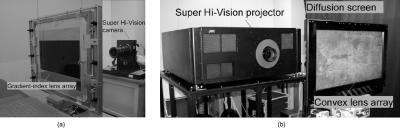
The experimental setup for (a) capturing video and (b) displaying video. Both steps involve a large array of convex lenses to generate a 3D effect. Image credit: Arai, et al. (c)2010 IEEE.
To record images, a large array of many convex lenses is placed in front of a Super Hi-Vision camera, which records the direction and intensity of light as viewed from slightly different directions. To display the images to a viewer, a Super Hi-Vision projector projects the images onto a diffusion screen, in front of which is an identical convex lens array. This set-up can recreate the direction and intensity of the light that was originally recorded. Since each lens looks slightly different at different viewing angles, the images look slightly different from different directions, giving a 3D impression.In terms of the image characteristics, there is a trade-off in the system in which an increase in the viewing angle results in a decrease in the image resolution. To maximize both characteristics, the researchers explain that it is necessary to shorten the distance between the lens array and the display device, and also narrow the pitch of the lenses, which requires a large number of pixels. Overall, the system uses a total of 7,680 pixels in the horizontal direction and 4,320 pixels in the vertical direction. With these adjustments, the researchers could ensure a viewing angle of 24 degrees and a spatial frequency that is 2.4 times higher than that of their previous system. Arai added that it should be possible to further improve both the viewing angle and image resolution with future research.
This video is not supported by your browser at this time.
A demonstration of an integral 3D TV video. Credit: Jun Arai.
“The greatest challenges in improving this system are capturing and displaying a huge amount of information,” Arai said. “To maximize both [viewing angle and image resolution], in principle, a large number of pixels is required. Today, the large number of pixels and lenses required make this system complex and expensive to manufacture. This is a problem for manufacturing a consumer product. In the future, I predict the progress in mass production technology will solve this problem.” More information: Jun Arai, et al. “Integral Three-Dimensional Television Using a 33-Megapixel Imaging System.” Journal of Display Technology. To be published. DOI:10.1109/JDT.2010.2050192
Copyright 2010 PhysOrg.com.
All rights reserved. This material may not be published, broadcast, rewritten or redistributed in whole or part without the express written permission of PhysOrg.com.
-
3D TV -- Without the Glasses (w/ Video)
Oct 29, 2009 |
not rated yet |
0
-
Latest 3D TV Technology Offers Interactive Control
Mar 19, 2009 |
not rated yet |
0
-
Japanese Researchers Develop Portable 3D Display System
Sep 29, 2006 |
not rated yet |
0
-
Microsoft working on glasses-free 3D display (w/ Video)
Jun 13, 2010 |
not rated yet |
0
-
World's Highest Resolution 3D Images
Aug 31, 2004 |
not rated yet |
0
-
Engineers build first sub-10-nm carbon nanotube transistor
Feb 01, 2012 |
4.9 / 5 (31) |
30
-
Something old, something new: Evolution and the structural divergence of duplicate genes
Jan 31, 2012 |
4.6 / 5 (7) |
1
-
The hidden nanoworld of ice crystals: Revealing the dynamic behavior of quasi-liquid layers
Jan 30, 2012 |
5 / 5 (3) |
1
-
Stock market network reveals investor clustering
Jan 27, 2012 |
3.9 / 5 (23) |
8
-
Of microchemistry and molecules: Electronic microfluidic device synthesizes biocompatible probes
Jan 26, 2012 |
5 / 5 (1) |
0
-
Help with thermal stress please
55 minutes ago
-
Calling function with no input argument
5 hours ago
-
Force free body diagram problem on gym equipment
6 hours ago
-
Empirical data regarding shower heads and water
14 hours ago
-
feed hold button on CNC lathe
Feb 09, 2012
-
RFAC in Fortran
Feb 09, 2012
- More from Physics Forums - General Engineering
More news stories
New error-correcting codes guarantee the fastest possible rate of data transmission
Error-correcting codes are one of the triumphs of the digital age. Theyre a way of encoding information so that it can be transmitted across a communication channel such as an optical fiber o ...
Technology / Computer Sciences
8 hours ago |
5 / 5 (3) |
4
|
Small modular reactor design could be a 'SUPERSTAR'
(PhysOrg.com) -- Though most of today's nuclear reactors are cooled by water, we've long known that there are alternatives; in fact, the world's first nuclear-powered electricity in 1951 came from a reactor ...
Technology / Energy & Green Tech
7 hours ago |
4.2 / 5 (10) |
17
|
Advanced power-grid model finds low-cost, low-carbon future in West
(PhysOrg.com) -- The least expensive way for the Western U.S. to reduce greenhouse gas emissions enough to help prevent the worst consequences of global warming is to replace coal with renewable and other ...
Technology / Energy & Green Tech
7 hours ago |
5 / 5 (2) |
7
|
New power source discovered
(PhysOrg.com) -- Researchers at the Massachusetts Institute of Technology (MIT) and RMIT University have made a breakthrough in energy storage and power generation.
Technology / Energy & Green Tech
7 hours ago |
5 / 5 (7) |
3
|
Netflix light on flicks as viewers soak up TV shows
Like most fresh faces that arrive in Hollywood, Netflix wanted to be a movie star. But now it's learning what many in Tinseltown have known for decades: Movies are sexy, but the real money is in television.
5 hours ago |
not rated yet |
1
Complex wiring of the nervous system may rely on a just a handful of genes and proteins
Researchers at the Salk Institute have discovered a startling feature of early brain development that helps to explain how complex neuron wiring patterns are programmed using just a handful of critical genes. ...
Human cognitive performance suffers following natural disasters, researchers find
Not surprisingly, victims of a natural disaster can experience stress and anxiety, but a new study indicates that it might also cause them to make more errors - some serious - in their daily lives. In their upcoming Human Fa ...
The power of estrogen -- male snakes attract other males
A new study has shown that boosting the estrogen levels of male garter snakes causes them to secrete the same pheromones that females use to attract suitors, and turned the males into just about the sexiest ...
Both maternal and paternal age linked to autism
Older maternal and paternal age are jointly associated with having a child with autism, according to a recently published study led by researchers at The University of Texas Health Science Center at Houston (UTHealth).
Putting the squeeze on planets outside our solar system
(PhysOrg.com) -- Using high-powered lasers, scientists at Lawrence Livermore National Laboratory and collaborators discovered that molten magnesium silicate undergoes a phase change in the liquid state, abruptly ...
Curry spice component may help slow prostate tumor growth
Curcumin, an active component of the Indian curry spice turmeric, may help slow down tumor growth in castration-resistant prostate cancer patients on androgen deprivation therapy (ADT), a study from researchers ...

Aug 27, 2010
Rank: 5 / 5 (4)
Aug 27, 2010
Rank: 4.3 / 5 (3)
Aug 27, 2010
Rank: 1 / 5 (2)
Aug 27, 2010
Rank: 2.8 / 5 (4)
Aug 27, 2010
Rank: 2.3 / 5 (3)
Aug 27, 2010
Rank: 5 / 5 (3)
I personally don't think we will have really achieved true 3D until we get pixel density to the point of hologram reproduction (in color) which requires 10K-50K pixels per inch, along with the appropriate camera's required (think multi gigapixel motion picture speeds).
Since I still remember the day when it took heroic efforts to save the 2 or 3 gigabytes per day incoming stream from the first Landsat satellites, I have no doubt that this capability will dawn sooner than anyone thinks.
We are still at the baby step stages.
Aug 27, 2010
Rank: not rated yet
Aug 28, 2010
Rank: 1 / 5 (1)
Although most 3D movies do just that, if done correctly it adds a sense of realism that 2D movies do not. Did you not see Avatar? Regardless what people think of the storyline, the 3D was tastefully done, and it showed what could be possible with the 3D if not just thrown in for the shock value.
All the others I have seen would have been just as good without the 3D.
Aug 28, 2010
Rank: 1 / 5 (1)
Of course it can be done badly as well.
Aug 28, 2010
Rank: not rated yet
Aug 28, 2010
Rank: not rated yet
Aug 29, 2010
Rank: 5 / 5 (1)
Aug 29, 2010
Rank: 1 / 5 (1)
Paranoid much?
It's not a scam, it is a choice, one that requires new hardware you are not being forced to buy. Even if you get a 3D ready television, you can just turn the feature off ( or on assuming on default settings ).
Only someone with no imagination/ a closed mind would be negative about such progress.
Aug 30, 2010
Rank: not rated yet
When did 3d come out anyway? 80s or something? I was too young to notice but why anyone calls this progression in 2010 I can't understand. I can only assume they are easily pleased by slight adaptions to products they already have and possibly enjoy resurrecting past fads.
When I buy 3d I expect to get off my sofa, walk to the side of my 3dtv and see sideboob!! That's what 3d is afterall, not just some 2d image with a couple millimetres of perceived depth.
Aug 31, 2010
Rank: 5 / 5 (1)
3D came out way before the 80's, it is progression in 2010 because the technology is becoming mainstream and much more advanced. Comparing old 3D techniques ( the blue and red glasses ) to current and developing ones is completely unfair.
lol @ sideboob though.