Going live to the beating heart
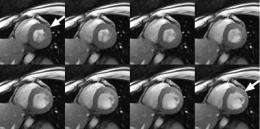
German scientists succeed in filming organs and joints in real time using magnetic resonance imaging.
"Please hold absolutely still": This instruction is crucial for patients being examined by magnetic resonance imaging (MRI). It is the only way to obtain clear images for diagnosis. Up to now, it was therefore almost impossible to image moving organs using MRI. Max Planck researchers from Göttingen have now succeeded in significantly reducing the time required for recording images - to just one fiftieth of a second. With this breakthrough, the dynamics of organs and joints can be filmed "live" for the first time: movements of the eye and jaw as well as the bending knee and the beating heart. The new MRI method promises to add important information about diseases of the joints and the heart. In many cases MRI examinations may become easier and more comfortable for patients. (NMR in Biomedicine 2010, Journal of Cardiovascular Magnetic Resonance 2010)
A process that required several minutes until well into the 1980s, now only takes a matter of seconds: the recording of cross-sectional images of our body by magnetic resonance imaging (MRI). This was enabled by the FLASH (fast low angle shot) method developed by Göttingen scientists Jens Frahm and Axel Haase at the Max Planck Institute for Biophysical Chemistry. FLASH revolutionised MRI and was largely responsible for its establishment as a most important modality in diagnostic imaging. MRI is completely painless and, moreover, extremely safe. Because the technique works with magnetic fields and radio waves, patients are not subjected to any radiation exposure as is the case with X-rays. At present, however, the procedure is still too slow for the examination of rapidly moving organs and joints. For example, to trace the movement of the heart, the measurements must be synchronised with the electrocardiogram (ECG) while the patient holds the breath. Afterwards, the data from different heart beats have to be combined into a film.
Future prospect: extended diagnostics for diseases
The researchers working with Jens Frahm, Head of the non-profit "Biomedizinische NMR Forschungs GmbH", now succeeded in further accelerating the image acquisition process. The new MRI method developed by Jens Frahm, Martin Uecker and Shuo Zhang reduces the image acquisition time to one fiftieth of a second (20 milliseconds), making it possible to obtain "live recordings" of moving joints and organs at so far inaccessible temporal resolution and without artefacts. Filming the dynamics of the jaw during opening and closing of the mouth is just as easy as filming the movements involved in speech production or the rapid beating of the heart. "A real-time film of the heart enables us to directly monitor the pumping of the heart muscle and the resulting blood flow - heartbeat by heartbeat and without the patient having to hold the breath," explains Frahm. The scientists believe that the new method could help to improve the diagnosis of conditions such as coronary heart disease and myocardial insufficiency. Another application involves minimally invasive interventions which, thanks to this discovery, could be carried out in future using MRI instead of X-rays. "However, as it was the case with FLASH, we must first learn how to use the real-time MRI possibilities for medical purposes," says Frahm. "New challenges therefore also arise for doctors. The technical progress will have to be 'translated' into clinical protocols that provide optimum responses to the relevant medical questions."
Less is more: acceleration through better image reconstruction
To achieve the breakthrough to MRI measurement times that only take very small fractions of a second, several developments had to be successfully combined with each other. Whilst still relying on the FLASH technique, the scientists used a radial encoding of the spatial information which renders the images insensitive to movements. Mathematics was then required to further reduce the acquisition times. "Considerably fewer data are recorded than are usually necessary for the calculation of an image. We developed a new mathematical reconstruction technique which enables us to calculate a meaningful image from data which are, in fact, incomplete," explains Frahm. In the most extreme case it is possible to calculate an image of comparative quality out of just five percent of the data required for a normal image - which corresponds to a reduction of the measurement time by a factor of 20. As a result, the Göttingen scientists have accelerated MRI from the mid 1980s by a factor of 10000.
Although these fast MRI measurements can be easily implemented on today's MRI devices, something of a bottleneck exists when it comes to the availability of sufficiently powerful computers for image reconstruction. Physicist Martin Uecker explains: "The computational effort required is gigantic. For example, if we examine the heart for only a minute in real time, between 2000 and 3000 images arise from a data volume of two gigabytes." Uecker consequently designed the mathematical process in such a way that it is divided into steps that can be calculated in parallel. These complex calculations are carried out using fast graphical processing units that were originally developed for computer games and three-dimensional visualization. "Our computer system requires about 30 minutes at present to process one minute's worth of film," says Uecker. Therefore, it will take a while until MRI systems are equipped with computers that will enable the immediate calculation and live presentation of the images during the scan. In order to minimise the time their innovation will take to reach practical application, the Göttingen researchers are working in close cooperation with the company Siemens Healthcare.
More information:
-- Martin Uecker, Shuo Zhang, Dirk Voit, Alexander Karaus, Klaus-Dietmar Merboldt, Jens Frahm: Real-time MRI at a resolution of 20 ms. NMR in Biomedicine 23, doi:10.1002/nbm.1585 (Online 27 August 2010)
-- Shuo Zhang, Martin Uecker, Dirk Voit, Klaus-Dietmar Merboldt, Jens Frahm: Real-time cardiovascular magnetic resonance at high temporal resolution: radial FLASH with nonlinear inverse reconstruction. Journal of Cardiovascular Magnetic Resonance 12, 39 (2010), doi:10.1186/1532-429X-12-39


