First clear evidence of feasting in early humans

August 30, 2010
First clear evidence of feasting in early humans

Enlarge

Two wild cattle lumbar vertebrae consumed as part of a feast are under excavation in Structure B at Hilazon Tachtit Cave, Israel. Credit: Natalie Munro

Community feasting is one of the most universal and important social behaviors found among humans. Now, scientists have found the earliest clear evidence of organized feasting, from a burial site dated about 12,000 years ago. These remains represent the first archaeological verification that human feasting began before the advent of agriculture.

"Scientists have speculated that feasting began before the , which starts about 11.5 thousand years ago," says Natalie Munro of the University of Connecticut, and author of a research article released yesterday in the . "This is the first solid evidence that supports the idea that communal feasts were already occurring - perhaps with some frequency - at the beginnings of the transition to agriculture."

At a burial cave in the Galilee region of northern Israel, Munro and her colleague Leore Grosman of Hebrew University in Jerusalem uncovered the remains of at least 71 tortoises and three wild cattle in two specifically crafted hollows, an unusually high density for the period. The tortoise shells and cattle bones exhibited evidence of being cooked and torn apart, indicating that the animals had been butchered for human consumption.

Each of the two hollows, says Munro, was manufactured for the purpose of a ritual human burial and related feasting activities. The tortoise shells were situated under, around and on top of the remains of a ritually-buried shaman, which suggests that the feast occurred concurrently with the ritual burial. On their own, the meat from the discarded tortoise shells could probably have fed about 35 people, says Munro, but it's possible that many more than that attended this feast.
First clear evidence of feasting in early humans
Enlarge

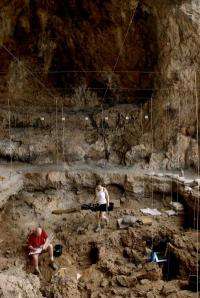
This is a view of excavation area at Hilazon Tachtit Cave, Israel. Credit: Naftali Hilger

"We don't know exactly how many people attended this particular feast, or what the average attendance was at similar events, since we don't know how much meat was actually available in the cave," says Munro. "The best we can do is give a minimum estimate based on the bones that are present."

A major reason why humans began feasting - and later began to cultivate their own foods - is because faster human population growth had begun to crowd their landscape. In earlier periods of the Stone Age, says Munro, small family groups were often on the move to find new sources of food. But around the time of this feast, she says, that lifestyle had become much more difficult.

"People were coming into contact with each other a lot, and that can create friction," she says. "Before, they could get up and leave when they had problems with the neighbors. Now, these public events served as community-building opportunities, which helped to relieve tensions and solidify social relationships."
First clear evidence of feasting in early humans
Enlarge

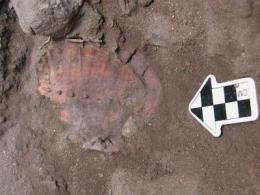
Articulated tortoise carapaces are under excavation in the grave of a unique woman in Structure A interpreted as a shaman at Hilazon Tachtit Cave, Israel at Hilazon Tachtit Cave. The grave contained the remains of at least 71 tortoises consumed by humans as part of a burial feast. Credit: Natalie Munro

But when a once-nomadic group of humans settles down, that can put tremendous pressure on the local resources. Munro notes that humans around the time of this feast were intensively using the plants and animals that their descendants later domesticated.

"The appearance of these feasts at the beginnings of agriculture is particularly interesting because people are starting to experiment with domestication and cultivation," she notes.

This combination of increased social interaction and changes in resources, says Munro, is what eventually led to the beginnings of agriculture.

"Taken together, this community integration and the changes in economics were happening at the very beginning when incipient cultivation was getting going," she says. "These kinds of social changes are the beginnings of significant changes in human social complexity that lead into the beginning of the agricultural transition."

Provided by University of Connecticut (news : web)

4.8 /5 (9 votes)  

Filter


Move the slider to adjust rank threshold, so that you can hide some of the comments.


Display comments: newest first

rgwalther
Aug 30, 2010

Rank: 1 / 5 (5)
People ate when they could? Absolutely amazing! Did research did ya????
Skultch
Aug 30, 2010

Rank: not rated yet
I'm surprised we haven't found evidence of this earlier in the fossil record. I wonder how long we had the cognitive capacity for this kind of thing before we actually got together and figured it out.
RobertKLR
Aug 30, 2010

Rank: 5 / 5 (2)
The evidence of the first communal feast. 12,000 years later nerdy researchers still don't get invited.
HealingMindN
Aug 31, 2010

Rank: 5 / 5 (1)
I remember that feast well. The meat was tough and the wine was awful. 6000 years later, the meat was still tough, but the wine was much better.
Rank 4.8 /5 (9 votes)
Related Stories
Relevant PhysicsForums posts
  • Protease cleavage
    created6 hours ago
  • Pertubance in a model
    created12 hours ago
  • Cancer drugs and Alzheimer's, Oh my!
    created20 hours ago
  • Squishing cells
    created21 hours ago
  • Any books/articles for evolutionary stable strategy models in humans?
    createdFeb 09, 2012
  • Science behind the bore feeling?
    createdFeb 09, 2012
  • More from Physics Forums - Biology

More news stories

Employers feel no love for unscrupulous practice of 'service sweethearting'

A new study led by two Florida State University marketing professors finds that some frontline service employees who are rewarded for hikes in customer loyalty and satisfaction also may engage in "service ...

Other Sciences / Economics & Business

created 6 hours ago | popularity 4 / 5 (1) | comments 4

A frank discussion of the power law and linking correlation to causation

(PhysOrg.com) -- Michael Stumpf a mathematics professor at Imperial College in London, and Mason Porter a lecturer at Oxford have teamed together to write and publish a perspective piece in Science regarding the in ...

Other Sciences / Mathematics

created 12 hours ago | popularity 5 / 5 (2) | comments 2 | with audio podcast report

The question of life in the ancient world

There’s a general feeling that we don’t get the Greeks – ancient or modern. Many, including heads of state like Angela Merkel, visibly shake their head in exasperation, rightly or wrongly, at ...

Other Sciences / Archaeology & Fossils

created 12 hours ago | popularity 1 / 5 (2) | comments 4

Sonic Cradle lands spot in TED exhibition

A Simon Fraser University graduate student project that melds music, meditation and modern technology has landed a rare spot as an exhibit at TEDActive 2012 in Palm Springs, California this month.

Other Sciences / Other

created 8 hours ago | popularity not rated yet | comments 0

Chilean miners' rescue capsule on show in London

The capsule used to rescue Chilean miners trapped underground for two months goes on display Saturday at the Science Museum in London -- the first time it has been seen in Europe.

Other Sciences / Other

created 11 hours ago | popularity not rated yet | comments 0


Google users warned of threat to smartphone wallets

Users of Google smartphone wallets were being warned on Friday that there is a way to crack pass codes intended to thwart thieves from going on illicit shopping sprees.

Anonymous knocks CIA website offline (Update)

The website of the Central Intelligence Agency was inaccessible on Friday after the hacker group Anonymous claimed to have knocked it offline.

Complex wiring of the nervous system may rely on a just a handful of genes and proteins

Researchers at the Salk Institute have discovered a startling feature of early brain development that helps to explain how complex neuron wiring patterns are programmed using just a handful of critical genes. ...

New error-correcting codes guarantee the fastest possible rate of data transmission

Error-correcting codes are one of the triumphs of the digital age. They’re a way of encoding information so that it can be transmitted across a communication channel — such as an optical fiber o ...

Putting the squeeze on planets outside our solar system

(PhysOrg.com) -- Using high-powered lasers, scientists at Lawrence Livermore National Laboratory and collaborators discovered that molten magnesium silicate undergoes a phase change in the liquid state, abruptly ...

The power of estrogen -- male snakes attract other males

A new study has shown that boosting the estrogen levels of male garter snakes causes them to secrete the same pheromones that females use to attract suitors, and turned the males into just about the sexiest ...